What You Learn First When You Start a Casting Job With No Experience
This article was automatically translated from the Japanese original. Read the original in Japanese

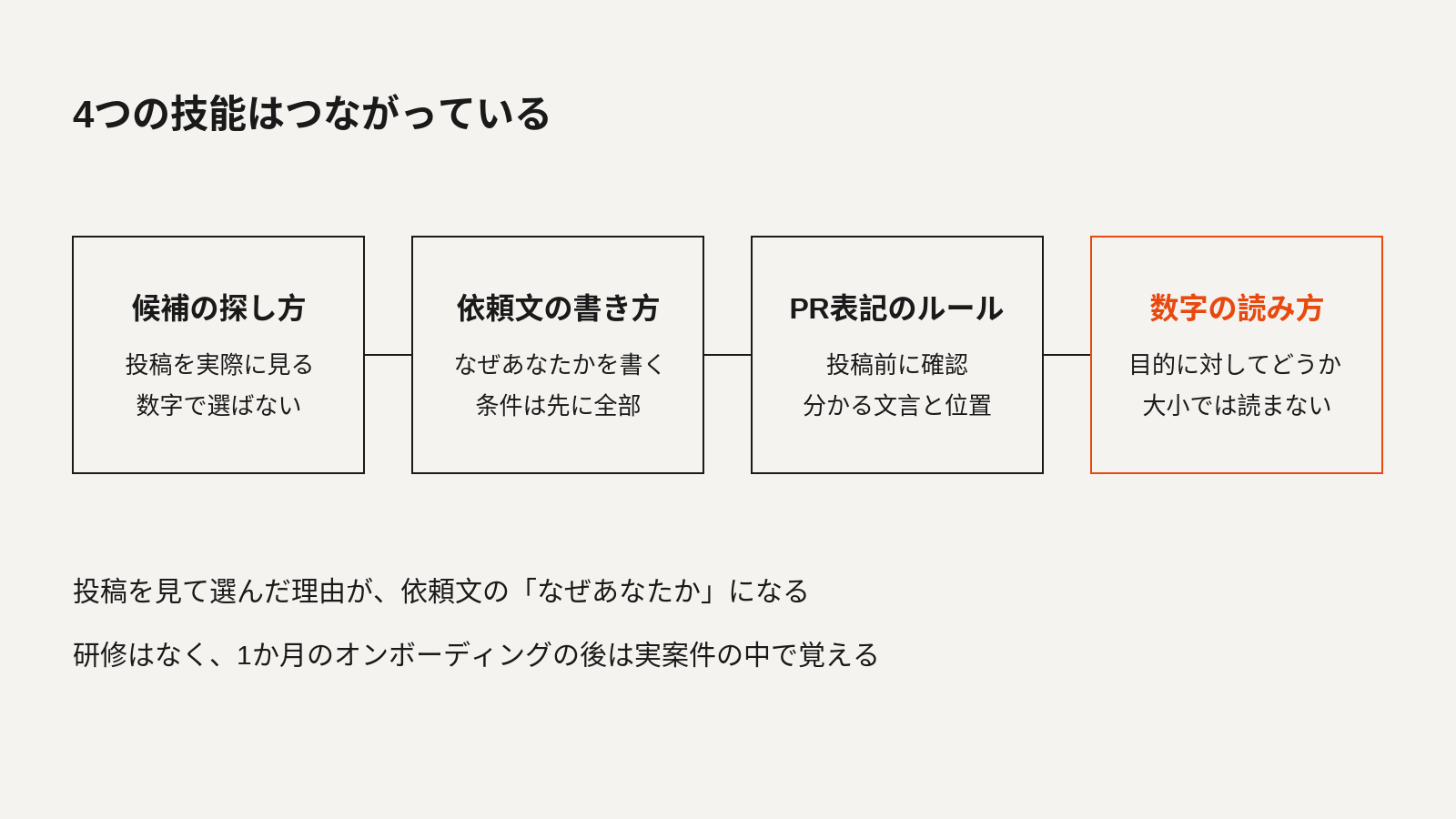
When you start a casting job with no experience, the first four things you learn are "how to find candidates," "how to write a request," "the rules for PR labeling," and "how to read the numbers." Our recruitment page says "no prior work experience required" and "we do not have a training program." In other words, you learn these four skills not in a classroom but on real projects after you join. This article explains where in the job each of the four is needed and where to start.
| What you learn first | Where you use it | Article to read beforehand |
|---|---|---|
| How to find candidates (reading a candidate list) | Lining up candidates that fit the brand, based on the project brief | Reviewing a Candidate List: What to Look at When Making Your Selection |
| How to write a request | Asking a candidate to take part and communicating the terms | What Do Projects That Tend to Get Declined Have in Common? |
| Rules for PR labeling | Reviewing the content of a post and checking whether the disclosure is sufficient | PR Labeling and the Stealth Marketing Regulation |
| How to read the numbers | Compiling results after posting and reporting to the brand | The Difference Between Reach and Impressions |
How Does Casting Work Progress Within a Single Project?
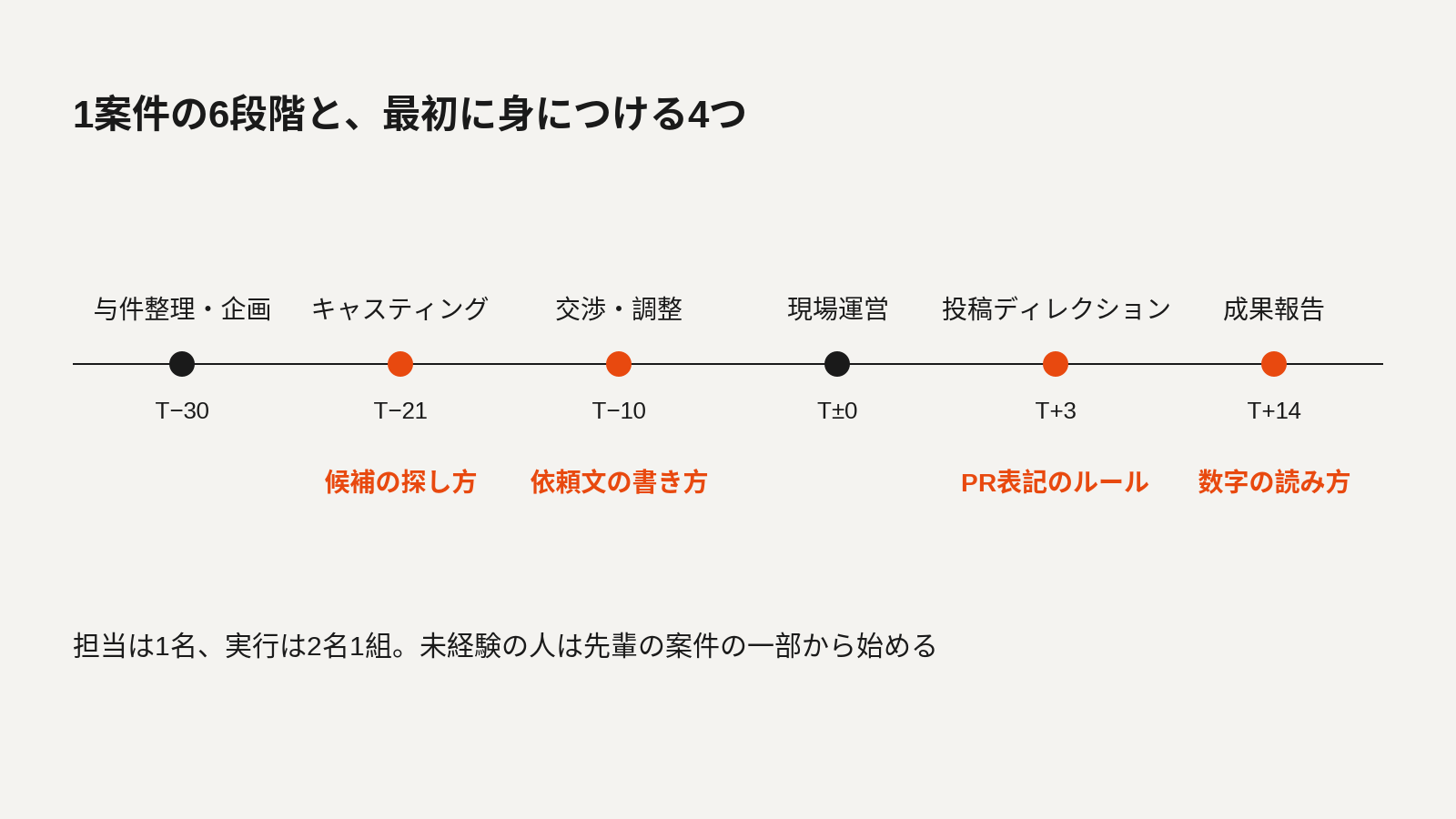
In our work, one person handles everything from planning, candidate selection and negotiation, on-site operations, and post direction through to results reporting, without dividing these tasks among specialists. Execution is carried out by a team of two, with one person in charge. Our recruitment page lays out the flow in six stages, based on the event day (T): requirements and planning (T−30), casting (T−21), negotiation and coordination (T−10), on-site operations (T±0), post direction (T+3), and results reporting (T+14). The four skills in the table above correspond to four of these six stages: casting, negotiation, post direction, and results reporting.
Newcomers also start with just a part of this flow. For example, on a project led by a senior colleague, you begin by researching the candidate list (looking at past posts to confirm whether they fit the brand's context), then expand your scope to drafting requests, checking labeling before posts go live, and tallying the figures for reports. We describe the full picture of the job, as six tasks and a typical day, in What Is an Influencer Casting Job?.
Where Do You Start When Learning How to Find Candidates?
The candidate list is generated by our internal system, but people make the selection. The first thing you learn is "don't choose by the numbers." Rather than sorting by follower count, you open past posts and see whether the look of the photos and the tone of the language fit the brand's world. For example, when searching for candidates for a gifting campaign for a new cosmetics release, you check whether they consistently post in the same category and how they handle products in their posts (flat-lay shots, or showing the product in use), and keep the people whose approach is closest to how the brand wants to be presented.
This work takes time, but the success of casting is largely decided at the list stage. We explain this way of thinking in The Success of Casting Is Largely Decided at the List Stage. Our code of conduct includes "always take the other person's perspective," and our recruitment page also states our policy of not changing how we treat people based on follower count, and of continuing relationships even when they don't lead to a booking this time. Looking at candidates with this attitude from the search stage onward is a given.
What Makes Writing a Request Difficult?
The hard part of a request is not stating the terms accurately but writing "why we want to ask you" grounded in the person's own posts. Sending a template message to everyone gets a weaker response. For example, when sending products to 20 people before a launch, you add one or two sentences to each of the 20 messages about which of that person's posts made you want to ask them. You can write this if you have actually looked at their posts while searching for candidates, which shows how the four skills connect.
As for terms, you state the number of posts, the number of revisions, and the usage period and scope of materials at the request stage. Adding terms later tends to damage the relationship. For a guide to how long it takes from request to the person's agreement, see How Much Lead Time Should You Allow From Request to Agreement?.
At Which Stage Are PR Labeling Rules and Reading the Numbers Needed?
PR labeling is needed at the stage of checking posts before publication. Since October 2023, posts that a business has asked a third party to make, and that do not make clear they are advertisements, have been subject to regulation under the Act against Unjustifiable Premiums and Misleading Representations. The regulation applies to the advertiser, but checking posts is our job, so we need to be able to judge which disclosures are sufficient and which are lacking. At first, you sit in on a senior colleague's review and look at real posts to see where the words "advertisement" or "PR" need to appear to be clear.
Reading the numbers is needed at the results reporting stage. You learn the difference between reach and impressions, what the number of saves indicates, and how to calculate the posting rate as you build reports. We summarize how to set KPIs in Designing KPIs for Influencer Campaigns. You read a number not as "big or small" but as "how it performed against the purpose of the campaign."
Who Is Well Suited to This Work, and Who Is Not?
Our recruitment page lists the people who thrive here as "people who research on their own and go ask questions," "people who find joy in making others happy," and "people who work backward from two to three years ahead to expand their scope of responsibility." With no training program, and with learning happening on real projects after a one-month onboarding, whether you can go and ask about things you don't understand will shape your first few months. About half a year after joining, you are expected to handle roughly 5 to 10 projects at once, and the workload fluctuates.
The people we list as not a good fit are "those motivated by being able to publicize the projects they handled," "those who want to handle a fixed set of tasks," "those who expect systematic training," and "those who seek only the glamorous side." Projects you handle cannot be disclosed outside the company because of confidentiality obligations. Everyone, including leaders, has a sales target. We write about fit in more detail in Who Is Suited to Casting Work, and Who Is Not.
What Should You Know Before You Join?
- There is no training program. After a one-month onboarding, you learn through on-the-job training on real projects.
- The workload fluctuates. It increases before deadlines, events, and right before posts go live, and how you allocate your time in quieter periods is left to each person.
- Projects you handled cannot be disclosed outside the company because of confidentiality obligations.
- Everyone, including leaders, has a sales target.
- As application requirements, we do not ask about work experience, educational background, or the industry of your previous job. In selection, experience, educational background, and the name recognition of your previous employer are not evaluation criteria.
The entry question is "Name three influencers you like and explain why," and there is no right answer. This question is itself the very first step in finding candidates: looking at someone's posts and putting into words why you think they are good. Job details such as working conditions, the selection process, and benefits are posted on our recruitment page.
Scope of This Article
This article is written solely from facts published on our recruitment page and in our previously published articles. It does not cover salary or benefit amounts, or the backgrounds or projects of individual employees. The "four things you learn first" reflect the order in our own workplace and do not necessarily apply to casting roles at other companies. The length of the development period and benchmarks for reaching proficiency vary by person, so we do not state them here.
Conclusion
When you start with no experience, the first four things you learn are how to find candidates, how to write a request, the rules for PR labeling, and how to read the numbers. You learn all of them within projects, and if you read the articles in the table above beforehand, you will know what to look at in your first project. If you are considering applying, please also read "What we tell you in advance" on our recruitment page.