How Japan's Stealth Marketing Rules Differ from Korea's Disclosure Rules
This article was automatically translated from the Japanese original. Read the original in Japanese
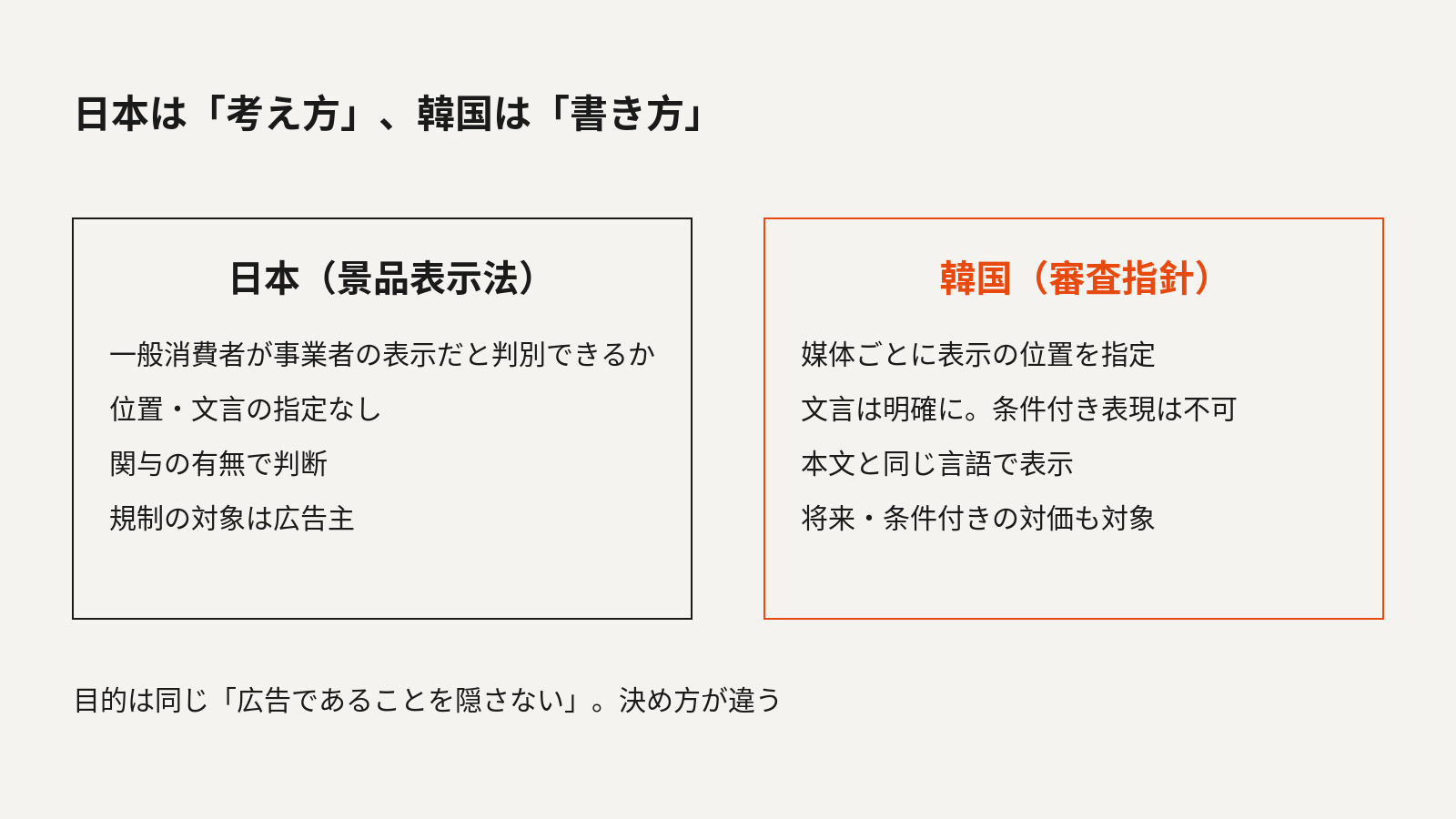
The goal is the same in both countries: do not hide the fact that something is advertising. The way each country sets its rules is different. Japan's stealth marketing regulation presents a principle: "Can ordinary consumers tell that this is the advertiser's own advertisement?" It does not specify where the disclosure goes or what it says. In Korea, the Fair Trade Commission's review guidelines specify the placement, wording, and even language of the disclosure for each medium. When explaining this to your head office, the quickest way to frame it is: "Japan sets a principle; Korea sets a format."
| Case | Japan (Act against Unjustifiable Premiums and Misleading Representations) | Korea (review guidelines) | Reason |
|---|---|---|---|
| Paying compensation and requesting a post | Counts as the advertiser's own advertisement; a disclosure that makes clear it is an ad is required | Disclosure of the economic interest is required | In both countries, a post made on request and for compensation is treated as advertising |
| Sending products free of charge, with the post left to the individual's discretion | Not covered if the advertiser has no involvement in deciding the content. Covered if the advertiser asks for posts that follow its policy | Free provision also counts as an economic interest; disclosure is required if the person recommends or endorses the product | Japan judges by whether the advertiser was involved; Korea judges by whether there is an interest |
| Paying a reward later based on results from a purchase link | Covered if the advertiser is involved (affiliate programs are treated the same way) | Future or conditional compensation is expressly covered by the disclosure requirement (December 2024 amendment) | Korea has put "compensation not yet received" into explicit text |
| Employees or family members posting about the company's own products | Posts by employees in a position to promote sales are treated as the advertiser's own advertisement | Employment, kinship, and similar relationships are also included in economic interests | In both countries, a post by a related person is not treated as a third-party post |
How Do the Japanese and Korean Rules Differ, Item by Item?
The legal basis in Japan is the designated notice under the Act against Unjustifiable Premiums and Misleading Representations (in effect since October 1, 2023). In Korea it is the Act on Fair Labeling and Advertising and the "Review Guidelines on Labeling and Advertising Concerning Recommendations and Endorsements." Lined up item by item, the differences center on two points: whether placement, wording, and language are specified, and how compensation is understood. As described in the Consumer Affairs Agency's guidance (checked October 2026), the regulation in Japan covers only the business operator that supplies the product or service (the advertiser); third parties who accept a request are not covered. The operating standards give wording such as "advertisement," "promotion," "PR," and similar as examples that show the content is the advertiser's own, but they do not mandate specific wording. As examples of unclear disclosure, they cite burying the disclosure among a large number of hashtags, displaying it in text smaller or paler than the surrounding text, and showing it only in the middle of a long video.
In Korea, the review guidelines of the Korea Fair Trade Commission require the disclosure to appear in the title or at the beginning for text-centered media; inside the image, or at the beginning of the body text or in the first hashtag, for photos; and repeatedly in the title, at the beginning, and at the end for video. The wording must be clear, and conditional phrasing such as "may receive a certain commission" is treated as an example of unclear disclosure. In December 2025, the guidelines' explanatory handbook was revised, and it has been reported that it sets out four principles (accessibility, recognizability, clarity, and language consistency) along with disclosure examples for the main media. Language consistency means the disclosure should be in the same language as the body text.
| Item | Japan | Korea |
|---|---|---|
| Legal basis | Designated notice under Article 5, item 3 of the Act against Unjustifiable Premiums and Misleading Representations, and operating standards | Act on Fair Labeling and Advertising, and the Fair Trade Commission's review guidelines |
| Who is regulated | Advertisers (business operators) only | Mainly advertisers. Commentary indicates that those who make recommendations or endorsements are also treated as subject to the guidelines |
| Placement of disclosure | Not specified. Judged by whether it can be recognized | Specified by medium (title, beginning, inside the image, repetition) |
| Wording | Not specified. Examples include "advertisement" and "PR" | Must be clear. Conditional phrasing is not acceptable |
| Language | Not specified (it is assumed to be understandable in Japanese) | Same language as the body text |
| Future or conditional compensation | Judged by whether the advertiser is involved | Expressly covered by the disclosure requirement |
| Penalties for violations | Cease-and-desist order against the advertiser | Provisions for corrective measures, administrative fines, and criminal penalties |
What Should You Explain First When Describing Japan's Rules to a Korean Head Office?
There are three points, in this order. First, "the regulated party is the advertiser." From a Korean perspective, it is easy to assume that an influencer who fails to disclose is also held responsible, so start by explaining that in Japan the party subject to a cease-and-desist order is the advertiser. Second, "neither placement nor wording is specified." If the head office instructs, "put 'advertisement' at the beginning," that is not a problem in itself in Japan, but because the requirement is that the disclosure be understandable, the wording must make sense in Japanese. Third, "judgment depends on involvement." Even if the setup is free provision with the post left to the individual, if the advertiser requests a posting policy or specific content, the post becomes the advertiser's own advertisement in Japan. The result is close to the Korean approach of "free provision means disclosure," so this is an area that is easy to align.
For example, suppose a Korean cosmetics brand sends pre-launch gifting to 20 people in Japan, and the head office assumes, "Just as in Korea, disclose at the beginning." In Japan, as long as you confirm that the disclosure is worded so it is understandable in Japanese and that it is not buried within the post, the head office's policy can be adopted as it is. The differences in how requests are handled in Korea and Japan are covered in How Does the Process of Requesting Influencers Differ Between Korea and Japan?.
Where Do Problems Arise When Korean-Style Disclosure Is Brought to Japan?
Problems arise in two directions. When bringing the Korean approach to Japan, putting a Hangul disclosure or an abbreviation used in Korea straight into a Japanese post means Japanese consumers will not recognize it as an ad. Replace it with meaningful Japanese wording such as "広告" or "PR." In the other direction, when bringing the Japanese approach to Korea, the common Japanese practice of putting "PR" at the end of the body text does not fit Korea's placement requirements. A disclosure consisting only of the English "AD" should also be avoided in light of the language consistency principle.
Another difference arises in campaigns that run in several countries at once. For example, in a simultaneous Japan–Korea launch, if an influencer living in Korea posts in Korean and the post is then reposted on a Japanese account, the repost becomes a disclosure aimed at Japanese consumers at that point, so a disclosure understandable in Japanese must be added. The basics of disclosure are summarized in our pillar article, PR Labeling and Stealth Marketing Regulation.
Who Checks What?
The brand (advertiser) should proceed on the premise that it is the party regulated under Japanese rules, and is responsible for the final check of the post's disclosure. The agency writes a disclosure format that meets both countries' requirements into the request brief, and in its pre-posting check looks at whether the disclosure is buried and whether it is understandable in Japanese. For the influencer, tell them at the request stage "where and in what wording" the disclosure goes, and share the flow of checking before the post goes live. Leaving the method of disclosure to the individual and asking for corrections afterward tends to damage the relationship, so avoid it. What happens in case of a violation is covered in What Happens If You Violate the Stealth Marketing Regulation?.
What Should Be Decided at the Request Stage?
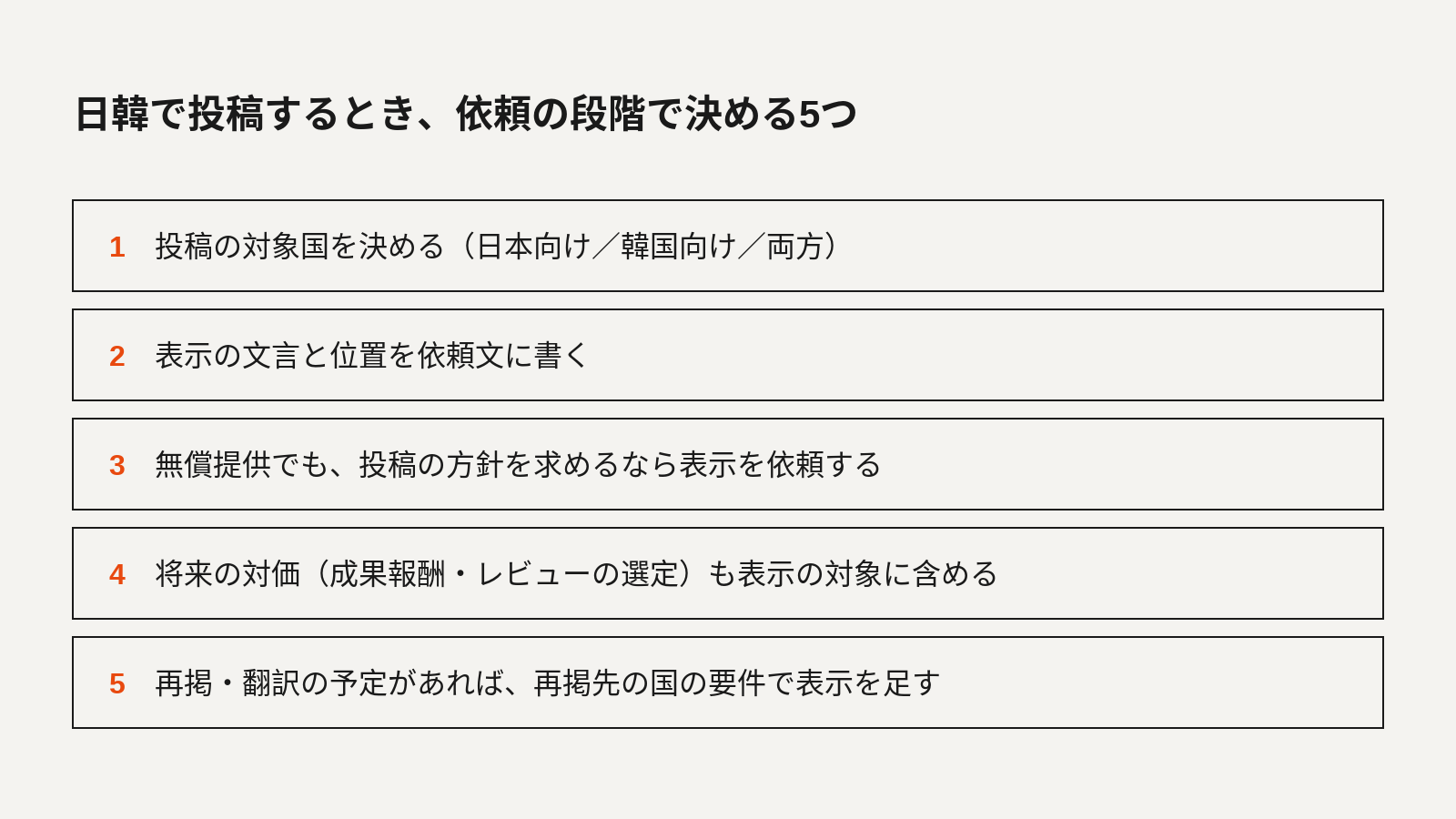
- Decide the target country for the post. The disclosure requirements change depending on whether it is aimed at Japan, Korea, or both.
- Write the disclosure wording and placement into the request brief. For Japan, wording understandable in Japanese; for Korea, placement and language in line with the guidelines.
- Even for free provision, request a disclosure if you are asking for a posting policy. Because Japan judges by involvement and Korea by interest, it is safer to assume a disclosure in either case.
- If there is future compensation (performance-based rewards for purchase links, selection of outstanding reviews, and so on), include it in the scope of disclosure at the time of the request.
- If a repost or translation is planned, add a disclosure that meets the requirements of the country where it will be reposted.
Where Do Common Misunderstandings Arise?
"Adding #PR at the end will pass in both countries" is a misunderstanding. In Korea the placement is specified, and in Japan too, a disclosure buried in a large number of hashtags is considered unclear. "The English 'AD' is universal" is also a misunderstanding. In Korea the principle is the same language as the body text, and in Japan the premise is that it be understandable in Japanese. "In Japan, influencers are punished too" is also a misunderstanding; the regulated party in Japan is the advertiser. Precisely because the advertiser is the regulated party, however, the advertiser and the agency bear the responsibility to check before posting. Our approach to casting for the Japan rollout of Korean cosmetics is summarized on this page.
Scope of This Article
This article summarizes the differences as of October 2026, based on public information about the Japanese Consumer Affairs Agency's guidance and operating standards and the Korea Fair Trade Commission's review guidelines. The Korean content is written within the scope of what we could confirm through reports on the guideline amendments and published commentary; please check the original provisions yourself on the Korea Fair Trade Commission's website. This article does not judge whether an individual post falls under the regulations, nor does it provide legal advice. Because both countries continue to revise their rules, you need to check the latest information for each project.
Conclusion
Japan sets its rule as a principle of "can people tell?", while Korea sets it as a format covering "where, what, and in which language." Starting your explanation to the head office with this single line makes it easier to get across. If you decide the target country and the form of the disclosure at the request stage, creating posts that satisfy both countries' requirements at once is not difficult.