How to Keep Your Invitation List Consistent Across Luxury Launch Events
This article was automatically translated from the Japanese original. Read the original in Japanese
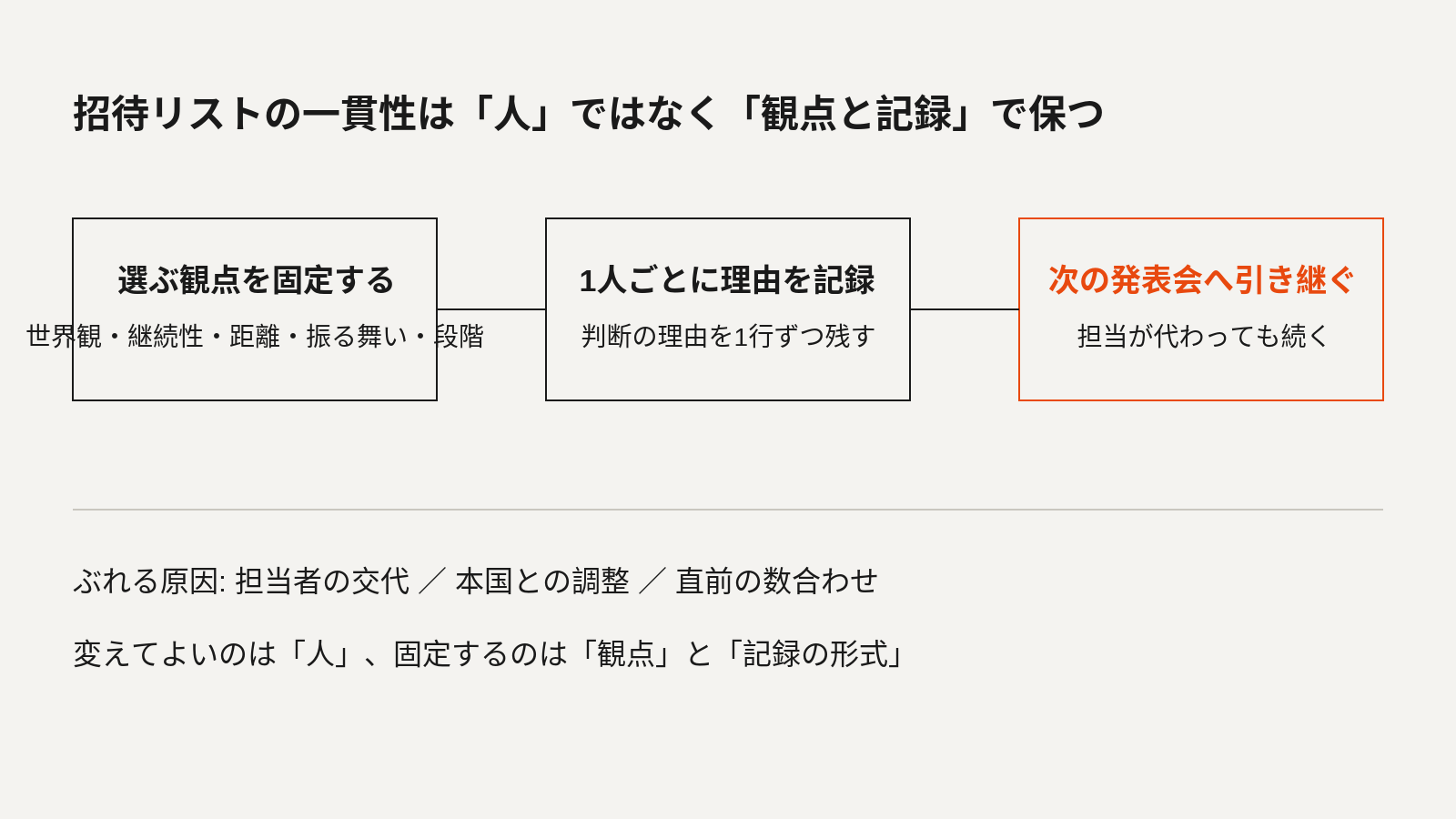
Consistency in an invitation list does not mean "inviting the same people every time." It means fixing the criteria you select on, recording the reasons behind each decision, and handing those records on to the next event. At luxury launch events, criteria tend to drift when the person in charge changes or when you coordinate with headquarters, and the brand's world view falls apart the moment the list becomes a matter of filling seats. The basic approach is to set the criteria first and keep a reason for each person.
| Criterion | What to look at | How to record it |
|---|---|---|
| Fit with the brand's world view | Whether the tone of past posts (photo texture, wording, the kinds of items featured) sits naturally within the brand's context | "Fit / On hold," plus one example of a post you based the decision on |
| Consistency of posting | Whether the person posts continuously in the same area (jewelry, watches, fashion, etc.) | One line on the area and frequency of recent posts |
| Distance from other brands | Whether other brands in the same area are concentrated in their recent posts during the same period | One line on the other brands' areas seen in recent posts (no evaluation) |
| Conduct at the event | If previously invited, whether their posts and presence suited the atmosphere of the event | Number of attendances, and whether they posted and what, as facts |
| Stage of relationship | Whether this is a first-time guest, a returning guest, or someone with whom you are discussing a long-term partnership | The stage in one word (First-time / Returning / In discussion) |
Why does the invitation list drift from event to event?
The causes come down to three. The first is a change of person in charge. If the predecessor's knowledge of "why this person was invited" is not handed over, the successor has no choice but to reselect by numbers (follower counts). The second is coordination between headquarters and Japan. When headquarters sends a direction such as "strengthen this segment," and the criteria are not shared, the list gets rebuilt to fit the direction and continuity with the previous event is lost. The third is filling seats. When you add people at the last minute to account for venue capacity or expected no-shows, those added without going through the criteria end up falling outside the brand's world view.
For example, suppose you invite 30 people to a jewelry collection launch: 20 returning from the previous event and 10 newly invited. If there are no criteria for choosing those 10, you end up with 10 people whose context differs from the previous 20, and the tone of the photos taken at the venue splits in two. Consistency breaks down in exactly this newly added portion.
What should the selection criteria fix, and what can change?
What you fix is "the criteria themselves" and "the format of the records"; what can change is "the people." The five criteria in the table above are not for ranking people, but for checking whether a person fits the occasion. That is why someone put "on hold" at one event may become a "fit" for a different collection. If the criteria are fixed, even that change can be explained with reasons.
There is one thing to decide when fixing the criteria: do not include follower count. The purpose of a luxury launch event is not to reach as many people as possible, but to be talked about within the brand's context. Numbers follow as a result, and if you make them a reason for selection, people who were prioritized for numbers over fit with the world view will slip in. For occasions where numbers matter (such as a new store opening), it is practical to design a separate initiative from the launch event. The challenges of communicating in the luxury space are covered in Why Is SNS PR for Luxury Brands So Difficult?.
How should invitation stages be divided?
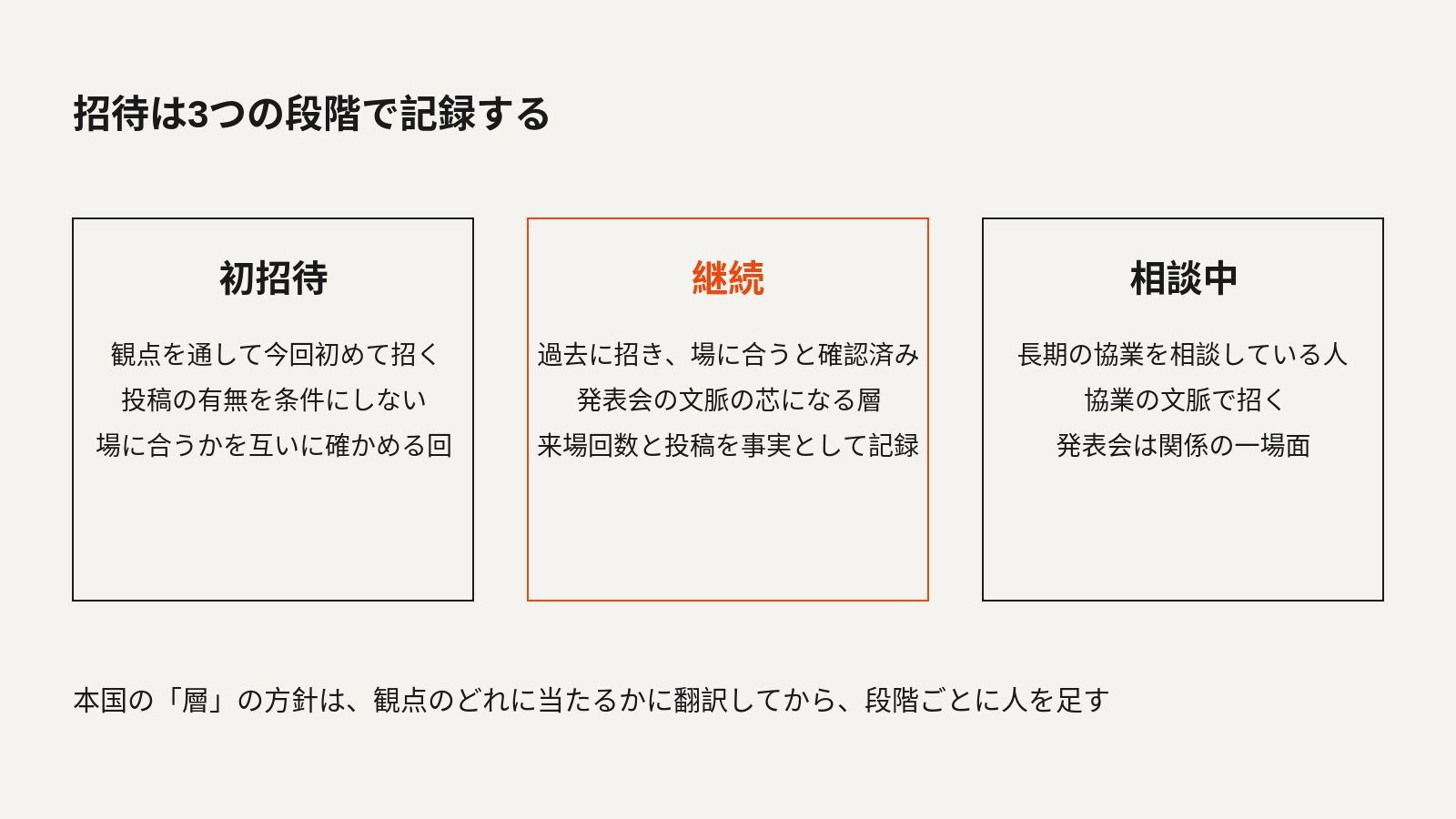
To make consistency easier to maintain, record each invitee in one of three stages: "First-time," "Returning," and "In discussion." A first-time guest is someone you are inviting for the first time after running them through the criteria. For a first visit, do not make posting a condition; treat it as an occasion for both sides to see whether they fit. A returning guest is someone you have invited before and who has been confirmed to fit the occasion. This group forms the core of the event's context. A guest in discussion is someone with whom you are discussing a long-term partnership (such as an ambassador role), and the event invitation is extended within that partnership context.
Dividing by stage also makes coordination with headquarters easier. If you can explain the list by stage, as in "these 30 are 20 returning, 8 first-time, and 2 in discussion," you can respond to headquarters' direction to "strengthen this segment" by saying which stage you will increase. When criteria and stages are aligned, consistency is maintained even when people are swapped in and out.
How do you align headquarters' direction with the Japan team on the ground?
Direction from headquarters is often phrased in terms of "segments" (a younger segment, a segment strong in fashion contexts, and so on). What the Japan team holds on the ground is "people." The criteria table is what connects the two. If you translate headquarters' direction into which criterion it corresponds to, and then review the Japanese candidates through that criterion, you can respond to the direction without breaking continuity. For example, for a direction like "strengthen the segment strong in fashion contexts," you would use the "consistency of posting" criterion to add, as first-time guests, people who continuously post in the fashion area.
Conversely, if you tie headquarters' direction directly to swapping people, the returning guests from last time drop off without a reason. Even when you do remove someone, record which criterion you judged by, and leave room to bring them back next time. For how to read a candidate list once you receive it, see What Should You Look at When You Receive a List of Influencer Candidates?.
How should you schedule the timing of events and list updates?
A luxury launch event sits within a sequence: the collection announcement, arrival in stores, and the start of the season. The basic approach is to update the list not right before the event, but at the time of the review of the previous event. If you record, as facts, whether guests posted after attending and what they posted, and decide who stays in "Returning" and who goes "On hold," preparing for the next event comes down to "how many first-time guests to add."
How to send invitations and collect RSVPs is covered in Invitation Design That Raises Your RSVP Rate, and the process from inviting guests to confirming posts is covered in Inviting Influencers to Brand Events. Our approach to casting in the luxury space is summarized on this page. For sample invitation emails for launch events, see S/PASS GUIDE's invitation email templates.
Scope of this article
This article focuses on the "selection criteria" for the invitation list and the "handover of records." It does not cover venue design, on-the-day reception, or the process of confirming posts. The criteria table is not meant to evaluate or rank people, but to check whether they fit the occasion, and it assumes that records are kept to facts that could be disclosed to the individual. Judgments about specific brands or individuals are outside the scope of this article. For a comparison of how to keep a record of attendance at the on-the-day reception, see S/PASS GUIDE's Paper Guest List Check-In vs. QR Check-In.
Conclusion
Invitation list consistency is maintained not by fixing the people, but by fixing the criteria and the records. Settle on five criteria and leave one line of reasoning for each person. That alone keeps the event's context going, even when the person in charge changes or headquarters' direction shifts. Start preparing for your next event with a review of the last one.