How to Work Backward from the Venue to Decide How Many Guests to Invite to an SNS Activation
This article was automatically translated from the Japanese original. Read the original in Japanese
The number of guests to invite to an SNS activation should be worked out not from venue capacity, but from "how many people can experience the event one by one and take photos at the same time." As a rule of thumb, the smallest of three figures sets the cap for a single time slot: the number of places where guests can take photos, the time the experience takes, and the number of staff available to accompany guests. Multiply that cap by the number of time slots, and you get the daily cap.
| Step | What to decide | Who is involved |
|---|---|---|
| 1. Set the objective | What you want guests to talk about after the visit, and how much each guest needs to experience to get there | Brand / agency |
| 2. Count the venue | The number of photo spots and experience stations | Agency / venue staff |
| 3. Estimate the time | The time each guest needs from check-in through the experience and photo-taking | Agency / production |
| 4. Decide on accompaniment | The number of staff who can guide guests in the same time slot | Casting lead |
| 5. Divide into time slots | The number of time slots per day and how many guests to invite to each | Brand / casting lead |
Here, SNS activation means an activation designed to include the stage where the experience gets talked about on social media. For the definition of the term and the overall process, see What Is SNS Activation?.
Why shouldn't you decide guest numbers based on venue capacity?
Because venue capacity is the number of people who can safely be inside at once, not the number who can each go through the experience and take photos. Invited guests post when they can describe the experience in their own words and when they have captured photos or videos they are happy with. If you invite guests right up to capacity, queues form at the photo spots, and explanations of the experience can only be given to everyone at once.
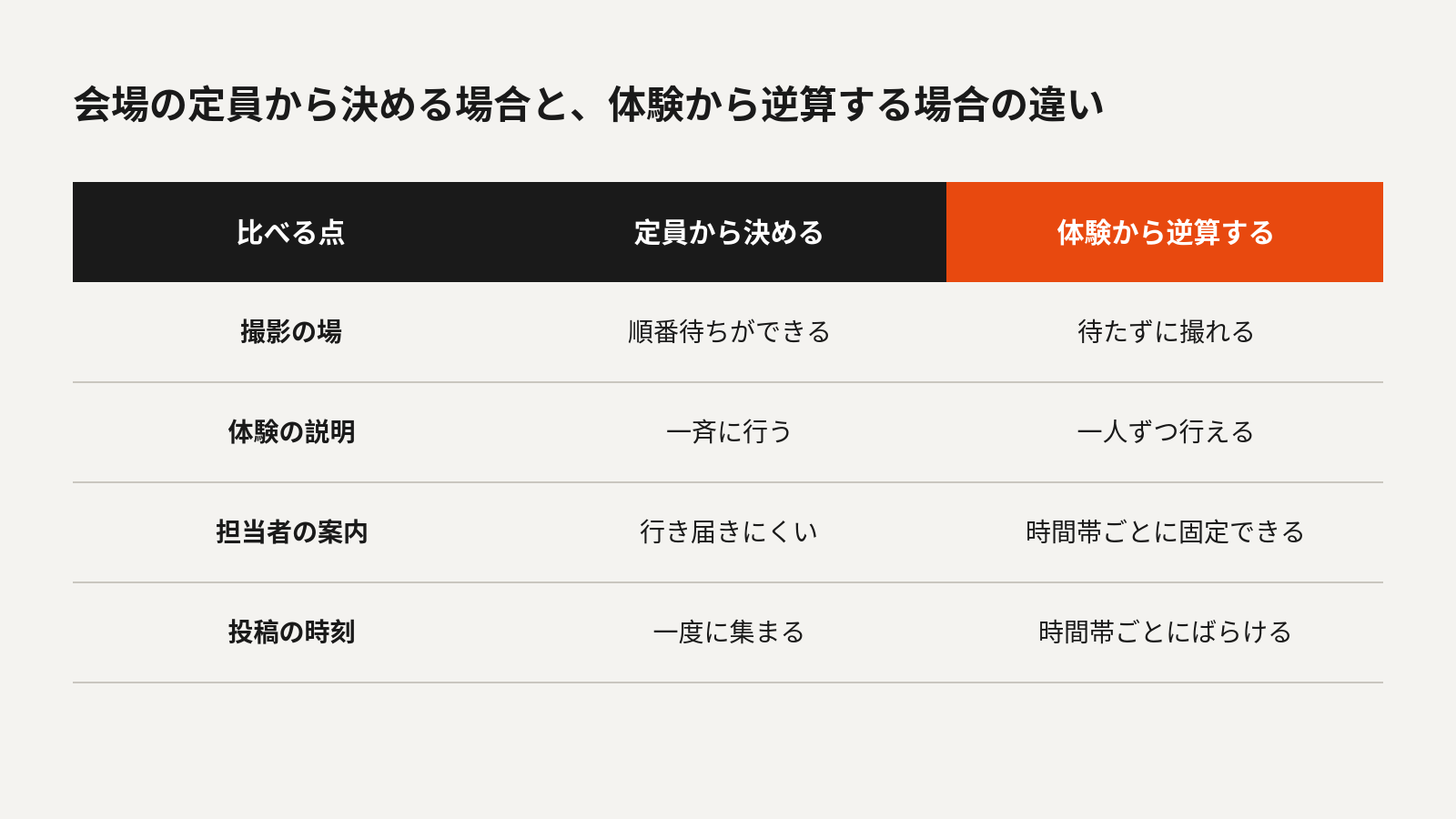
For example, consider a launch event for a new fragrance where the venue has only one place to try the scent, and guests are invited close to capacity. Guests wait to try the fragrance, and after trying it they have to give up the spot to the next person right away. The venue may look busy, but the amount of experience each guest has to talk about is thin. The first turning point is shifting the starting point for deciding headcount from "how many people fit in the venue" to "what do we want each guest to experience."
How many guests can you invite in the same time slot?
The cap is set by the smallest of three figures: the number of places to take photos, the time each guest spends at the experience station, and the number of staff accompanying guests. Even if one of them is large, if the others fall short, waiting time piles up at the bottleneck.
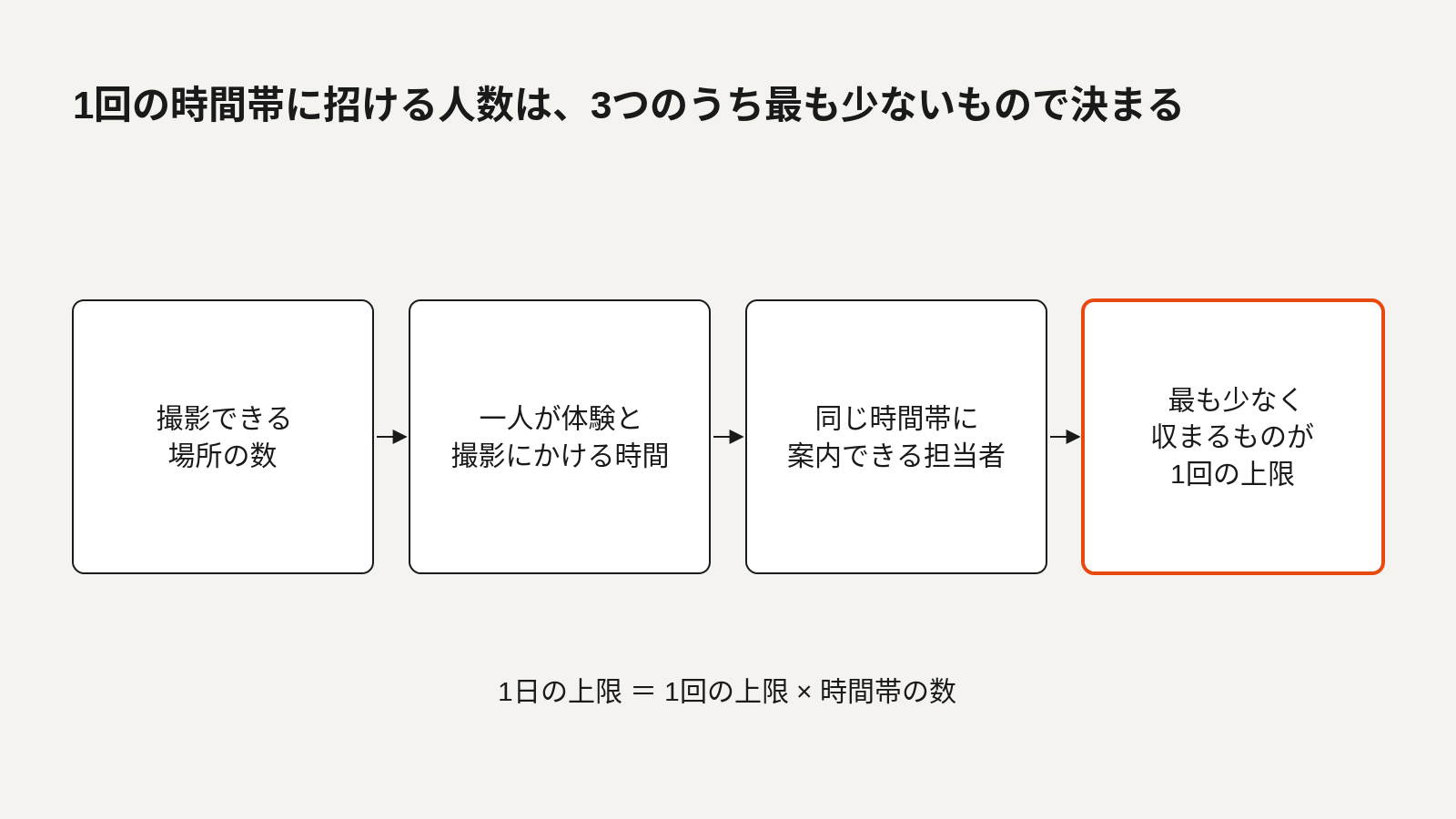
Even with plenty of photo spots, if there are few staff members accompanying guests, product explanations and help with photography will fall short. Conversely, even with many staff, if there is only one photo spot, a line will form there. When scouting a venue, actually count the places where photos can be taken and walk through the process from check-in to photo-taking as a single guest would to estimate the time. This reduces the gap from desk calculations. The design of photo spots themselves is covered in What Is a Photo Spot, and Why Does It Matter for Event Design?. For how the verification method affects check-in time, see the comparison in S/PASS GUIDE's Paper Guest List Check-In vs. QR Check-In.
How should you divide time slots?
If the number of guests you want to invite in a day exceeds the cap for a single time slot, don't cut the headcount; divide the day into time slots. Specify an arrival time slot in the invitation and keep the number of guests per slot within the cap.
For example, if you set an invitation day on the first day of a two-week pop-up, dividing it into three slots (morning, afternoon, and evening) lets you increase the number of guests per day at the same venue while keeping each guest's experience time intact. For when to place the invitation day within the pop-up period, see When Inviting Influencers to a Pop-Up Store, How Should You Allocate Visit Days?. Dividing into time slots also staggers the times at which posts appear, which has the added benefit of extending how long the buzz reaches beyond the venue.
What should you strengthen as headcount grows?
As headcount grows, strengthen individual communication with each guest and on-site accompaniment. In our records, among 37 projects and 390 people for whom we could track whether every attendee posted, all 109 people in projects with fewer than 10 influencers posted. In projects with 10 or more, 260 of 281 people (92.5%) posted (Event Attendee Post Rate of 94.6%). We cannot say that headcount itself is the cause, but we believe that the larger the project, the more likely it is that people with weaker relationships are included and that communication tends to become one-size-fits-all.
For this reason, when the scale exceeds 10 people, assign in advance who guides whom, and fix the staff member for each time slot. Also decide that you will make individual contact at least once between the on-site guidance and the posting.
What should you decide first?
- What you want guests to talk about after the visit, and what each guest needs to experience to get there
- The number of places to take photos, and the time each guest needs from check-in to photo-taking
- The number of staff who can guide guests in the same time slot, and how they are assigned
- The number of time slots per day and the cap on guests per slot
- Backup candidates to contact when someone declines, and the deadline for contacting them
Scope of This Article
This article covers how to decide how many influencers to invite to invitation-only events and pop-ups. It does not cover headcount management for admission that includes general visitors, safety standards, or venue contract terms. For the venue's safe capacity, follow the standards set by the venue's administrator. If you would like to consult on everything from experience design to on-site operations, our contact point is summarized on the SNS activation service page.
Conclusion
The number of guests to invite is determined not by the size of the venue, but by the amount of experience you want to give each guest. If you avoid fixing the headcount first and instead keep to the order of working backward from the experience and the photo spots, the content of posts becomes richer and the buzz is more likely to reach beyond the venue.