How Does the New Freelance Act Apply to Influencer Requests?
This article was automatically translated from the Japanese original. Read the original in Japanese

When you ask an individual influencer to post content or make an appearance, the new Freelance Act applies if the counterpart is an individual with no employees (or a corporation run by a single director). Its official name is the "Act on Ensuring Proper Transactions Involving Specified Entrusted Businesses," and it took effect on November 1, 2024. The ordering party must state the transaction terms immediately after making the request, in writing or by email, social media message, or similar means. If the ordering party is a company with employees, it must also pay the fee by the payment due date. For requests made through a talent agency, the treatment depends on the agency's structure.
| Case | Covered by the Act? | Reason |
|---|---|---|
| Asking an individual influencer with no employees directly | Covered | The counterpart is a "specified entrusted business operator" (an individual who uses no employees) |
| Asking a corporation whose only member is its representative, with no employees | Covered | Corporations with no officers other than one representative and no employees are included |
| Contracting with a talent agency that has employees, which then passes the request to the influencer | Transaction with the agency is unlikely to be covered | The contracting counterpart is not a specified entrusted business operator |
| An agency subcontracts work it received from a brand to an individual influencer | Covered (the agency is the ordering party) | When work is subcontracted or effectively entrusted, the agency is more than an intermediary |
| Only selling products, without asking for posts or appearances | Not covered | This is a sale and purchase, not an entrustment of work |
Which influencers are covered by the new Freelance Act?
The Act covers individuals who use no employees, and corporations with a single representative and no other officers or employees. Here, "using employees" means employing someone expected to work 20 hours or more per week for 31 days or more. Requests accepted by company employees as a side job are also included.
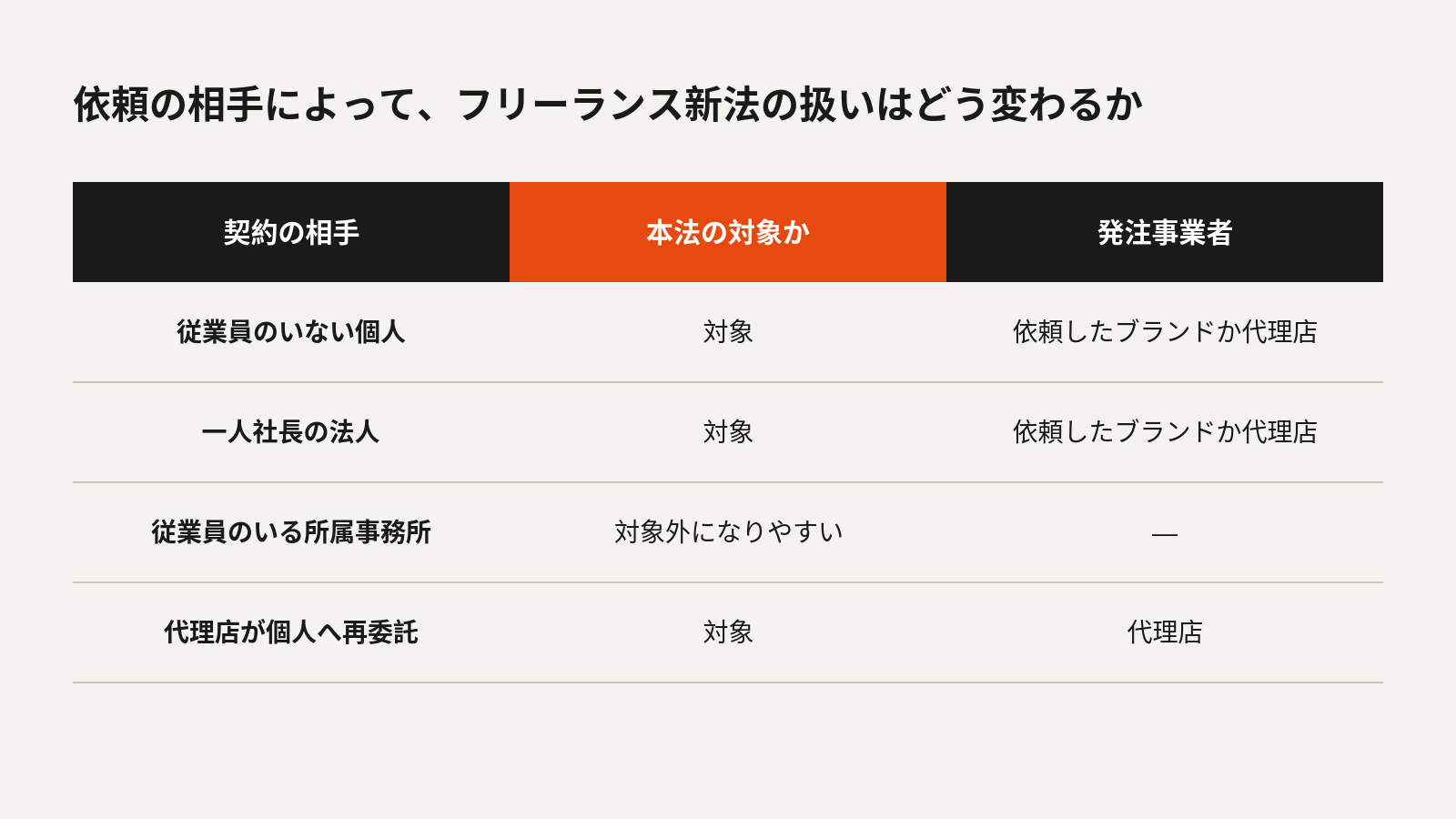
Influencers include a mix of people who work as individuals, people who have set up a one-person corporation, and people who belong to a management company. Follower counts and name recognition reveal nothing about which category someone falls into, so the starting point is to confirm, before making a request, who the contracting counterpart is and whether that counterpart has employees.
For example, suppose you ask 10 individual influencers to post about a new product before its release. If several belong to management companies and the rest handle their own contact, a single campaign will include both transactions covered by the Act and transactions that are not. Presenting your terms in a uniform way makes it less likely that anything slips through.
What must the ordering party comply with when making a request?
The first obligation is to state the transaction terms. Once the counterpart agrees to the request, you must immediately state the names of the ordering party and the contractor, the date of the entrustment, the content of the work requested, the delivery or work deadline and location, and the fee amount and payment due date. The ordering party may choose the method: in writing, or by electronic means such as email, social media messages, or chat tools. When using social media messages, you are limited to functions that let you send to a specific recipient.
For requests involving posts, the "content of the work" should specify the number of posts, the platform, and the post format. If the brand will reuse the photos or videos that were posted, the scope of use must also be stated clearly. For our approach to secondary use, see What Should an Influencer Contract Include at a Minimum?.
When a company with employees places the order, the fee payment due date must be set as short as possible within 60 days of the date the work, such as the post, is received. When an agency subcontracts work it received from a brand, there is an exception: if it states that the work is a subcontract and similar details, it may set the due date within 30 days of the payment due date from the original ordering party.
What is added for long-term ambassador contracts?
When a company with employees entrusts work for a period of one month or more, prohibited acts are added, such as refusing to accept work, reducing fees, and demanding unreasonable redo work. For entrustments of six months or more (including those that continue for six months or more through renewals), the obligations to give 30 days' advance notice when terminating midway or not renewing, and to state the reason upon request, are added. Consideration for balancing work with childcare and caregiving is also required.
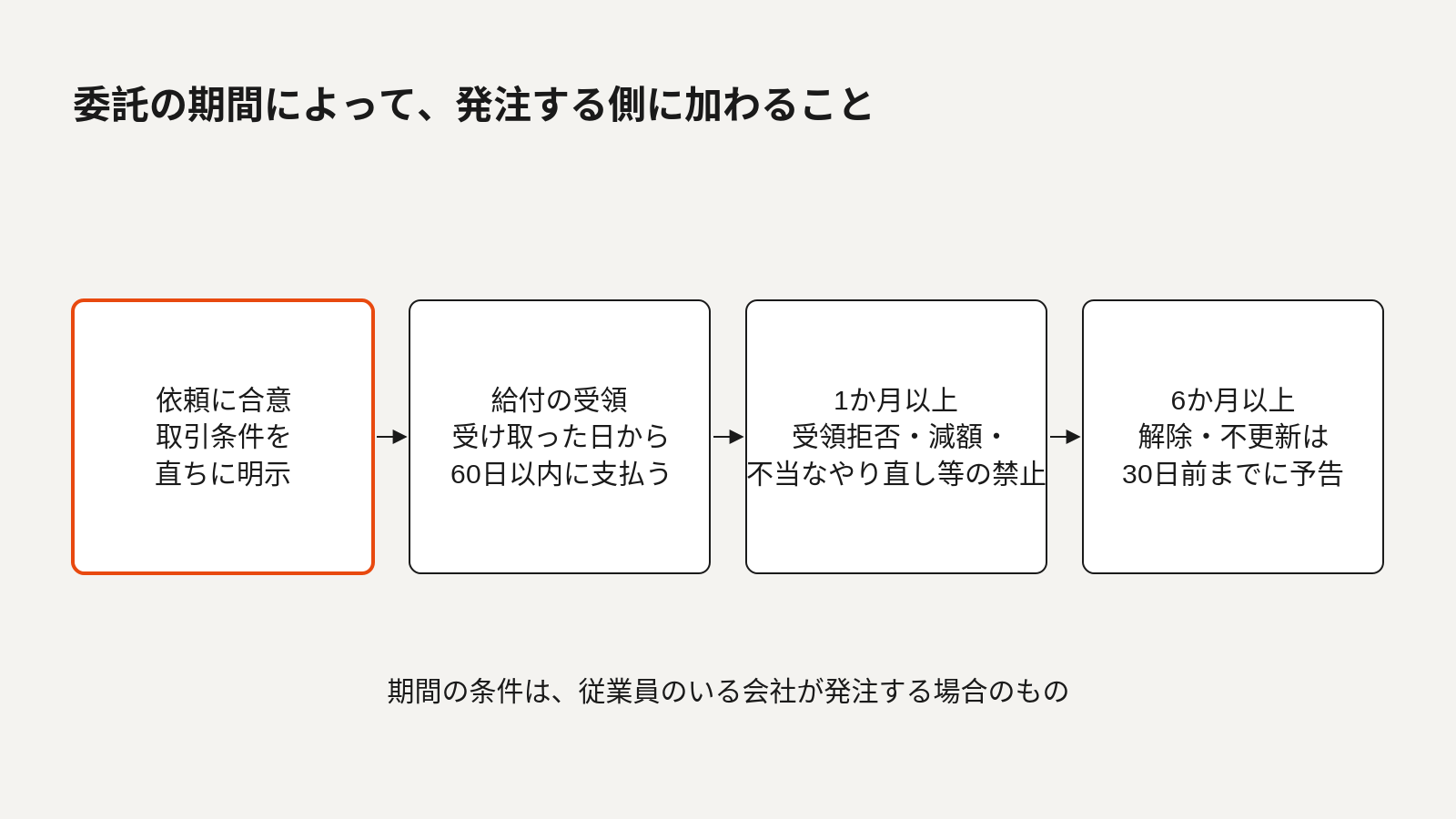
For example, if a brand that has signed a one-year ambassador contract decides not to renew at the next renewal due to a change in policy, it must notify the ambassador of non-renewal at least 30 days before the contract expires. A contract renewed every six months is treated the same way if it has continued for six months or more in total. Cases where the individual is seriously at fault, such as in a scandal, are judged strictly, so check them together with the contract provisions discussed in What Happens to the Contract If an Influencer You're Working With Causes a Scandal?.
What should brands, agencies, and influencers each check?
If a brand asks an individual directly, the brand itself is the ordering party. When an agency or casting company is involved, one that merely makes introductions is not an ordering party. However, if it subcontracts the work, or is deeply involved in selecting the counterpart and setting the fee so that it effectively entrusts the work, that company becomes the ordering party. Deciding at the planning stage who is responsible for stating the terms and making payment will help prevent misunderstandings later.
Influencers should check whether the terms presented include the content of the posts, deadlines, fee, and payment due date. Even after receiving terms by electronic means, they can request that they be provided in writing.
What should be decided at the request stage?
- Confirm who the contracting counterpart is (the individual or an agency) and whether that counterpart is a specified entrusted business operator
- Decide whether the brand or the agency is the ordering party, and make clear who is responsible for stating terms and making payment
- Write the number of posts, platform, format, delivery date (posting date), and scope of secondary use as the "content of the work"
- Write the fee amount and a specific payment date within 60 days of the date the work is received
- Check whether the period will be one month or more, or six months or more, and build the timing of advance notice of non-renewal into the schedule
What are the common misunderstandings?
One misunderstanding is that "we discussed the terms over DM, so the terms have been stated." It is not enough for the required items to be scattered across an exchange; they must be presented in a form where all the required items can be confirmed together. Another mistake is thinking "the post hasn't been made yet, so we haven't entrusted anything." The obligation to state terms arises at the moment the request is agreed to. Rules on PR disclosure are set by separate laws and regulations, so it is also worth reviewing The Basics of PR Disclosure and Stealth Marketing Regulation.
Scope of this article
This article summarizes the parts relevant to influencer requests, based on the Japan Fair Trade Commission's page on efforts toward fair freelance transactions and the pamphlet on the Act on Ensuring Proper Transactions Between Freelancers and Businesses prepared by the Ministry of Health, Labour and Welfare and others (both checked in October 2026). It does not judge whether any individual contract or transaction falls under the Act. If in doubt, please consult the contact desks of the Japan Fair Trade Commission or the Ministry of Health, Labour and Welfare, or a specialist.
Conclusion
The new Freelance Act may look like a law that adds new work for ordering parties, but its core requirement is to state the terms up front, in a form that can be confirmed. If the terms are in place at the start of a request, misunderstandings over post content and payment will themselves decrease.