What Goes Wrong When You Set the Wrong Goal for an SNS Activation
This article was automatically translated from the Japanese original. Read the original in Japanese
When the goal of an SNS activation is set only on same-day numbers such as "attendance" or "post count," the experience becomes thin. Posts appear, but what people say in them is inconsistent, and the campaign ends as a one-time buzz. The right order is to decide first what attendees will say, and in what words, when they leave, and then set the numbers as a result of that. An SNS activation is an activation designed to include the point where the experience gets talked about on social media, so how you set the goal is itself part of the design.
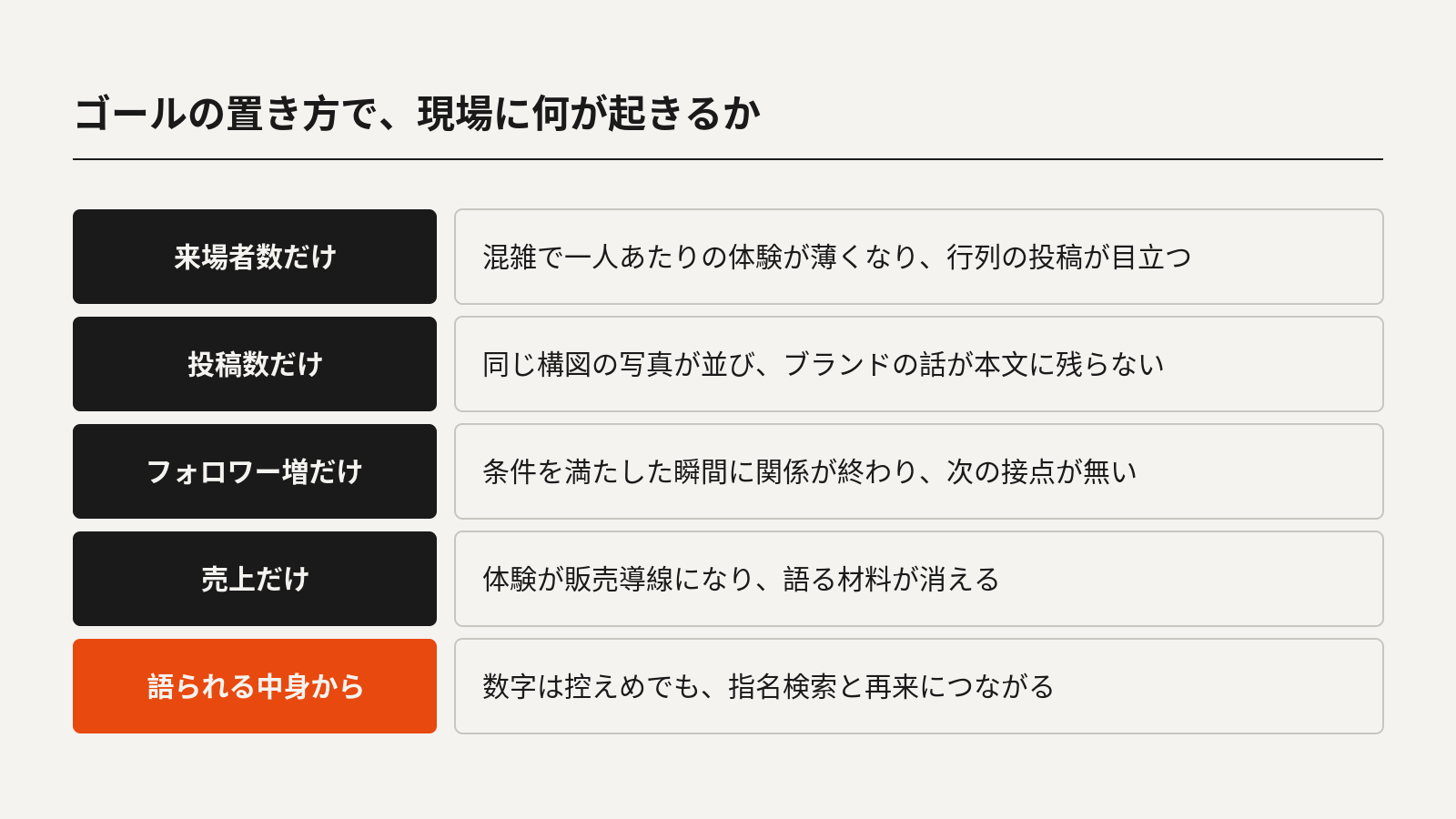
| How the goal is set | Failure that tends to occur | Signs on site |
|---|---|---|
| Attendance only | Crowding thins out each person's experience | Posts about wait times and queues stand out |
| Post count only | Photos with identical composition pile up, with nothing about the brand | Plenty of posts, but captions are a single line |
| Follower growth only | People drop off after the campaign, with no next touchpoint | Followers decrease the week after the campaign |
| Sales only | The experience becomes a sales funnel, and there is nothing left to talk about | Attendees just receive a product explanation and leave |
| Working backward from what gets talked about | Numbers may be modest, but they lead to branded searches and repeat visits | Brand strengths are posted in attendees' own words |
What Does a Numbers-Only Goal Cause on Site?
When attendance is the goal, driving traffic takes priority, and more people show up than the venue can hold. For example, suppose a three-day pop-up is held in a corner of a commercial facility and promotion is expanded to hit an attendance target. By the afternoon of the first day, wait times for the experience grow long, and what attendees post are photos of the queue. The experience itself gets shortened, and the only thing people can say is "it was crowded."
When post count is the goal, a different failure occurs. Mechanisms to prompt posting take center stage, the design centers on photo spots and giveaways, and a large number of photos with the same composition line up. Posts increase in number, but what was good about the brand does not remain in the captions, and people who see the posts have no reason to search for the brand name. As we explained in What Should You Use to Measure the Effect of an SNS Activation?, posting rate and UGC volume are intermediate indicators, not the end point.
The structure is the same when follower growth or sales is the goal. An experience conditioned on following or purchasing ends the relationship the moment the condition is met. If the goal is confined to "what is achieved on the spot," nothing remains after the campaign.
What Does a Goal Decided from "What Gets Talked About" Look Like?
Writing the goal in words changes the design. You first decide what you want to remain in the body of attendees' posts, for example: "Attendees leave talking about the product's feature X as their own experience." Numbers come afterward, such as "what proportion of attendees will publish posts containing that content" and "how branded searches move after the campaign."
For example, if you want people to talk about "long-lasting moisture" at a new skincare experience event, a flow that lets them compare their skin an hour later gets closer to the goal than a photo spot for shots taken right after application. When the goal is set in words, decisions about which mechanisms to cut and which experiences to devote time to stay consistent. As discussed in What Makes a Product Suited or Unsuited to SNS Activation?, for a product with no feature worth talking about, this kind of goal cannot be established in the first place, so the form of the campaign should be reconsidered at that point.
What If You Notice Midway That the Goal Is Off?
If you realize during preparation or during the event that you are "chasing numbers only," get back on track in the following order.
- Rewrite what you want attendees to talk about in one sentence and share it with everyone involved
- Remove mechanisms that do not connect to that content (such as elements that invite posts motivated by giveaways)
- Limit admission to a number of people that allows enough experience time per person
- Change staff outreach from product explanations to helping attendees put their experience into words
- Add to the same-day numbers report an analysis of what was actually written in the posts
Limiting admission during the event takes courage, but an experience thinned out by crowding shows up honestly in the body of posts. Even if the numbers are small, consistent content in what gets talked about leads more readily to the next campaign.
What to Decide at the Design Stage to Avoid the Same Failure
- Write the goal as a sentence describing what will be talked about, and place the numbers beneath it
- Work backward from venue capacity to determine experience time per person and daily admission numbers
- Do not make posting a condition; devote budget and time to an experience people want to post about
- Split the indicators you measure into two tiers: same-day numbers and post-campaign numbers (branded searches and repeat visits)
- Decide in advance that if things do not go well, what gets reviewed is the design conditions, not the attendees
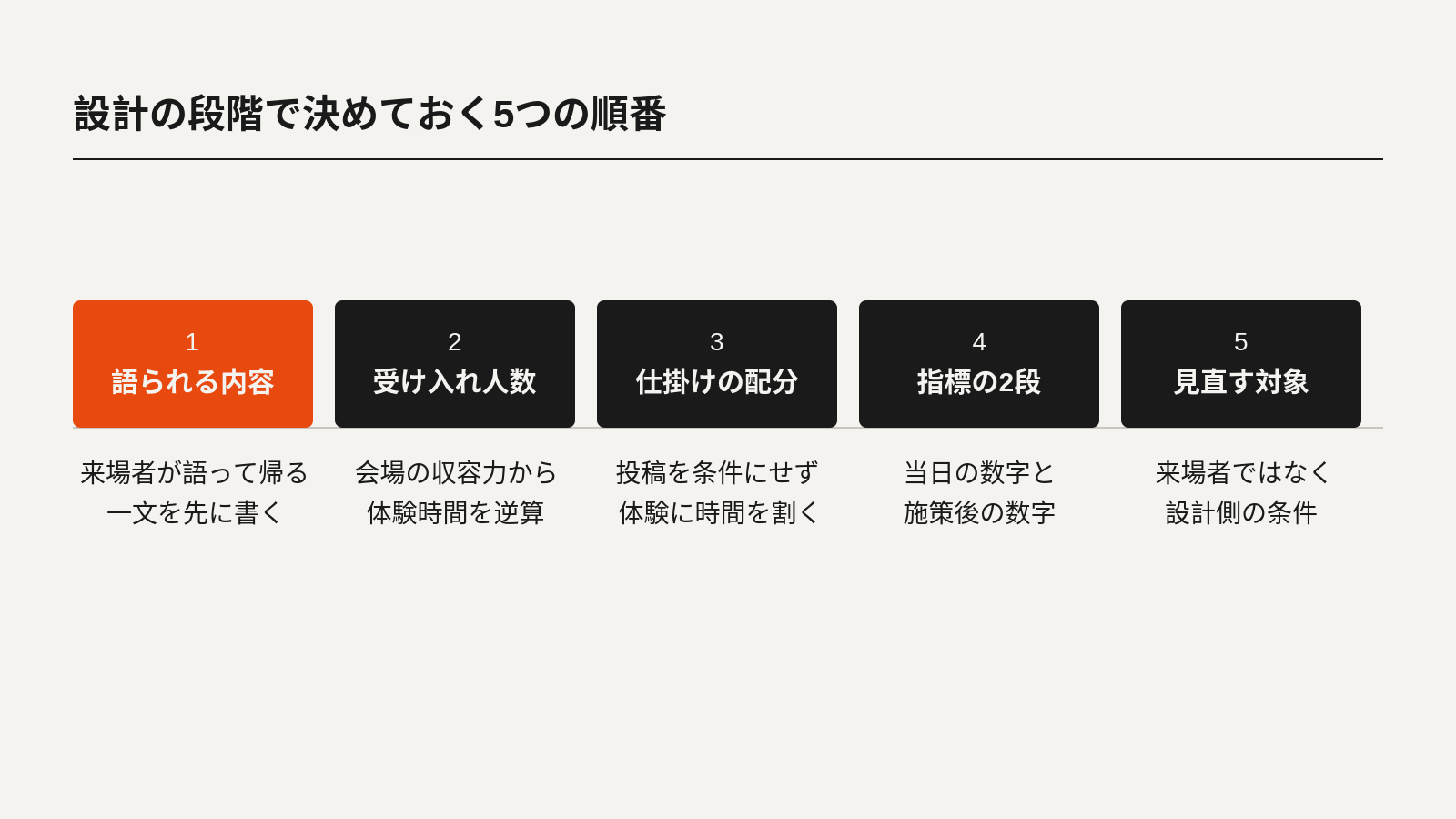
These five points are to be decided early in planning, within the flow of the process outlined in What Is SNS Activation?. When the client holds the goal in words, the design of the venue, the experience, and the number of people invited connects into one line. Our approach to design is also summarized on our service page.
Scope of This Article
This article focuses on the failures caused by a misaligned goal and the order for getting back on track. It does not cover specific KPI formulas, effect measurement periods, or constraints specific to individual industries. For how to review the design when attendees post little, see When an Experiential Event Generates No Posts, What Should You Review in the Design?.
Conclusion
Setting goals in numbers is not itself a mistake. It is a matter of order. If you first decide what attendees will talk about when they leave, and then set the numbers as a result of that, both traffic-driving and posting mechanisms work in service of what gets talked about.