When and How Should You Communicate Off-Limits Products and Expressions Before Booking an Influencer?
This article was automatically translated from the Japanese original. Read the original in Japanese
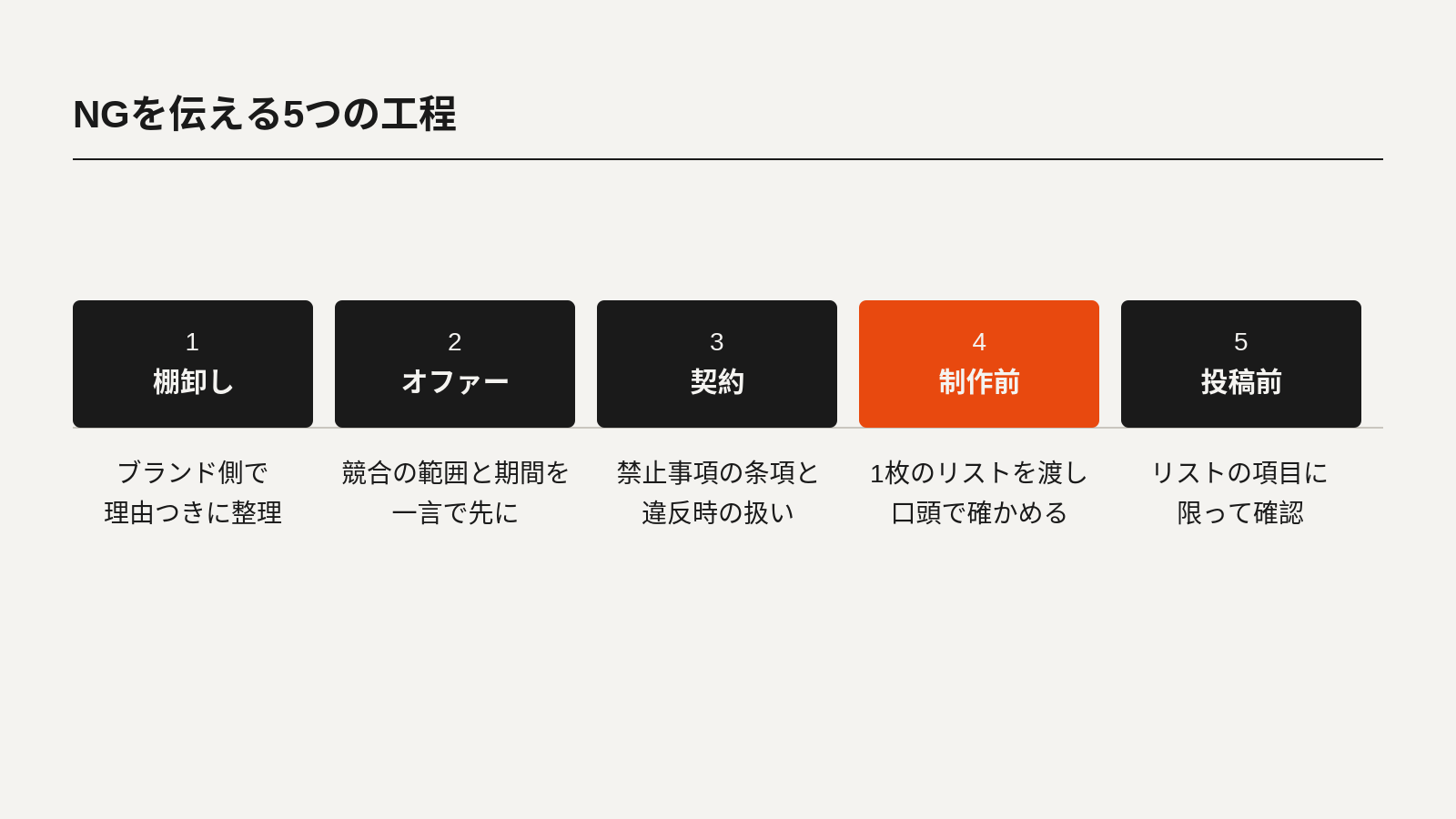
The practical approach is to hand over off-limits products and expressions as a one-page checklist, separate from the contract, right after the influencer is confirmed, and to confirm them verbally in the pre-production meeting. The prohibited-items clause in a contract is something to fall back on later; the checklist is what actually gets read on the ground. Simply sending a long set of guidelines along with the contract means no one reads it again by the time of the shoot.
| Stage | What to decide and do about off-limits items | Who is involved |
|---|---|---|
| Before selecting candidates | Take inventory of the brand's off-limits items and sort them into 3 categories, with reasons | Brand contact, casting agency |
| At the offer | Briefly communicate the handling of competitors and off-limits products up front | Casting agency, influencer |
| At contracting | Write them into the prohibited-items clause and decide how violations will be handled | Brand legal team, the influencer |
| Pre-production meeting | Hand over the checklist and confirm verbally | Everyone |
| Pre-publication review | Review against the checklist, and make revision requests by pointing to the relevant item | Brand contact, casting agency |
Why a Prohibited-Items Clause in the Contract Isn't Enough
A contract is a document you return to after something has happened. Almost no one opens the contract the day before a shoot to reread the prohibited-items clause. Yet issues with post expressions arise during shooting and editing. What the influencer has on hand at that moment needs to be short and easy to refer back to.
As we outlined in What Is Influencer Casting?, a casting agency's job doesn't end with finding candidates; it includes translating the brief's conditions into a form the influencer can follow without hesitation. How off-limits items are communicated is central to that process. When the communication doesn't land and revisions are needed, we treat it as a problem with how the message was designed by the party conveying it, not as the influencer's fault.
Sorting Off-Limits Items into 3 Categories Makes Them Clear
When you list off-limits items, mixing things of different natures makes the list go unread. Sort them into the following 3 categories and add a one-line reason for each.
- Product off-limits: products you don't want shown in the same post (competitors, products that clash with the brand's worldview)
- Expression off-limits: phrasing you don't want used (definitive efficacy claims, comparisons, expressions that run afoul of laws or industry self-regulatory standards)
- Behavior off-limits: things to avoid in the scenes of the post (portrayals that make someone look underage, dangerous acts, scenes that offend public order and morals)
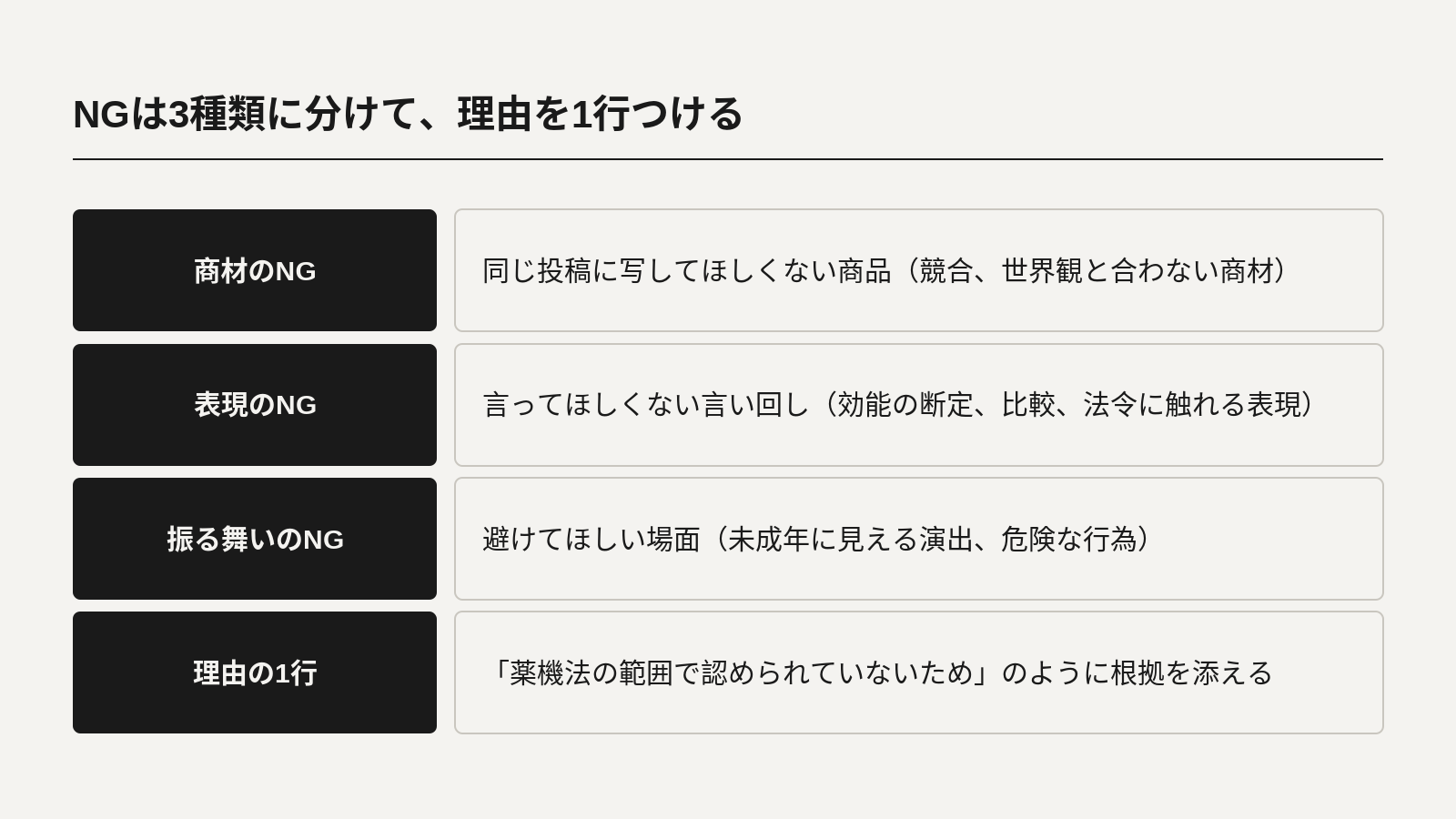
For example, if a skincare product can't use a definitive efficacy claim such as "spots disappear," add the reason: "Within the scope of Japan's Pharmaceuticals and Medical Devices Act, this is an expression not permitted for cosmetics." With a reason, the influencer can avoid similar expressions on their own. For how to think about the scope of expressions, see How Far Can Beauty Brands Go in Communicating Ingredients and Efficacy in Influencer Posts?.
As another example, if an alcohol brand asks that no one who looks underage appear in the post and that expressions encouraging drinking be avoided, these belong under behavior off-limits. Writing them in terms of scenes, such as "scenes that suggest underage drinking," reduces hesitation.
Where Things Tend to Go Wrong at Each Stage
At the offer stage, the handling of competitors tends to be put off. If you tell the influencer after booking, "Please don't post about products in the same category for a while," it may conflict with their schedule and the discussion goes back to square one. Include the scope and duration of the competitor restriction in a line of the offer text.
At the contracting stage, legal wording sometimes gets passed to the influencer as is. Keep the clauses as clauses, and prepare a separate version for the influencer. In the pre-production meeting, don't just send the checklist and call it done; confirm verbally, item by item, with something like "Does this look fine to you?" Comparing against the influencer's own concept proposal lets you find the spots likely to hit an off-limits item at this point.
At the pre-publication review, you may be tempted to fix even expressions that don't violate any off-limits item. Limit revision requests to those corresponding to items on the checklist. For how to think about scope, see How Far Can You Go When Giving Influencers Revision Instructions? and How Far Can You Specify Copy and Cut Composition in Sponsored Collaboration Posts?.
What to Decide at the Start
- The brand organizes the list of off-limits items with reasons before handing it to the casting agency
- Keep the checklist to one page, split it into 3 categories, and add a one-line reason to each item
- Include the scope and duration of competitor restrictions in the offer text
- Keep the contract clauses and the checklist handed to the influencer as separate documents
- Build time for verbal confirmation in the pre-production meeting into the schedule
- Limit revision requests at the pre-publication review to items on the checklist
Deciding these 6 points early in the booking process reduces the number of conditions added right before the shoot and helps preserve your relationship with the influencer. Our approach to casting is summarized on our service page.
Scope of This Article
This article focuses on how to communicate off-limits products and expressions and on the role of each stage. It does not cover the wording of contract clauses, how to respond to violations, or the details of expression regulations by industry. It also does not judge whether any individual expression violates laws or regulations.
Conclusion
The purpose of communicating off-limits items is not to constrain the influencer, but to let them create posts that are true to themselves without hesitation. Keep it short, give reasons, and hand it over at the moment it will be read. With these three in place, prohibitions become not a source of friction but a foundation for moving forward with confidence.