SNS Activation Case Studies: Why Three Campaigns That Broke Expectations in Just One Way Got People Talking
This article was automatically translated from the Japanese original. Read the original in Japanese
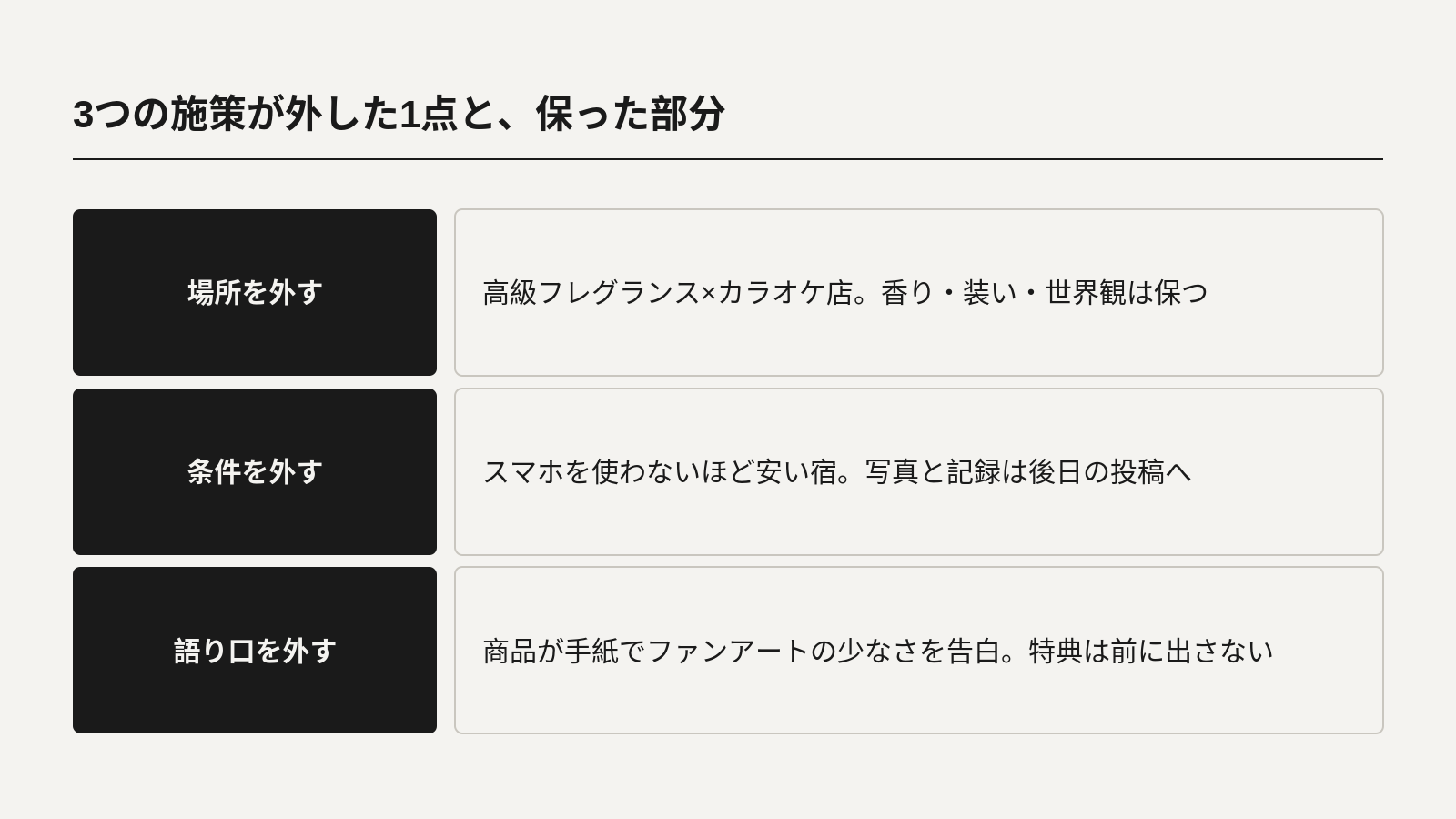
What the three campaigns have in common is that each broke the audience's expectation of "this is how this brand would show up" in just one way, while keeping everything else on-brand. Whether the one thing they shifted was the "place," the "condition for participation," or the "tone of voice," the gap from expectations gave people something to write about in their posts. SNS activation means designing an activation that includes the step where the experience gets talked about on social media. These three examples offer material for thinking about what to shift if you want people to talk.
| Country/Region | Industry | What they did | The mechanism that got talked about on social media | Source |
|---|---|---|---|---|
| Japan (Tokyo) | Beauty (fragrance) | A one-night party with fragrance as the star, held at a karaoke bar in Shibuya | The combination of a luxury fragrance and a karaoke venue | FASHIONSNAP |
| Australia | Wellness products e-commerce | A stay in off-grid cabins with no reception, where the price drops in proportion to how much you reduce your phone use | Screen-time screenshots from before and after the stay as proof of participation | Time Out |
| Japan | Convenience store (food) | A flagship product celebrating its 20th anniversary asked for fan art in the form of a letter | The confession that "there were only two pieces of fan art" and the hashtag | AdverTimes |
Case 1: A Luxury Fragrance Chose a Karaoke Bar
Yves Saint Laurent Beauté held the Tokyo edition of its brand party series as a one-night event at a karaoke bar in Shibuya. The series has previously been held in Madrid, New York, London, and other cities, with a bakery as the venue in France and a record store in London. The format of borrowing an everyday cultural spot in each city came first, and in Tokyo, karaoke was chosen. The venue was filled with the scent of perfume, and the aim is said to be to bring music, culture, and the brand's world together as one.
The one thing shifted was the "place." The venues you would expect for a luxury fragrance launch are hotels or galleries. By moving it to an everyday place like a karaoke bar, what attendees write in their posts is not a description of the scent but the context of the experience: "at that karaoke bar." Meanwhile, the brand's signature elements, such as the fragrance, the visuals, and the attendees' outfits, were preserved. Shifting only the place and aligning everything else is the balance that turns the sense of incongruity into a talking point.
Case 2: Cabins with No Reception, Where Putting Down Your Phone Lowers the Price
An Australian wellness products e-commerce company partnered with an accommodation operator running off-grid cabins to create a stay for couples. Guests submit screenshots of their average daily screen time on arrival and before departure, and the price of the stay drops according to the percentage reduction. According to the article, cutting it in half makes one night free. The rooms are equipped with a kit containing a disposable camera and a journal, and there is no Wi-Fi.
The one thing shifted was the "condition for participation." It is not unusual for a brand to offer a stay, but a condition where "the less you use your phone, the more you save" looks like the opposite of what you would expect from a campaign meant to be talked about on social media. Yet the screen-time screenshot serves as proof, and it becomes material for posting after the stay. Photos from the disposable cameras are posted after being developed, so the design generates posts at a later date rather than on the spot. It can be read as an example of shifting the moment of being talked about from "during the stay" to "after returning home."
Case 3: A Product Wrote a Letter and Confessed to Having Little Fan Art
To mark its 20th anniversary, a flagship convenience store product posted a handwritten-style letter from the product to its fans on its official X account. According to the article, while its cumulative sales had reached a large figure, a search of social media turned up only two pieces of fan art, and the letter openly said so and asked for fan art with a hashtag. The product itself was made the narrator, and it is reported that replies from fans and actual fan art came in.
The one thing shifted was the "tone of voice." What you would expect from a major brand at its 20th anniversary is an announcement of gratitude and achievements. By placing the scale of its achievements next to the scarcity of fan art and confessing it themselves, the campaign gave its audience a reason to reply. The mechanism for entry was only the hashtag and a promise to "view everything," with no incentive in the foreground. The design places the motivation to participate in replying to the product's personality.
What to Decide When Applying This in Japan
- Decide whether the one thing to shift is the "place," the "condition for participation," or the "tone of voice," and keep everything else aligned with the brand
- At the planning stage, imagine the one sentence that attendees or participants will write in their posts as a result of the shift
- Decide whether the moment of being talked about is "on the spot" or "at a later date," and prepare something that serves as proof (photos, records, replies)
- To keep the incongruity from turning unpleasant, do not move elements tied to the brand's stature or product safety
- Place the motivation to participate not in incentives but in a question or role that makes people want to respond
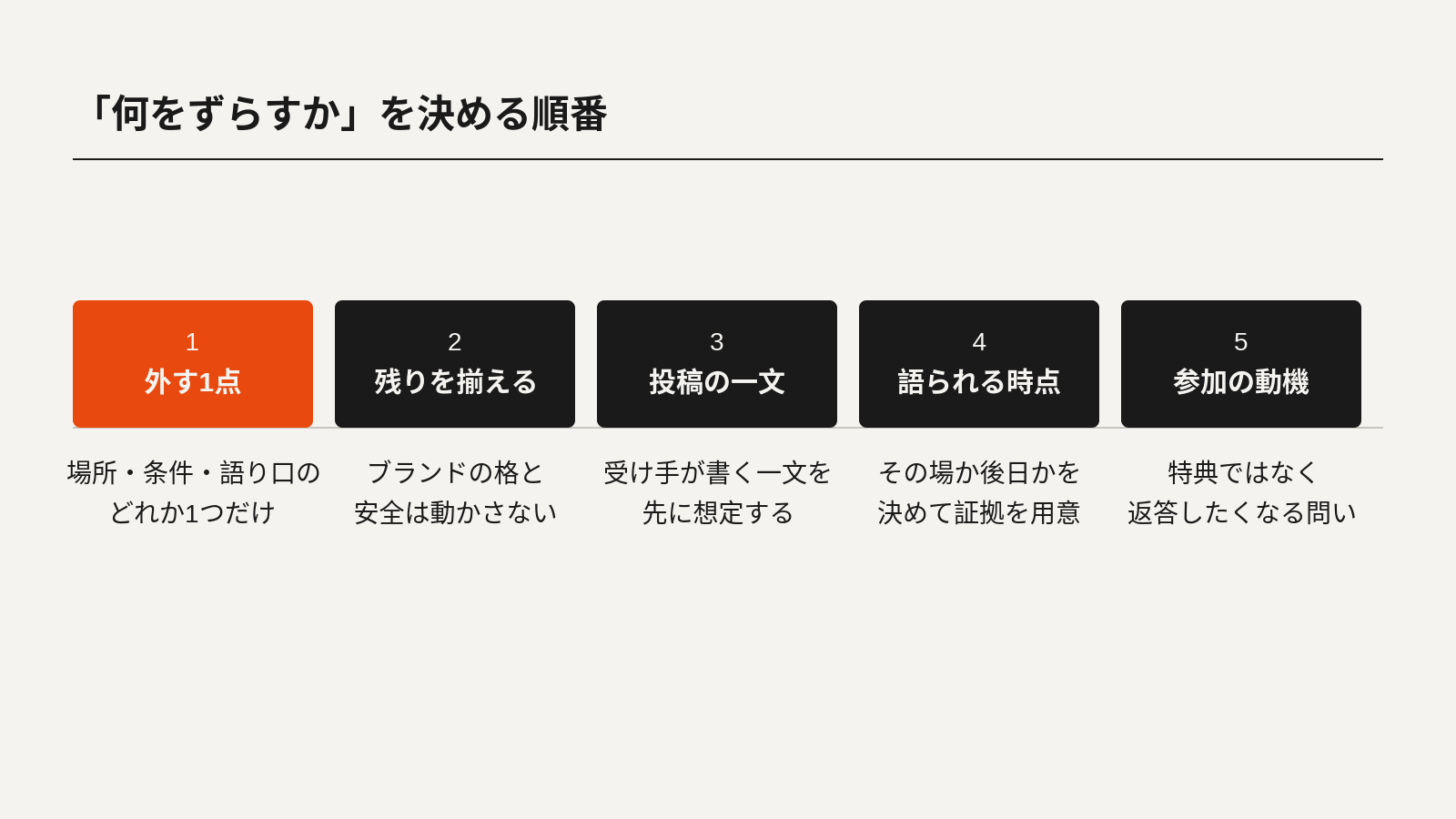
These five points span both the "experience design" and the "design for being talked about" outlined in What Is SNS Activation?. Our approach to design is summarized on our service page. For an example that uses visitors' own experiences as material, see What Do Campaigns That Turn Visitors' Own Experiences into Content Have in Common?.
Scope of This Article
This article examines the structure of the three campaigns based on facts stated in publicly available reports. It does not cover the results figures, costs, or details of statements from the people involved for each campaign. There is no intent to rank the campaigns; we only organize the structure of "why they got talked about."
Conclusion
Campaigns that get talked about have not abandoned the brand's character. Because they break expectations in just one way and carefully align everything else, the gap becomes material for conversation rather than a source of discomfort. Deciding first what to shift and what to protect is the starting point of the design.