SNS Activation Case Studies: Three Designs That Only Work on That Specific Day or Festival Run
This article was automatically translated from the Japanese original. Read the original in Japanese
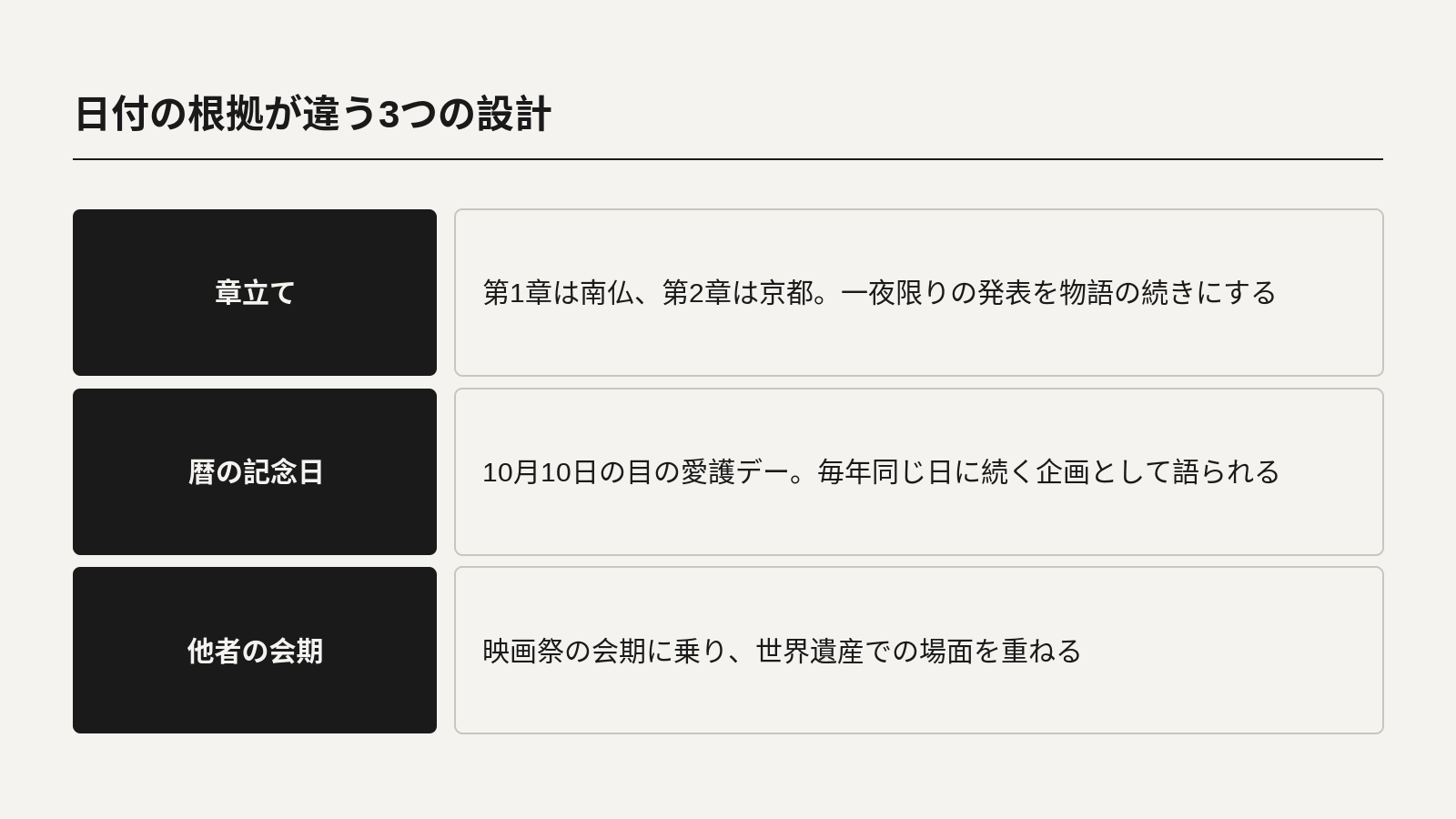
What the three campaigns have in common is that each tied place and date together so tightly that they cannot be separated, and made the fact of having been there on that day the very material people talk about. The basis for each date differs: a chapter structure set by the brand, a commemorative day on the calendar, and a film festival's run. SNS activation means designing an activation to include the stage where the experience gets talked about on social media, and "when to hold it" carries as much weight as the design of the venue.
| Region | Industry | What was done | Basis for the date | Mechanism that got people talking on SNS | Source |
|---|---|---|---|---|---|
| Japan (Kyoto) | High jewelry | Unveiled a new chapter in a building designated as an Important Cultural Property and held a one-night-only dinner | A chapter structure set by the brand (Chapter 1 was in the South of France in May) | The continuing story of "Chapter 2 in Kyoto" | FASHIONSNAP |
| Japan (Shin-Osaka to Tokyo) | Pharmaceuticals | Decorated two Shinkansen cars in green and offered parents and children an experience of resting their eyes | October 10, "Eye Care Day" | A single image of an all-green train car, and an initiative that continues every year | AdverTimes |
| Japan (Nara) | Fashion | As a partner of an international film festival, held a red carpet and dinner at World Heritage sites | The festival's run (a September holiday weekend) | Layered scenes that exist "only during the festival" with film and food | FASHIONSNAP |
Case 1: Placing a High Jewelry "Chapter 2" in a Single Night in Kyoto
Cartier unveiled Chapter 2 of its high jewelry collection in Kyoto on October 13. Chapter 1 had been presented in the South of France in May, so the chapter structure came first. The venue was the Meiji Kotokan at the Kyoto National Museum, where necklaces, earrings, and jewelry watches were displayed inside a building designated as an Important Cultural Property. The display included pieces shown in Japan for the first time. That evening, a one-night-only dinner was held in another building on the grounds, featuring a presentation by models wearing the jewelry and a dance performance by a kabuki actor. The guests were actors and artists from Japan and abroad, and a sales showing for clients followed on a later day.
The basis for the date is the chapter structure the brand itself set. Because of the sequence "Chapter 1 in the South of France, Chapter 2 in Kyoto," Kyoto on this day is told as the continuation of a story rather than a standalone event. Both the place (an Important Cultural Property) and the time (one night only) are fixed, so posts naturally include the coordinates "Kyoto on October 13." The design makes the night of the unveiling something people talk about, as a prelude to the later sales showing.
Case 2: Turning a Shinkansen Entirely Green for a Commemorative Day
On October 10, "Eye Care Day," Rohto Pharmaceutical chartered two Shinkansen cars and ran an event from Shin-Osaka Station to Tokyo Station. Green balloons floated from the ceiling, the headrest covers featured vegetable and fruit designs, and the happi coats and eye masks worn by participants were also all green. The participants were 18 parent-child pairs who applied through the brand's community site. They enjoyed a quiz themed on the scenery outside the window, a drink developed jointly with a partner company, a boxed meal made with ingredients said to be good for the eyes, and time to rest their eyes with eye masks. The company has been running events tied to this commemorative day since 2020.
The basis for the date is a commemorative day on the calendar. Because it falls on the same day every year, the event does not end after one run and is talked about as an annual, ongoing series. The aim of turning travel time into "time to think about your eyes" is condensed into a single image, an all-green train car, so it comes across in posts even to people who weren't on board. The article makes no mention of SNS, but three conditions, a commemorative day, a chartered space, and a unified color, supply the material for people to talk about.
Case 3: Layering World Heritage Scenes onto a Film Festival's Run
Giorgio Armani took part as a partner in the Nara International Film Festival, held over a September holiday weekend. On the first day, it provided costumes for the red carpet in front of the Great Buddha Hall at Todai-ji. The next day, after receiving a blessing at Kasuga Taisha, a photocall was held at the Manyo Botanical Garden, and a special dinner took place at a guesthouse facility that is normally closed to the public. The dishes were co-created by the chef of the brand's restaurant in Ginza and a chef from a Nara restaurant, and the participants included film directors, actors, dancers, and ambassadors. This year also marked the 160th anniversary of diplomatic relations between Japan and Italy.
The basis for the date is the festival's run. Outside the festival dates, neither the red carpet in front of the Great Buddha Hall nor the dinner at a facility closed to the public could happen. The brand did not create its own date. It rode an existing schedule, the film festival, and layered scenes of "the brand's costumes" and "the brand's food" onto it. The article's framing of a night where film, fashion, and food intersect shows that the brand borrowed from the festival a context it could not have created on its own.
What to Decide When Applying This in Japan
- Decide whether the basis for your date will be a "chapter structure you set yourself," a "commemorative day on the calendar," or "someone else's festival run."
- Tie place and date together so they cannot be separated, and narrow the coordinates that remain in posts (date and place) down to one pair.
- If you make it one night only, put the steps that follow (sales showing, sales, next year) in place first.
- If you ride a commemorative day, don't end after one run; design on the premise of continuing on the same day the following year.
- If you ride someone else's festival run, layer the brand's scenes on without breaking the context of that run.
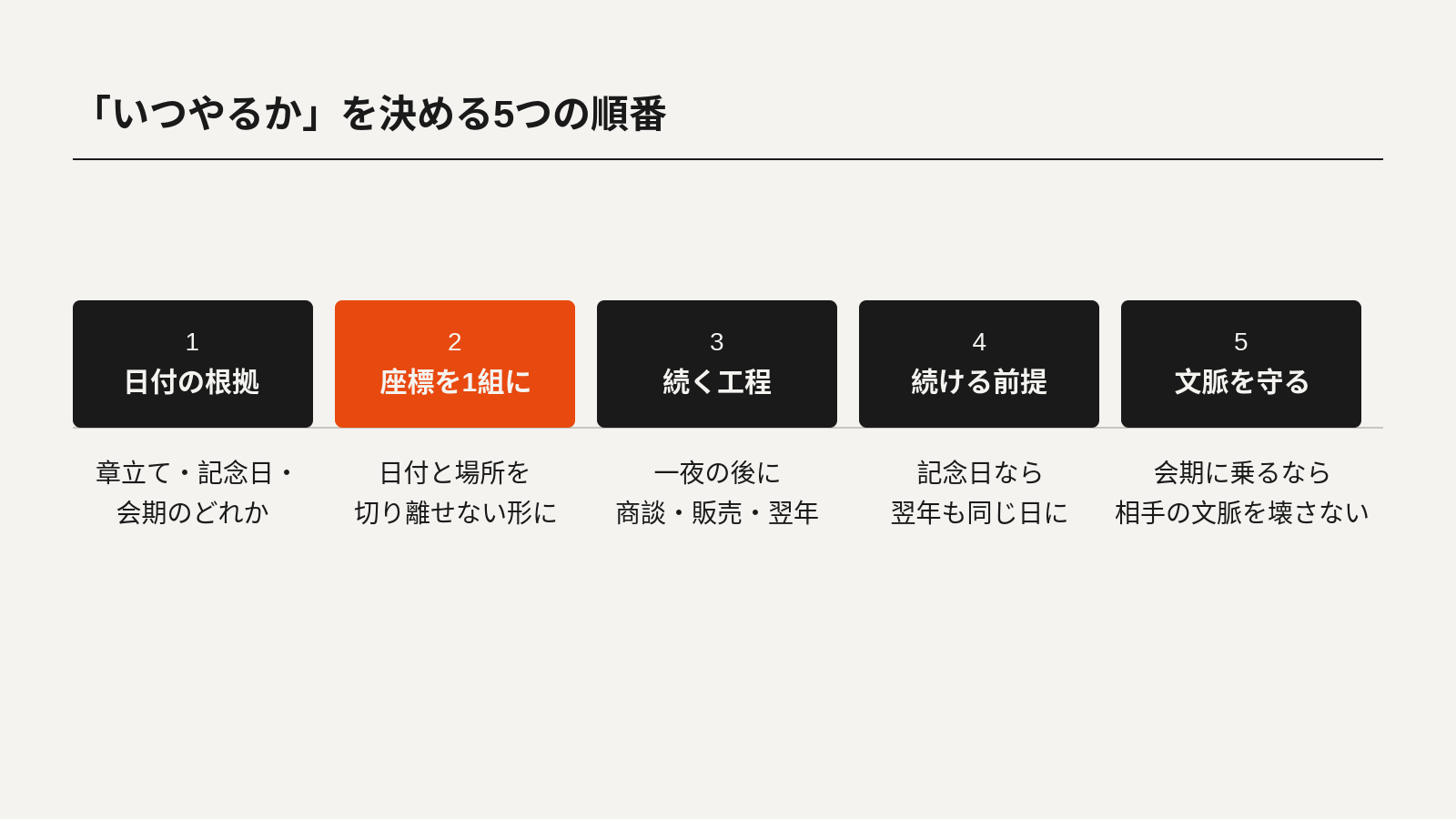
These five points correspond to the design of "place" and "time" outlined in What Is SNS Activation?. Our approach to design is summarized on our service page. For an example of replacing a launch event with an experience, see launch event case studies.
Scope of This Article
Based on facts reported in publicly available coverage, this article examined only the "date design" of the three campaigns. It does not cover each campaign's results figures, costs, details about the invited guests, or official statements from the brands. It does not rank the campaigns and is limited to analyzing their structure.
Conclusion
Decide the date with the same weight you give to choosing the venue. Whether you base it on a chapter structure, a commemorative day, or a festival run changes how the campaign is talked about and how it continues. A design that "only works on that day" starts by narrowing the coordinates that remain in posts down to one pair.