The Job of Creating an Experience vs. the Job of Creating a Talked-About State — Where Does Activation Design Branch Off?
This article was automatically translated from the Japanese original. Read the original in Japanese
Let's start with the conclusion. Creating a space for experience and creating a state in which that experience gets talked about may look like a continuous process, but they are actually separate jobs. It's not unusual for an event to run smoothly from start to finish, only for almost no posts to follow. And this divergence doesn't happen on the day of the event—it has already occurred at the point of several decisions made before that day. In this article, we lay out where that branch point lies, following the order in which we actually do the work ourselves.
Note that everything discussed in this article has been anonymized and generalized; it does not refer to any specific brand, project, or individual.
How Far Does the Word "Activation" Actually Reach?
First, let's align our terminology. Even when using the single word "activation," the scope can differ between the client placing the order and the agency receiving it, and conversations can proceed without that gap ever being noticed.
What Is Brand Activation?
Brand activation is a marketing approach that, rather than one-directionally delivering advertising, creates spaces and mechanisms through which customers can directly experience a brand's worldview—drawing out empathy and action. In Japanese, this is also called "experiential marketing." Pop-up stores, reception events, and in-store experience installations all fall under this category. The core idea behind this term is that it's not a measure for "conveying" something, but one for "letting people experience" something.
What Is SNS Activation?
SNS activation is our own framework for designing that same brand activation so that it extends all the way to "the experience being talked about on social media." This is a term we use internally for our own model. Rather than dividing the work across different parties, a single team handles everything: planning and producing the experience, designing who to invite, running the event on the day, designing the posts, and measuring the actual post rate. The key difference is that success is measured not by how many people gathered at the venue, but by how much that experience was talked about and how far it reached.
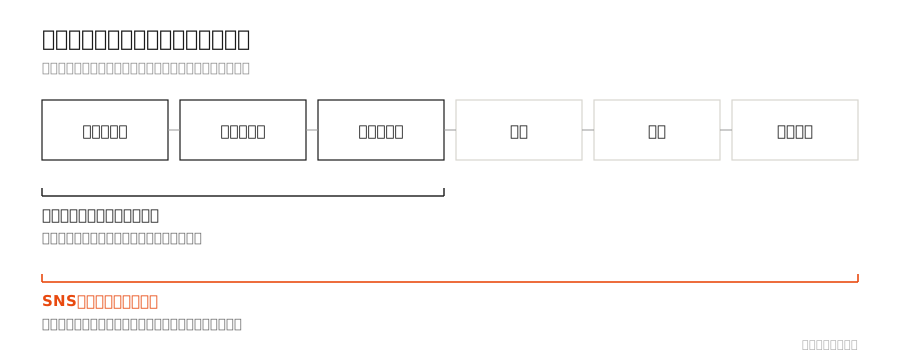
These two concepts are not opposed to each other. The former is a general term referring to a type of initiative, while the latter is about how far you extend that design scope. Still, mismatches in practice almost always show up as this kind of gap in scope. Is the job done once the space is created, or does it extend to creating a state where the experience gets talked about? When this isn't aligned from the start, you end up with the strange result of an event that succeeds on the day but leaves no one satisfied once it's over. We've also summarized these term definitions on our service page.
The Branch Point Occurs at Four Junctures, Not on the Day Itself
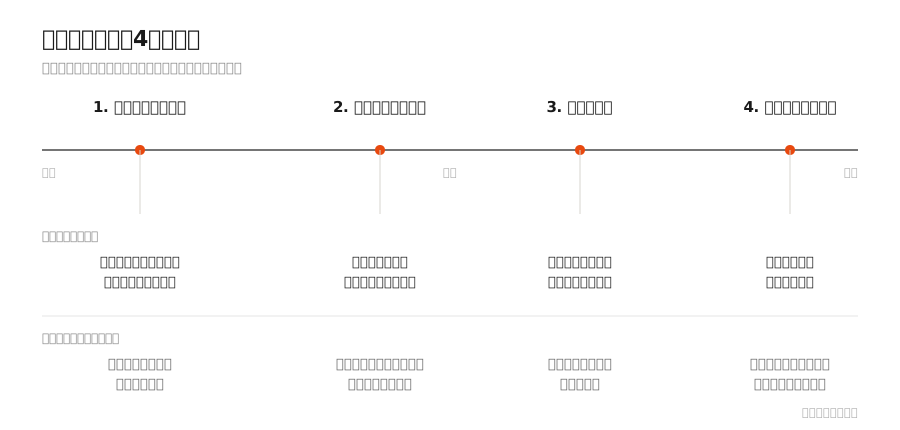
1. When Deciding Whom to Invite
The first branch point occurs at the moment of deciding who to invite. Whether the guiding criterion here is "how many people can we gather" or "will this experience fit naturally into this person's usual content and voice" largely determines almost everything about the design that follows.
To be clear, this isn't about screening for people who seem likely to post. What we're looking at isn't the other party—it's the experience we've prepared ourselves. Based on what themes and tone that person typically posts about, can we make this experience feel like a natural extension of that? If we can't, we believe the thing that needs fixing isn't the choice of person, but the experience itself.
2. When Creating the Experience
The experience at an event disappears the moment it ends. What remains is only what people can take home with them.
What we mean by "what people can take home" isn't a novelty item or giveaway. It's whether there is one point that person can put into their own words. No matter how lavish the venue design, if it doesn't add up to anything more than "it was amazing," that's an experience that's hard to talk about. Conversely, if what the brand values most is condensed into a single moment, words for talking about it will emerge even at a small scale. What shapes the content of a post has less to do with how skillfully the venue is designed, and more to do with whether "what this experience is, in one sentence" has been clearly decided.
3. On-Site Flow on the Day
The third point concerns operations. We believe that photography and posting shouldn't be something you ask for after the event is over—they should be built into the on-site flow in advance.
Is there time and space built into the flow for people to take photos calmly? Have the points the brand wants highlighted—and conversely, the points it wants kept out of shots—been shared in advance? Are the designated hashtags and mentions presented in a form guests can check on the spot? If these preparations are missing and it's simply left as "we'll leave the rest to you," the entire burden of posting falls on the guest. We touched on the point of putting the details of a request into words before sending it in The Failure Studies of Casting Design, but for events, the difference is that this extends even to designing the time and place on the day itself.
4. From the End of the Event to the Post
The last branch point comes right after the event ends.
With gifting, the product itself remains in hand. When the recipient decides to post, the material is right there. But with an event, once it's over, nothing remains. The photos from the day and the background the brand wanted to convey tend to exist only on the organizer's side. Whether or not photos and information from the day are handed over promptly makes a real difference in how easy it is for someone to post. This isn't about chasing people up—it's our own job of handing over the material and context.
Changing the Success Metric Changes the Design Decisions
All four points above are things that only become visible once you place "post rate" as the metric of success.
If attendance numbers are the metric of success, limited time and effort get allocated toward drawing a crowd. If post rate is the metric of success, that same effort gets allocated toward designing each individual's experience. Whether to invite more people or to secure more time per person—this is the decision that shifts here.
In our own track record, the post rate among influencers who attended our events was 94.6% (37 projects, 390 people). However, this figure isn't uniform across scale—once attendance reaches around 10 people, some attendees begin to not post. We've summarized the detailed breakdown in Post Rates Among Event Attendees. One could read this as "the more people attend, the less likely they are to post," but we instead take it as a matter on our own end—that as numbers grow, the design given to each individual tends to thin out.
We measure not in order to evaluate, but in order to change the design going forward. As long as we're only counting how many people showed up, there's no reason to touch the design of the experience itself.
In Closing
An experience is only half finished at the moment it's created. The other half refers to that experience becoming someone's words and reaching the people beyond them.
The reason we distinguish this full scope by calling it "SNS activation" is so that the second half isn't left to someone else's goodwill. Building in, from the start, what happens after the space is created—the branch point is always earlier than the day itself.
We'll share further updates via our email newsletter. You can sign up below.
Source: The post rate cited is based on research by STATS INC. (results from our own event initiatives, limited to 37 projects and 390 attendees for whom whether or not each attendee posted could be confirmed from our records). This is statistically processed data presented in a form that does not identify any specific project, brand, or time period.