What Is Influencer Marketing? Types of Methods and the Big Picture
This article was automatically translated from the Japanese original. Read the original in Japanese

Influencer marketing is a marketing method that delivers products and brands to consumers through the voices of people who hold influence on social media. Rather than the company speaking for itself, a third party who stands closer to everyday consumers speaks instead—and that shift changes how the message is received.
The term "influencer marketing" covers more ground than it might seem. Methods range from simply handing over a product and leaving the decision of whether to post up to the individual, to entering into an ongoing contract and having someone accompany the brand over the long term. The depth of involvement and the length of the engagement both vary widely. This article organizes the full picture.
Why It Works Differently from Advertising
There are three main reasons influencer marketing produces a different effect than advertising.
The first is that the speaker is a third party, not the company itself. Even identical information is received differently depending on whether it comes from a company or from someone who speaks in their own words from a position close to everyday consumers.
The second is that the message rests on an ongoing relationship with followers. Rather than a single, one-off touchpoint, mentions of a product or brand ride on top of an accumulation of daily interactions.
The third is that the content remains after it's posted. Unlike TV commercials or paid media, posts continue to exist in a form that can be searched for and revisited later.
However, none of this means influencer marketing simply "works better" than advertising. In practice, the more accurate way to think about it is that the nature of the effect is different.
A Map of the Methods
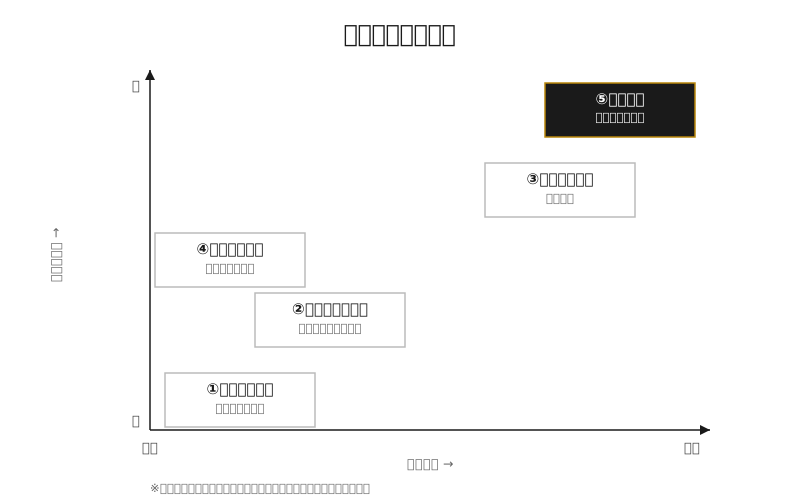
The overall picture of influencer marketing methods becomes easier to see when organized along two axes: "contract duration (one-off vs. ongoing)" and "depth of brand involvement (low vs. high)."
① Gifting
This method involves providing a product or service and leaving it up to the individual to decide whether and how to post about it. It's a one-off engagement, and among the five methods, it sits at the lowest level of brand involvement. Since posting isn't mandatory, one natural question is what proportion of gifted products actually result in a post. According to our own performance records, the posting rate was 91% (N=342) (How Often Do Gifted Products Actually Get Posted About?).
② Sponsored Collaboration Posts
In this method, compensation is paid in exchange for commissioning the creation of a post. Requests are typically one-off, but involvement runs deeper than with gifting, with content aligned starting from the planning stage of the post. Since compensation is involved, a PR disclosure is mandatory.
③ Ambassador
This method involves entering into an ongoing contract for a set period, during which the influencer takes on responsibility for the brand's messaging. Unlike one-off initiatives, it assumes that the relationship will build over time. Among the five methods, it ranks high in both depth of involvement and contract duration.
④ Event Invitation
This method involves inviting influencers to a new product launch event or hands-on experience session and having them share that experience. It's a one-off initiative, but because it involves an actual hands-on experience, involvement runs deeper than with gifting. According to our own performance records, the posting rate among event attendees was 94.6% (N=390) (How Often Do Event Attendees Actually Post?).
⑤ Co-Development / Co-Production
This method involves having the influencer participate directly in the planning of a product or collection. Among the five, it ranks highest in both contract duration and depth of involvement, with the brand and influencer working as equal partners to build something together.
Characteristics by Platform
Even the same method can be more or less suited to a given platform depending on where it's carried out.
Instagram is well suited to conveying a brand's worldview and visual context. With multiple formats—Feed, Stories, and Reels—it tends to be effective at visually communicating a brand's atmosphere. On the other hand, it has limits when it comes to detailed text-based explanation.
YouTube is well suited to longer explanations and comparisons. Because videos can run longer, creators can go deep into the experience of using a product and the thinking behind it. Posts also tend to remain visible in search results for a long time, functioning as a kind of accumulating asset.
TikTok stands out for its virality and the ease with which content is discovered by chance. Because of the way its algorithm surfaces content even to non-followers, posts can reach audiences that weren't originally anticipated. That said, this also means it's not entirely possible to control the context in which content spreads.
All of these characteristics are tendencies, not laws that always hold true. Even on the same platform, results will vary depending on which influencer is engaged and how the content is created.
The Five-Step Process
With an understanding of the methods and platforms in place, here's how to organize the actual execution.
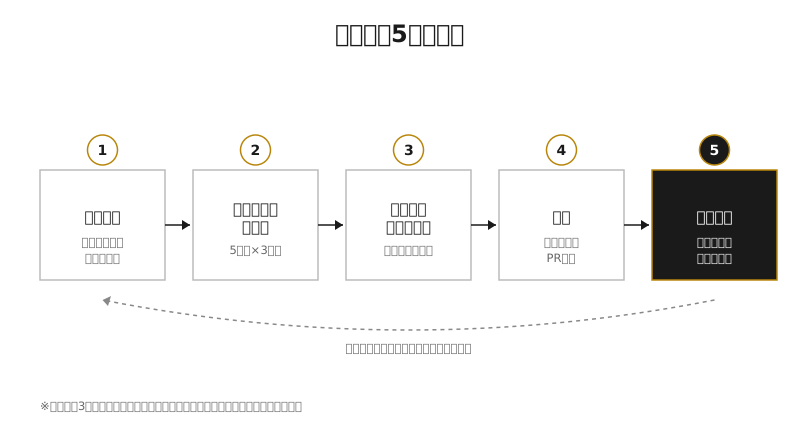
- Define the objective — Is the goal to build awareness, drive purchases, or convey the brand's worldview? Because the right method and platform depend on the objective, it needs to be clearly articulated from the start.
- Choose the method and platform — Based on the defined objective, select the optimal combination from among the five methods and three platforms.
- Select the influencer to work with — At this stage, consider not just follower count but also fit with the brand and actual engagement. The details of this selection process are covered in a separate article (What Is Influencer Casting?).
- Execute — Carry out the campaign with careful briefing (sharing the request details), and align on rules to be followed—such as PR disclosure—in advance.
- Review — Check the results against the objective and use them as material to sharpen the precision of the next initiative.
Three Common Pitfalls
When influencer marketing doesn't go well, the cause is often found not on the influencer's side, but in how we, as the brand, designed the campaign. Here are three common examples.
① Selecting based on follower count alone
A larger follower count doesn't necessarily mean a bigger effect. Even within the same follower range, there can be non-negligible differences in engagement rate (How Much Does Engagement Rate Vary Even Within the Same Follower Range?). Basing selection criteria on follower count alone is one reason results may fall short.
② A mismatch between objective and method
There are cases where the objective and the method don't align—for example, entering into an ambassador contract when the goal is to build awareness, or relying solely on gifting when the goal is to drive purchases. This stems from choosing a method while the objective definition from the earlier stage remains vague, and it is not a problem on the influencer's side.
③ Insufficient preparation of PR disclosure
A compensated post without a PR disclosure may run afoul of the stealth marketing regulations under the Act against Unjustifiable Premiums and Misleading Representations (Consumer Affairs Agency, "Views on Stealth Marketing under the Act against Unjustifiable Premiums and Misleading Representations"https://www.caa.go.jp/policies/policy/representation/fair_labeling/stealth_marketing/)。Preparing disclosure rules in advance and clearly communicating them at the request stage is the responsibility of us as the brand, not the influencer.。Preparing disclosure rules in advance and clearly communicating them at the request stage is the responsibility of us as the brand, not the influencer.)
About Us
STATS INC. is an influencer casting company centered on Instagram, YouTube, and TikTok. Combining an eye for reading a brand's worldview with objective data grounded in performance records, we have supported the casting and PR event production of more than 240 brands, including international luxury brands.