SNS Activation Case Studies: 3 Designs That Turned Passive Viewers into People Who Show Up in Person
This article was automatically translated from the Japanese original. Read the original in Japanese
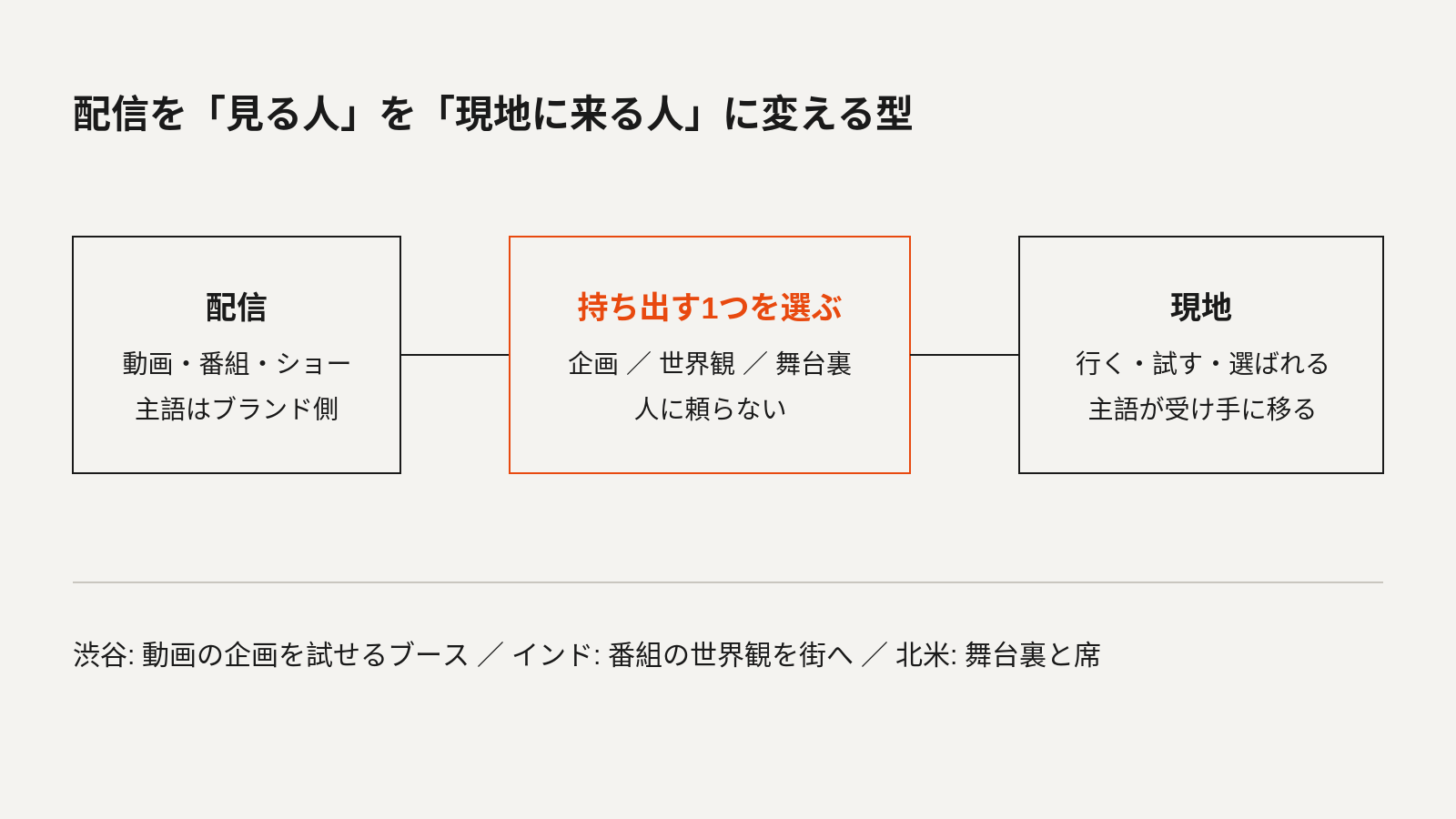
Streaming ends at "watching." The 3 campaigns below took what's inside the stream (a video concept, a show's world, the behind-the-scenes of a runway show) and brought it on-site, giving people who had only watched a reason to go. People who show up become the subject of their own posts, and those posts reach people who never saw the stream. This is the design the 3 cases share.
| Country / Region | Industry | What they did | What got talked about on social media | Source |
|---|---|---|---|---|
| Japan (Shibuya) | Video platform | Held a 4-day, free, reservation-only pop-up where visitors can experience popular video concepts and photo spots | Photos of "I did it myself" with a concept seen in a video are posted for people who know the video's context | YouTube Official Blog (October 14, 2026) |
| India (Hyderabad) | Video streaming service | A group in costumes from the show's world lined up in front of a historic monument, holding a Telugu slogan | The show's world appeared in an everyday place, and passersby took photos and posted them | Siasat (September 24, 2026), Deccan Chronicle (October 8, 2026) |
| North America (Los Angeles) | Apparel | Streamed its fashion show for free while combining simultaneous cinema screenings, a serialized documentary following newcomer models, and a ticket lottery via social media | The experiences of "being chosen to attend" and "watching together in a cinema" generate posts different from those of people who simply watch the stream | Adweek, HOLA! (October 16, 2026) |
What Did the Shibuya Pop-Up Bring Out by Turning Video Concepts into a "Place to Experience"?
From November 5 to 8, 2026, the video platform will hold its first experiential pop-up in Japan at a venue in Shibuya. Admission is free, and advance visit reservations are accepted on a first-come, first-served basis. The venue will feature photo spots recreating scenes from creators' videos, and booths where visitors can actually try the items and concepts featured in those videos. Genres are divided into short-form video, science, beauty, fitness, food, lifestyle, and more, with many channels planned. One notable point is that the official announcement states that the featured creators themselves will not attend or stay at the booths on the day. Details are in the YouTube Official Blog announcement (October 14, 2026).
What was brought out is not people but "concepts." Viewers who know the experiments and concepts from the videos try them for themselves and take photos of those scenes, creating posts aimed at others who watch the same videos. A design that works without the creators present doesn't rely on their appearance to draw visitors; the video's context itself becomes the reason to come. The fact that it follows the live show on October 29 also builds an order of "go after you've watched."
Why Did Passersby Take Photos of the Streaming Service's Campaign That Brought a Show's World onto the Street?
Ahead of the launch of the Telugu-language reality show (October 15), the video streaming service had a group wearing matching blue hooded robes and gold masks line up in front of a historic monument in Hyderabad. The placards they held carried the service's logo, the show's title, and a Telugu slogan, which the article describes as translating the show's theme of "trust and betrayal" into the local language. According to another article, at the trailer launch event on October 6, the actor serving as host met 5 of the company's delivery partners, and photos, videos, and behind-the-scenes content were reportedly shared on social media. Telugu is spoken mainly in the southern Indian states of Telangana and Andhra Pradesh, and Hyderabad is the capital of Telangana. The street scene is covered in the Siasat article (September 24, 2026), and the launch event in the Deccan Chronicle article (October 8, 2026).
What was brought out is the "world of the show." Even passersby who don't know the show photograph a group in matching costumes suddenly appearing in an everyday place. For those who do know the show, there is a second layer: they understand the slogan's meaning. Meeting the delivery partners is a design that invites the people who bring the streaming service to customers as "fans," making people inside the service the storytellers.
What Did the Apparel Brand Change by Wrapping Its Fashion Show in "Participation Mechanics"?
The apparel brand streamed its fashion show, held on October 18, 2026 at a studio near Los Angeles, for free on its official YouTube, Instagram, and TikTok channels. On its own, that would end at "watching," but this year it placed participation mechanics around the show: simultaneous screenings at 10 cinemas across the U.S. (with photo opportunities and merchandise sales), a 7-episode YouTube documentary following newcomers aiming to become exclusive models (the winner makes a runway debut at the show), and a ticket lottery through social media. According to Adweek, after fans were seen gathering to watch the 2025 show, the approach this year was to make it "more participatory," and a TikTok Live was held for the first time after the show ended. Details are in the Adweek article and the HOLA! article (October 16, 2026).
What was brought out is the "behind the scenes and the seat." People who followed the newcomers' journey in the documentary come to see who debuts on the big night. Those who won a seat in the lottery and those who watched together in a cinema each post "here's how I watched." Whereas people who simply watch the stream post similar content, each participation mechanic produces a different kind of post, and this is the crux of the design.
What Is the "Talked About" Structure the 3 Campaigns Share?
In all 3 cases, one element from within the stream was chosen and brought on-site, creating a reason for "people who only watch" to go. We see this as one model of SNS activation, that is, activation designed to include the point where the experience gets talked about on social media. Our overall thinking is summarized in What Is SNS Activation and on our service page.
Streams reach many people, but the subject of the posts remains the brand. People who go on-site say "I went," "I tried it," or "I was chosen," and their posts reach those who know the stream's context in depth, and serve as an entry point for those who don't. The fact that what's brought out is not "people" but "concepts," "worlds," and "behind-the-scenes" offers a useful reference for projects in Japan as a design that doesn't rely on a person's appearance to draw visitors.
What Should You Decide in Advance When Applying This in Japan?
- Choose one element of the stream to bring on-site. Narrow it down to a concept, a world, or behind-the-scenes, and make it something that can be recreated on location
- Confirm that it works even without the person present. For example, if you want visitors to try at a store the usage shown in a launch-commemoration stream, design it without assuming the performer will visit the store
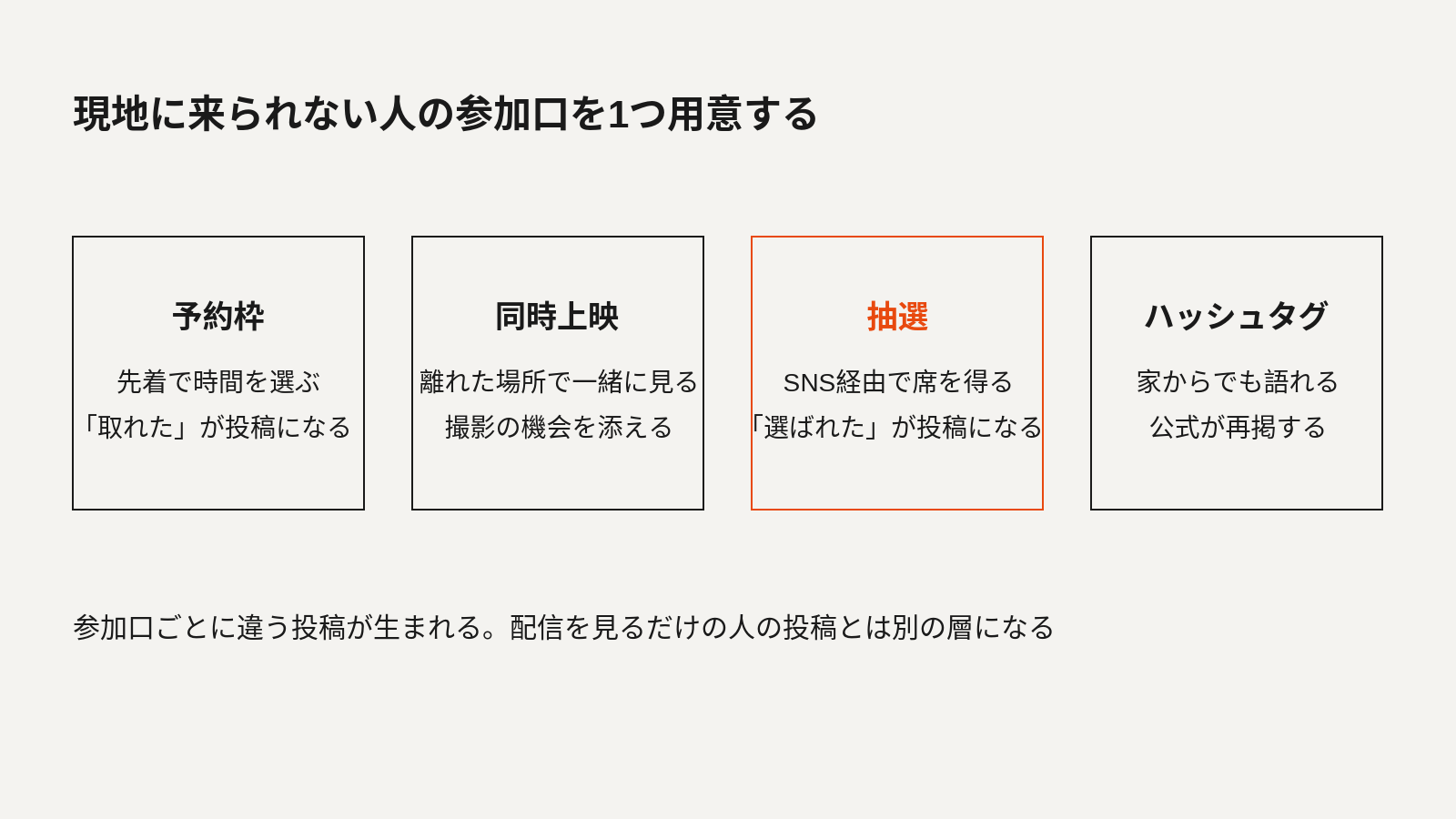
- Provide ways for people who can't come on-site to take part. Through reservation slots, simultaneous screenings, lotteries, or hashtags, let "people who couldn't come" join the conversation too
- Decide whether to place it before or after the stream. Placed before, it becomes a teaser for the stream; placed after, it becomes a place for viewers to reconfirm what they saw
- Decide in advance which scenes will be photographed on-site. For example, with a photo spot recreating a scene from a video, settle on one composition that resonates with people who watched the same video, and leave everything else open
Scope of This Article
This article interprets the structure of the 3 campaigns based solely on what is stated in published reports and official announcements. It does not cover visitor numbers, post counts, or impact on sales. For the Indian campaign, the implementation date and public response are not described in the articles, and the Shibuya pop-up had not yet taken place at the time of the article. "Why it got talked about" is our own interpretation, not the official view of each company.
Conclusion
The model for turning stream viewers into people who show up in person starts with choosing "one thing to bring out" from the stream's content. If you bring out a concept or a world without relying on people, the design is unaffected by any individual's schedule. We encourage you to review your own streams and videos for elements that can be recreated on-site.