Do Posts by Ambassadors, Employees, and Store Staff Need a PR Label?
This article was automatically translated from the Japanese original. Read the original in Japanese

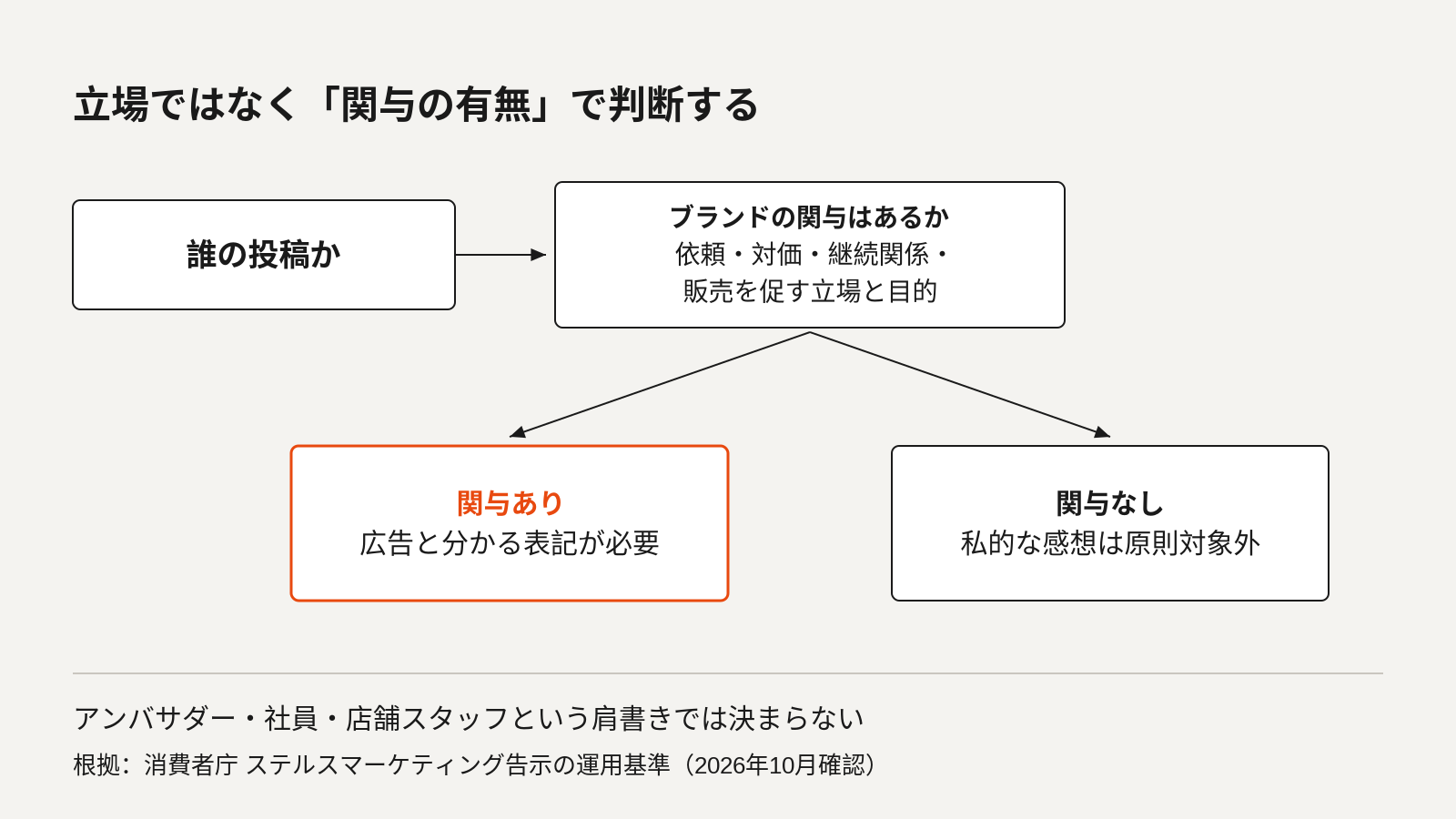
Whether a post by an ambassador, employee, or store staff member needs a PR label is not determined uniformly by the person's position. It depends on whether the brand is involved in the content of the post. When a person who has been commissioned, is compensated, or is in a position to promote sales posts in order to sell, the post is treated as the brand's own advertising, and a label making clear that it is an advertisement is required. The basis for this is the notification on stealth marketing under Japan's Act against Unjustifiable Premiums and Misleading Representations, together with its operating standards (Consumer Affairs Agency guidance, checked October 2026).
| Case | Label required? | Reason |
|---|---|---|
| An ambassador posts under a contract or after receiving products | Required | There is a commission or compensation, and the brand is involved in deciding the content |
| An executive, manager, or member of a team involved in sales or development posts to promote a product | Required | A representation by a person in a position to promote sales is treated the same as the brand's own representation |
| Store staff introduce a product from a personal account as part of their work | Required | They are promoting sales as part of their duties, and the brand is involved |
| An employee in a department unrelated to sales privately shares an opinion based on information anyone can know | Generally not required | They are not in a position to promote sales, and the post is not intended to promote sales |
| Posts from the brand's official account or the store's official account | Label usually not required | It is visually clear who is posting, so it can be recognized as advertising |
| A business partner (such as a retailer) posts at the brand's request | Required | Even if made by a third party, a representation made at the brand's request becomes the brand's representation |
Why judge by "involvement" rather than position?
The stealth marketing regulation targets content that looks like a third party's post but is actually the brand's advertisement. The Consumer Affairs Agency's operating standards (checked October 2026) set out the approach that a post is treated as the brand's representation when the brand is recognized as having been involved in deciding its content.
Therefore, even among "employees," a post made by someone in a position to promote sales with the aim of spreading awareness of a product requires a label, while a personal opinion written privately by someone not involved in sales, based on information anyone can know, is generally not covered. For ambassadors too, the judgment depends not on the title but on whether there is a relationship such as a contract or product provision. For how the regulation targets the brand side, see Who Is Subject to the Stealth Marketing Rules, and Are Brands Held Responsible?.
When does an ambassador's post require a label?
The basic principle is that posts about the brand made during a period in which there is compensation, such as a contract, product provision, or event invitations, require a label. The operating standards state that compensation includes not only money and goods but also economic benefits such as event invitations. Also, even if the brand has not explicitly asked for a post, it may be treated as the brand's representation if, given a relationship that has continued from the past or the prospect of future transactions, the post cannot be called the person's own voluntary one.
For example, during a one-year ambassador contract, the person may casually pick up and photograph the product in an everyday post that is not covered by the contract. Even in this case, as long as the contractual relationship continues, the brand's involvement is easily suspected, so adding a label makes things clearer for readers. For the ambassador model of casting, see What Is an Ambassador? Differences from One-Off Sponsored Collaborations and Suitability.
Where should the line be drawn for employees and store staff?
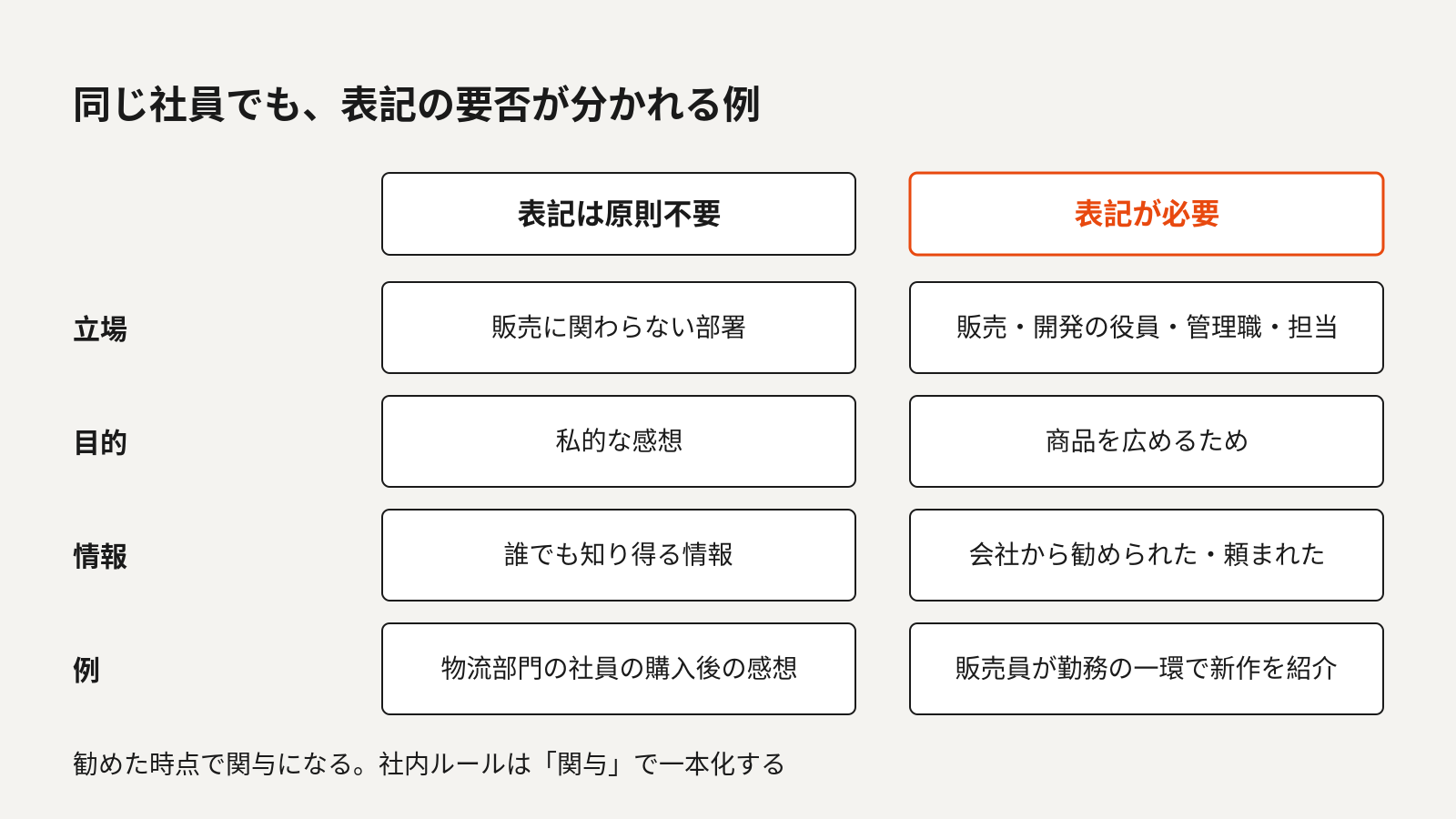
There are two guidelines for drawing the line: whether the person is "in a position to promote sales," and whether the post is "made for the purpose of promoting sales." The operating standards cite as an example of the brand's representation a case in which an executive, manager, or member of a team involved in sales or development posts to spread awareness of a product.
For example, when a sales associate at a cosmetics brand introduces a new product from a personal account as part of their work, it is treated as the brand's representation, and it should be written in a way that makes clear it is an advertisement and shows the relationship with the brand. On the other hand, when a logistics department employee privately writes an opinion, based on information anyone knows, about a product they bought in store after release, it is generally outside the scope. However, if the company encouraged the post, then there was involvement.
What should be defined in internal rules?
When PR and social media managers at a brand create internal posting rules, defining the following points reduces confusion.
- The range of departments and positions that count as being in a position to promote sales
- How to word the label when people in that range post about the company's products
- The procedure when the company encourages or requests a post (a label becomes necessary at the point of encouragement)
- The flow for request wording and label confirmation when asking ambassadors or business partners to post
- Who owns the rules, and when they will be reviewed
For how to choose label wording, see What PR Label Wording Is Sufficient?.
What are some common misconceptions?
The first is the belief that "anything on an employee's personal account is private, so no label is needed." Even on a personal account, if a person in a position to promote sales posts in order to sell, it is treated as the brand's representation.
The second is the belief that "everyone knows an ambassador's relationship with the brand, so no label is needed." Not all followers necessarily know about the contract, and the basic principle is to make it clear that each post is an advertisement. For the basic approach to labeling, see What Is a PR Label for Sponsored Collaboration Posts?.
Scope of this article
This article organizes guidelines for judgment by position, based on the approach in the Consumer Affairs Agency's notification and operating standards. It does not determine whether any individual post falls under the regulation. It also does not cover work rules on employees' private social media use, or expression restrictions under other laws, such as those for pharmaceuticals and health foods. If you are unsure, the safest course is to check the operating standards and the Consumer Affairs Agency's Q&A, and then consult a specialist.
Conclusion
Whether a PR label is needed is determined not by titles such as ambassador, employee, or store staff, but by whether the brand is involved in the post. Aligning your internal rules around a single principle, that posts involving the brand get a label, reduces both confusion on the front lines and misunderstanding among readers.