How Requesting Influencer Collaborations Differs Between Korea and Japan
This article was automatically translated from the Japanese original. Read the original in Japanese
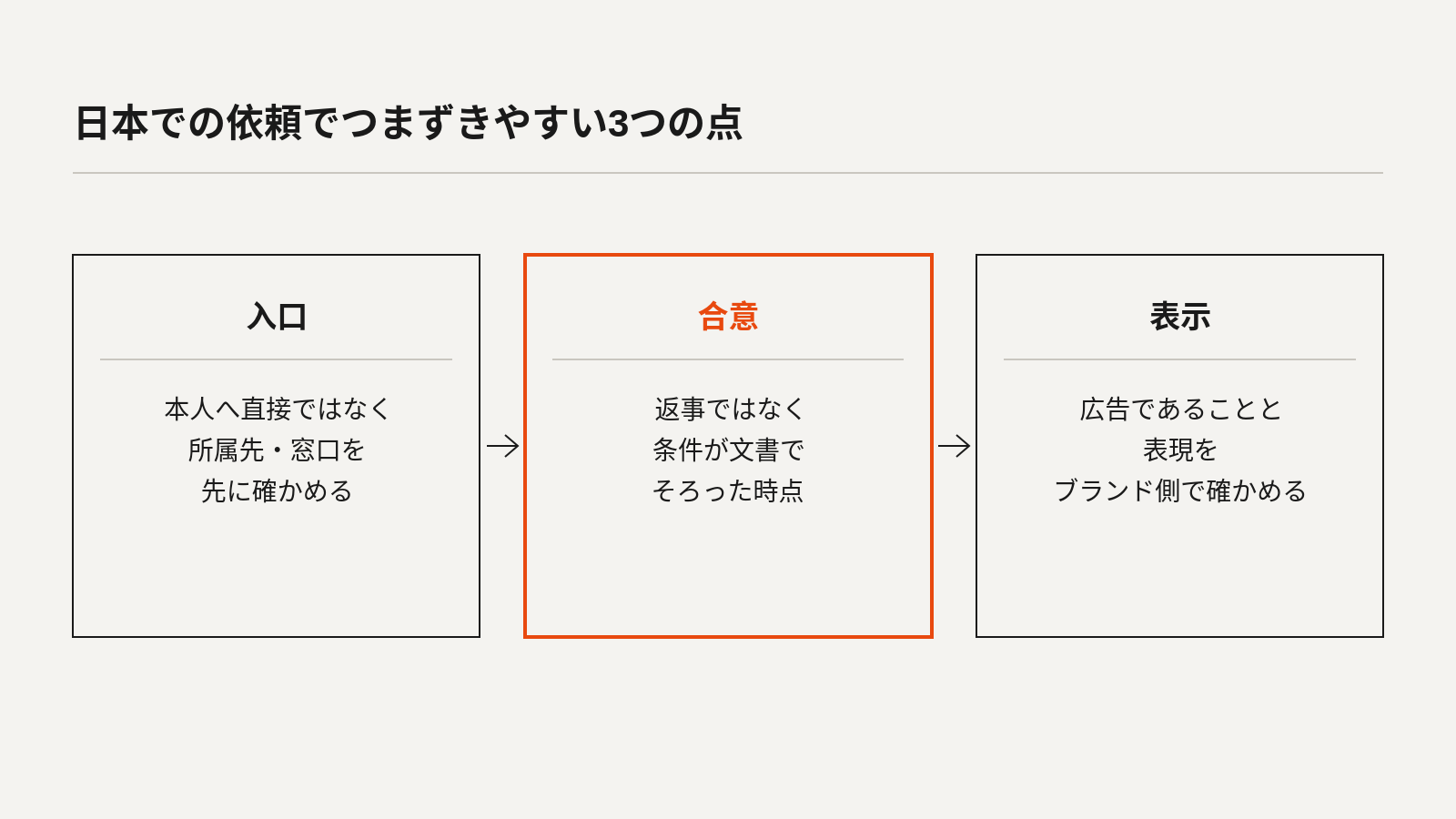
If you bring your Korean headquarters' way of working straight into Japan, three points tend to trip you up: "who to contact," "when to treat something as agreed," and "who checks the disclosure." In Japan, requests are built on confirming through the influencer's agency or contact channel, reaching agreement only after the terms are aligned in writing, and clearly labeling content as advertising. Headquarters' approach is not wrong; the underlying assumptions are simply different. The first job of the person in charge on the Japan side is to share those differences with headquarters up front.
| Situation | What headquarters often asks for | How it works in Japan | What to tell headquarters in advance |
|---|---|---|---|
| First contact | Contact the person directly, right away | Check whether there is an agency or contact channel, and if there is, reach out through it | Going through a contact channel adds days before a reply |
| Agreement | Proceed verbally or through brief exchanges | Align the post content, timing, disclosure, and secondary use in writing before treating it as agreed | Sending products before terms are aligned does not guarantee a post |
| Product provision | Send to many people at once | Confirm willingness to receive before sending, and separate optional posting from required posting | Optional provision and a post requested as a commission are different initiatives |
| Post review | Have headquarters' wording published as is | Check on the Japan side against Japanese disclosure and expression rules | Wording usable in the home country may not be usable in Japan |
| After posting | Use the materials in ads and on sales pages | Set the scope and period for secondary use and obtain permission beforehand | Anything added later requires a new request |
Why Do You Need to Confirm the Point of Contact on the Japan Side?
In Japan, many people belong to an agency or have a separate contact channel for work. Even if you send a request directly to the person's account, if a separate channel exists you will have to contact them again through it. Getting the entry point wrong not only delays the reply but also puts unnecessary burden on the other party.
For example, suppose that three weeks before launch, headquarters sends a list saying, "Please contact these 20 people this week." The first task on the Japan side is not to send the message but to confirm the contact channel for each of the 20. You check whether a business contact is listed on the profile and whether the person has an agency, then sort out where each message should go. Simply having this step included in headquarters' schedule prevents most later delays. For how to think about the time from request to agreement, see How Much Lead Time Should You Allow from Casting Request to the Person's Agreement?.
At What Point Is an Agreement Considered Established?
In Japan, an agreement is considered established when four points are aligned in writing: the post content, the posting timing, the disclosure that it is advertising, and secondary use of the materials. A reply saying "I'm interested" is not an agreement; it is the start of consideration.
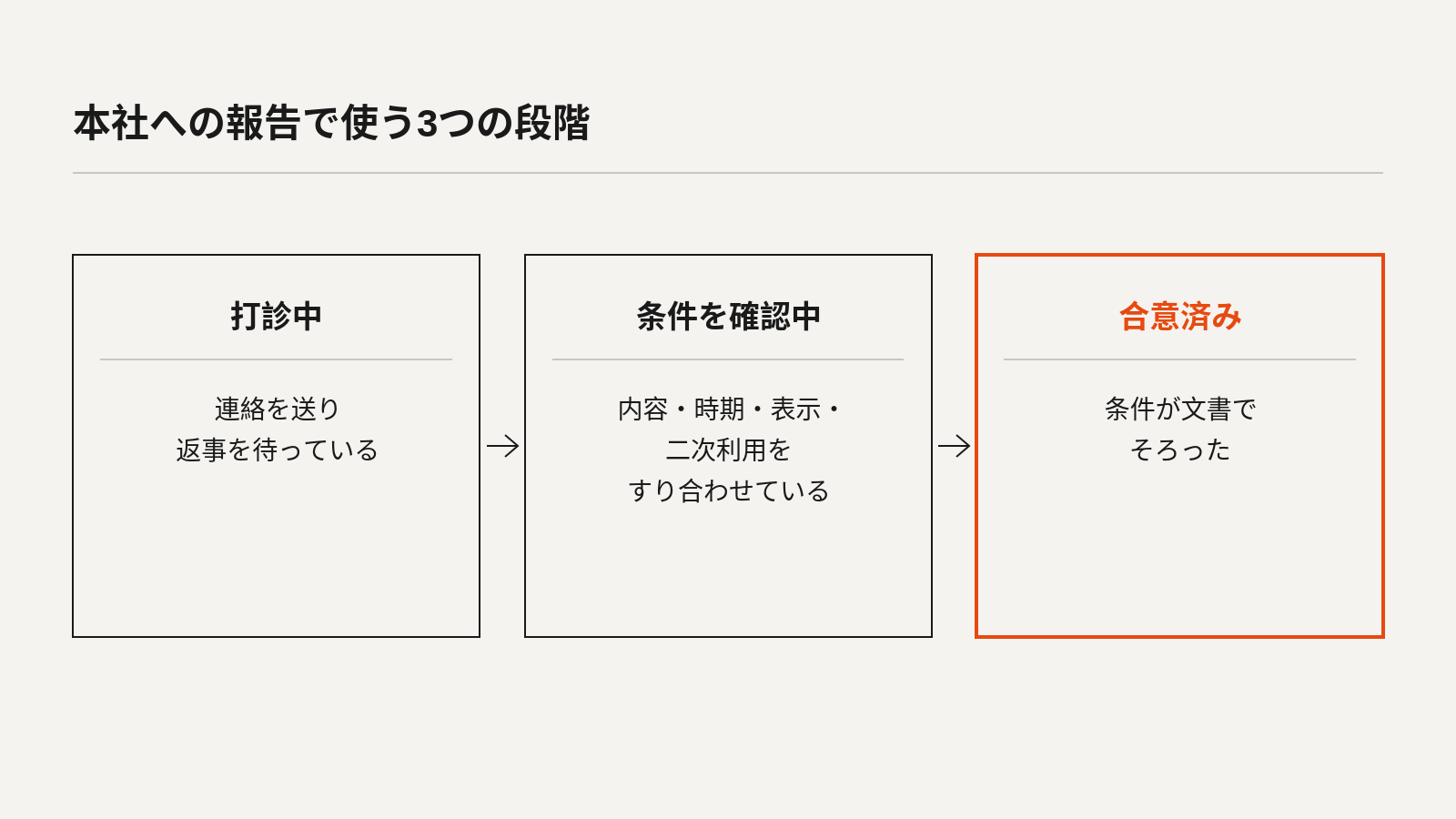
This is where discrepancies in reports to headquarters tend to arise. If headquarters takes "a reply came in" to mean "it's decided," plans that assume a posting date or use of the materials move ahead prematurely. If the Japan-side contact divides the wording of reports into three stages, "under inquiry," "confirming terms," and "agreed," understanding with headquarters stays aligned. If a plan advanced before terms were settled and then fell through, the cause lies not with the other party but with the approach that failed to align on the definition of agreement.
How Should Product Provision Be Separated from a Request?
Provision that does not promise a post and a request that asks for a post are designed as separate initiatives. With provision that does not promise a post, the recipient introduces the product at their own discretion if they like it, and it may not be posted about at all. If a post is the premise, communicate the terms as a request from the start.
For example, suppose a new cushion foundation is sent to many people and the number of posts is to be reported to headquarters. It is natural for there to be a gap between "the number sent" and "the number posted." Tell headquarters beforehand that provision is an entry point for building relationships and not a promise of any number of posts. The basics of provision are summarized in What Is Gifting? Differences from Sponsored Collaboration and When Each Fits.
Who Checks Disclosures and Expressions, and How Far?
The responsibility for checking lies with the brand. In Japan, since October 2023, the Act against Unjustifiable Premiums and Misleading Representations has regulated advertising that conceals the fact that it is advertising, and the regulated parties are the businesses that provide the products or services (Consumer Affairs Agency guidance, confirmed October 2026). For posts made following a request or product provision, ask for a disclosure that makes clear it is advertising, and check it on the Japan side before publication.
For cosmetics, you also need to be careful with how efficacy is phrased. Expressions used on the home-country sales page may not be usable as is in Japan. Rather than passing along the marketing copy from headquarters unchanged, rewrite it into phrasing usable in Japan before sharing it. For how to think about expression in the beauty category, see Influencer Marketing in the Cosmetics and Beauty Industry, and for how to think about casting for Korean cosmetics, see this page.
When Should You Start Moving to Match a Launch?
Start working backward as soon as headquarters' launch date is set. The things that take time first on the Japan side are three: confirming contact channels, putting terms in writing, and revising expressions. None of these is easy to shorten once the launch date is close.
- Once candidates are decided, confirm the entry point for contact
- Prepare a terms document for Japan and a list of expressions usable in Japan
- Make the inquiry and move toward agreement while confirming terms
- Deliver products and materials to those who have agreed
- Check disclosures and expressions before publication, and compile the results after posting
If headquarters' schedule is shorter than the Japan-side process, discuss with headquarters whether to narrow the number of people or to start with provision that does not promise a post. Trying to force it to meet the date by skipping the checking steps leads to corrections or takedowns after publication, and you end up losing more time.
Scope of This Article
This article organizes how to proceed with requests in Japan for the Japan-side contacts of Korean brands. It does not cover practices or laws in Korea themselves, as they go beyond what can be compared on solid grounds. It also does not cover judgments on whether an individual post complies with Japanese law.
In Closing
The Japanese way of working is not slow; the order of confirmation is simply fixed. If you share the three points of entry, agreement, and disclosure with headquarters first, your launch plan will fit reality.