What Is Influencer Casting? How It Works and the Request Process [Basics Explained]
This article was automatically translated from the Japanese original. Read the original in Japanese

Influencer casting is the work of selecting influencers who fit a brand or service, then handling everything from negotiation to managing the execution of posts. It's not just about deciding "who should post"—it refers to the entire process, from organizing requirements through to reviewing results.
What this article covers:
- How far the scope of casting work actually extends
- The standard flow from request to completed posts
- What determines whether an initiative succeeds or fails
The Scope of Casting Work
When people hear "influencer casting," many picture it as simply "finding people who seem like a good fit and reaching out to them." In reality, that's just a small part of the overall process. The work we do day to day breaks down into six major areas.
① Requirements definition: We align with the brand on who they want to reach and what message they want to deliver. This is where we put into words the target age group, interests, the platforms they want posts on, and expressions to avoid. ② Candidate selection: We cast a wide net for candidates who fit the requirements, then compile a list after checking not just follower counts but actual engagement levels and past post content. ③ Negotiation and contracting: We align on terms and formalize post content and publication timing as a contract. ④ Post direction: We create a brief that conveys the brand's intent and oversee the post content. ⑤ Execution management: We check that posting timing and PR disclosure labeling are appropriate. ⑥ Reporting: We compile the post results and share them with the brand.
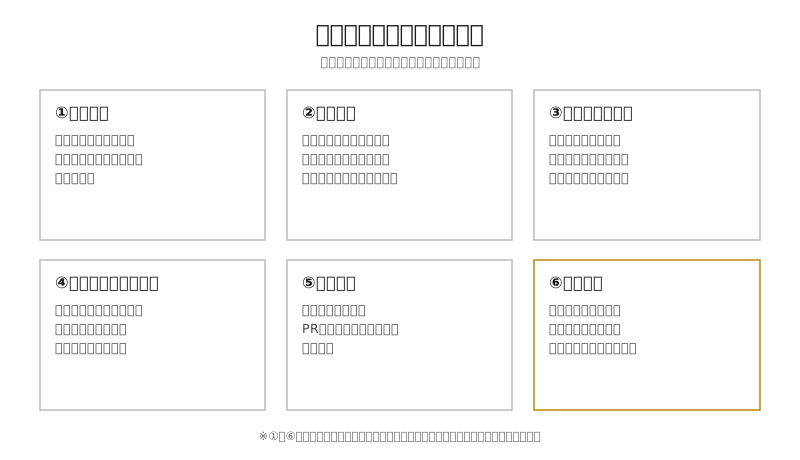
Of these six areas, only part of ② is visible from outside the agency. If candidate selection begins while requirements are still vague, the brand's intent and the actual post content diverge later on, leading to more back-and-forth revisions. Put another way, the more time spent on requirements definition upfront, the more smoothly the later stages proceed. The reason we prioritize hearing out requirements before presenting a candidate list is that misalignment at this stage directly affects the final quality of the posts.
Moreover, these six tasks aren't independent—the outcome of each step becomes the premise for the next. Information missed during candidate selection can become a source of trouble at the negotiation stage, and if post direction remains vague, gaps emerge during execution management that a simple PR-labeling check can't catch. That's precisely why we place importance on having the same team oversee all six steps as a continuous flow, rather than dividing them among separate staff.
The Flow From Request to Completed Post
From the client's perspective, the standard flow consists of the following six steps.
- Consultation — You share your objectives, the product or service, and an image of who you want to reach. It's fine if some details aren't fixed yet—we'll help you work them out.
- Requirements organization — Together, we organize the target demographic, the platforms you want posts on, the visual style and tone you'd like to reference, and expressions to avoid. Sharing past post examples or brand guidelines at this stage helps improve accuracy.
- Candidate list proposal — We present a list of candidates. You review each candidate's profile and past post content and provide feedback.
- Selection and negotiation — You choose the final candidates, and we handle negotiating the terms of engagement and the contracting process.
- Execution — We conduct the briefing, check content before posting, and confirm PR disclosure labeling and visibility after posting.
- Reporting — We compile the post results and share them for review.
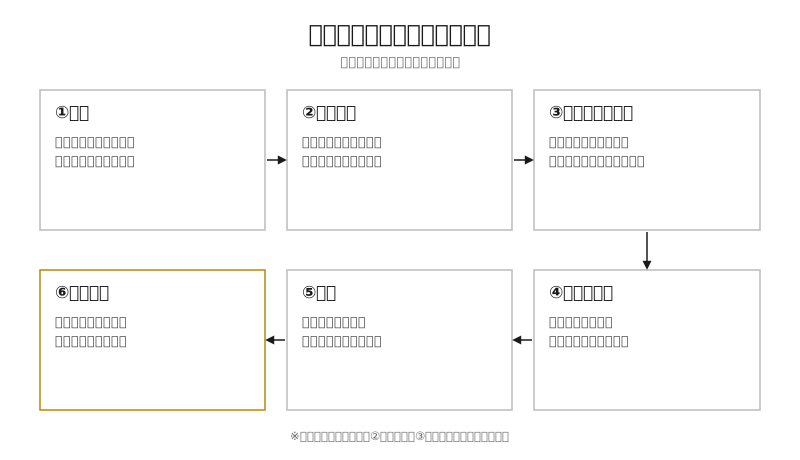
Steps 2 and 3 place the greatest demands on the client. The level of detail you provide here directly determines the precision of the candidate list. Conversely, if you take the time needed at these two stages, the selection, negotiation, and execution that follow proceed remarkably smoothly.
Step 6 exists to ensure the process doesn't simply end once the post goes live. By reviewing the post-publication response and whether the content reached the intended audience together with the brand, requirements organization for the next request becomes more precise. We recommend designing the flow with the assumption that it will feed into future engagements, rather than treating each project as a one-off.
Success or Failure Is Largely Decided at the List Stage
Based on our experience across a large number of projects, whether an initiative succeeds or fails is largely determined at the candidate list stage. That's because there's only so much adjustment that can be made after a post has already gone live.
What determines the quality of a list isn't follower count. Our performance data shows that engagement rates can vary significantly even among influencers with similar follower counts (for more detail, see How Much Does Engagement Rate Vary Within the Same Follower Range?). Building a list based on follower count alone tends to result in actual engagement falling short of expectations.
Another key factor is the overlap between an influencer's audience and the demographic the brand wants to reach. If followers' interests or age group don't match the brand's target, the post reaching the wrong audience will happen regardless of how polished it looks. In addition, whether the influencer's own content style aligns with the brand's aesthetic affects how natural the post feels. When this alignment is off, a post can go live successfully yet still fail to deliver results. We discuss why this kind of mismatch occurs in more detail in When Sponsored Collaboration Results Don't Add Up.
It's only when both requirements precision and careful judgment during candidate selection are in place that the subsequent negotiation and post direction can function effectively. If either one is lacking, no amount of careful contracting or post direction can fully recover the results.
Frequently Asked Questions
Is there a minimum follower count required to make a request?
There's no fixed minimum. What matters more than follower count is the overlap with your target audience and the actual state of day-to-day engagement. A candidate with fewer followers but strong audience overlap can sometimes deliver better results than one with more followers but a mismatched audience.
How long does it take from request to completed post?
The timeline varies depending on the scale of the project and the number of candidates involved. Candidate selection requires time to refine the accuracy of the list, and after selection, negotiation, briefing, and pre/post-publication checks all follow. The more schedule buffer you allow, the more time you have to compare candidates, which ultimately reduces the risk of mismatches.
What's the difference from gifting?
Gifting involves providing a product or service without requiring a post in return. Even without a posting obligation, our data shows that a significant number of posts actually occur (for more detail, see What Percentage of Gifting Actually Results in a Post?). Influencer casting, on the other hand, is an initiative where post content and publication timing are formalized as part of a contract. Which approach to use depends on how much certainty you need.
Can I request multiple influencers at the same time?
Yes. In fact, combining multiple candidates lets you reach several distinct audience segments with different follower bases. As the number of candidates increases, so does the importance of assessing how well each individual's style overlaps with the brand, meaning the precision of your requirements definition has an even greater impact on the overall quality of the list.
About Us
STATS INC. (Stats Corporation) is an influencer casting company focused on Instagram, YouTube, and TikTok. Combining a discerning eye for brand aesthetics with objective data backed by performance records, we have supported casting and PR event production for more than 240 brands, including international luxury brands.