What Is Gifting? How It Differs from Sponsored Collaboration and When Each Fits [Basics]
This article was automatically translated from the Japanese original. Read the original in Japanese

Gifting is an approach in which a brand sends products or services to an influencer and leaves the decision of whether to post up to the influencer. A sponsored collaboration is an approach in which the brand requests a post, with its content and timing agreed in advance. The difference lies in "what is promised." If you need certainty about the content and timing of posts, a sponsored collaboration is the better fit. If you value having influencers speak in their own natural words, gifting is the better fit.
| Axis | Gifting | Sponsored collaboration |
|---|---|---|
| Contract | Posting is not a condition | Posting is agreed as a condition |
| Involvement | After delivery, left to the influencer's interpretation | A brief and advance review are included |
| Certainty | Post content and timing are not promised | Content and timing are aligned in advance |
| Control over worldview | Appears naturally within the influencer's own content | Makes it easier to reflect the image you want to convey |
| Suited goals | UGC and building broad touchpoints | New product announcements and attitude change |
Definition: Gifting and sponsored collaboration differ in what they promise
Gifting is an approach in which a brand provides products or services to an influencer and leaves the decision of whether to post up to that person. Its defining feature is that posting is not a condition, and how the influencer receives the product after delivery is entirely at their discretion.
A sponsored collaboration, on the other hand, assumes that the influencer will post, and the post content, publication timing, and other details are set out in a contract. What will be posted, when, and how are aligned in advance before the project moves forward. The overall flow of influencer casting work is covered in [What Is Influencer Casting? How It Works and the Request Process [Basics]](https://statsworks.tokyo/insight/what-is-influencer-casting). In this article, we focus on sponsored collaboration as an approach for "requesting posts" and contrast it with gifting.
To organize this difference, we use four axes: "contract," "involvement," "certainty," and "control over worldview." Contract and involvement relate to the design of the approach itself, while certainty and control over worldview are outcomes that arise from that design. Let's look at each in turn.
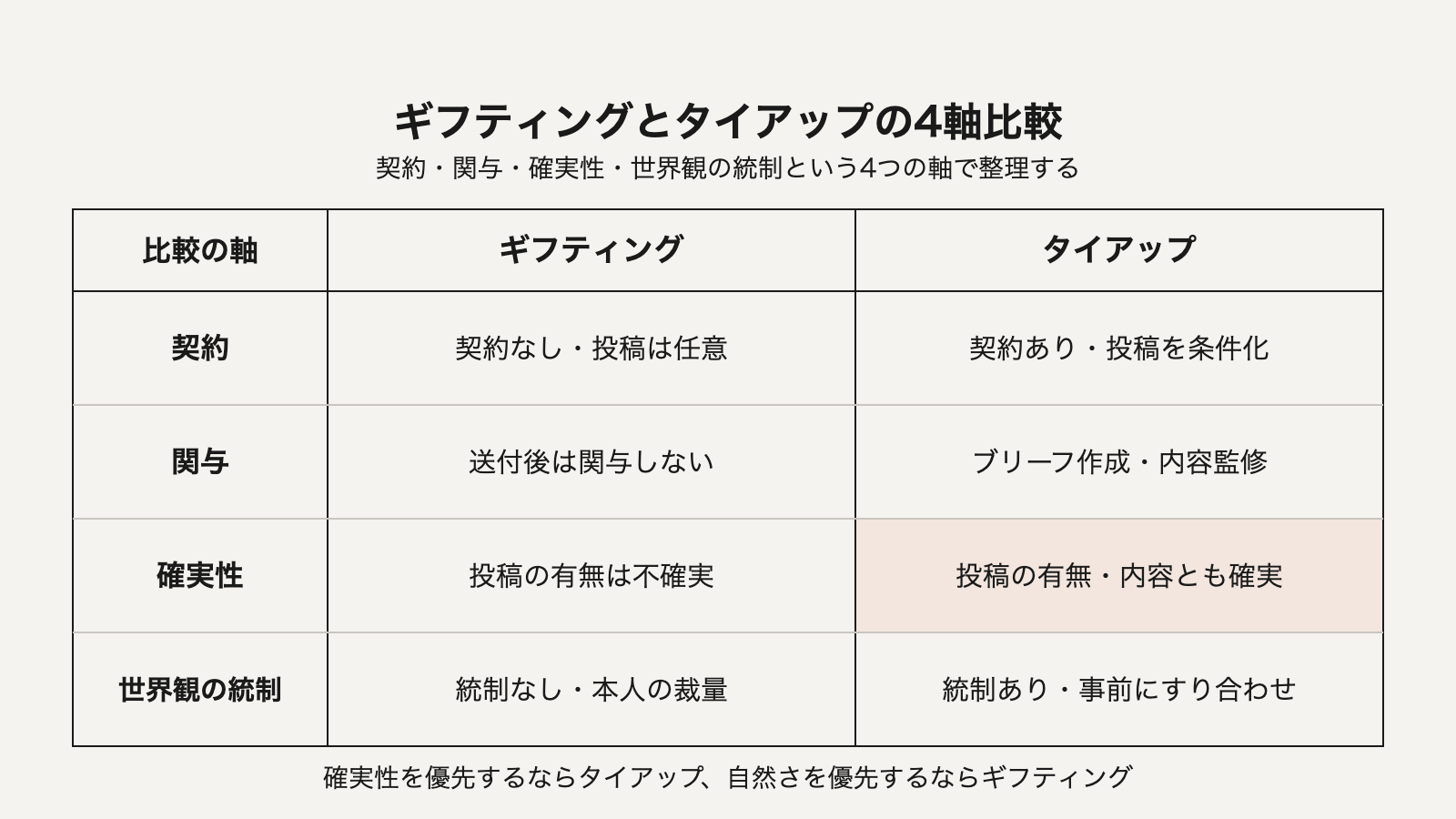
Figure 1: Four-axis comparison of gifting and sponsored collaboration
Whether a contract exists determines the certainty of posting
The biggest difference is whether posting is promised in a contract. Because a sponsored collaboration includes posting as a contractual condition, the certainty that a post will happen is high. Gifting, by contrast, does not promise posting, so there is no guarantee that a delivered product will lead to a post.
However, lack of certainty does not mean posts won't happen. In Of Gifting With No Posting Obligation, What Percentage Actually Gets Posted?, which compiles our own track record, 91% of gifted products were posted about even without a posting obligation. Even without the certainty a contract provides, the actual rate of posting is not low. For the differences from gifting that requires posting, see What Is the Difference Between Mandatory-Post and Optional-Post Gifting?.
That said, this figure does not guarantee "what will be posted." Even when an influencer does post about a gifted product, the content and angle are left to their discretion. On the axis of certainty, a sponsored collaboration can provide certainty about both "whether a post happens" and "what the post contains." Gifting, even when the certainty of "whether a post happens" is high, cannot provide certainty about "what the post contains."
The depth of involvement determines how far direction can reach
The flip side of whether a contract exists is the depth of our involvement. In a sponsored collaboration, a brief conveying the brand's intent is prepared, and post content can be reviewed in advance. The worldview you want to convey and the expressions you want to avoid are aligned beforehand, and a review step is added before the post goes live.
Gifting basically has no such step. After the product is delivered, how it is posted about is left to the influencer's interpretation. It's important not to see this difference as "inferior because we can't get involved." Not getting involved also means the influencer can speak in their own natural words and context. We believe gifting is valuable precisely because it is received as an extension of the influencer's everyday life rather than as a carefully crafted post.
Whether you need control over worldview determines which approach fits
The depth of involvement is directly tied to how much you can control the brand's worldview. In a sponsored collaboration, even the visual tone and the points to emphasize can be aligned in advance, making it easier to reflect the worldview the brand wants to convey in the post. This control pays off for new product launches and campaigns with a clearly defined context.
Gifting aims less at controlling the worldview than at having the brand appear naturally within the influencer's own content. Because control is limited, the result may not look exactly as intended, but it tends to reach the influencer's followers in a form that feels natural to them. Which one you need depends on which the brand wants to prioritize right now.
The right approach changes depending on your goal
Based on the three axes so far, the suitability for each goal becomes clear. Even for approaches that share the same premise of "sending products to influencers," the right choice changes depending on what you set as the goal.
If you want to spread awareness, both gifting and sponsored collaboration are options. When you want more influencers to know about the product, gifting, which involves no contract coordination, is easy to roll out widely. When you want to deliver your message reliably in an intended worldview, a sponsored collaboration is the better fit.
If you want to increase UGC (mentions in the form of posts), gifting is the better fit, because its value lies in having influencers speak in their own natural words. The more tightly you control post content, the less natural it feels as UGC.
If you aim for attitude change (deepening interest or favorable feelings), a sponsored collaboration is the better fit. Because the context and message you want to convey can be aligned in advance, you can present the brand from the intended angle. With gifting, even if the influencer posts, the post won't necessarily talk about the product from the angle you intended.
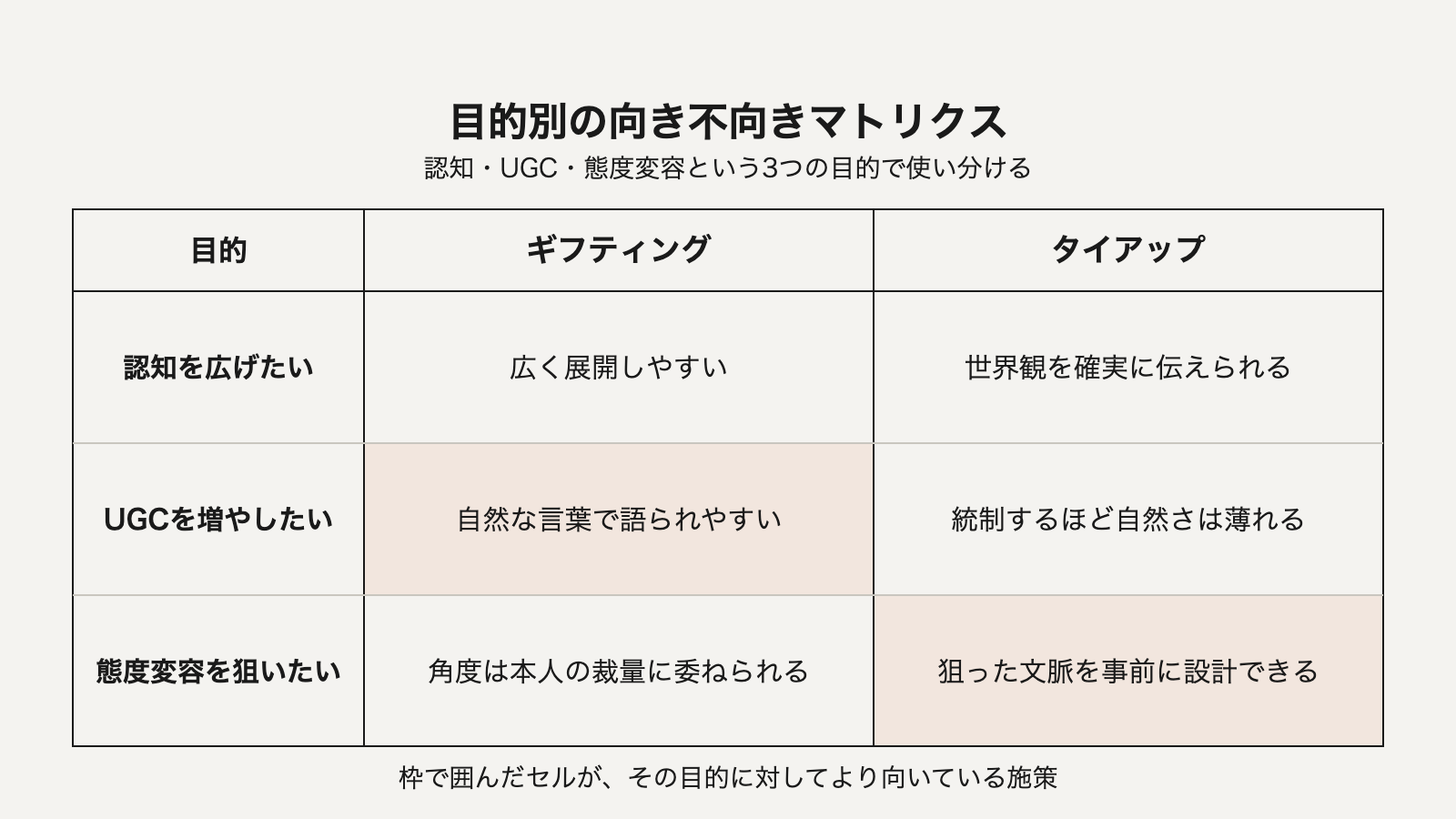
Figure 2: Suitability matrix by goal
The deciding point is whether you need certainty
When you're unsure which to choose, the first thing we check is a single question: "How much certainty do you need in advance about the content and publication timing of the post?" For the steps to work backward from your goal, see Gifting or Sponsored Collaboration: A Blueprint for Choosing Based on Your Goal.
For initiatives where the context and timing you want to convey are clearly set, such as a new product launch announcement, a sponsored collaboration that can provide certainty is the better fit. On the other hand, when you want to build touchpoints with a broad range of influencers, or let people learn about the brand's existence in a natural way, gifting gives you more flexibility.
There is also a difference in scale. Sponsored collaborations involve contracts, and coordinating with each person takes time, so the number of influencers you can engage at the same time is limited. Because gifting involves no contract coordination, it is easier to roll out to many influencers at once. This does not mean, however, that careful selection is unnecessary. Carefully choosing who receives what is just as necessary in gifting as in sponsored collaborations. The importance of selection in sponsored collaborations is covered in When Sponsored Collaboration Results Don't Add Up, What's Going On? The Anatomy of Casting Design Failures, but the point that careful selection shapes results applies equally to gifting.
Scope of this article
This article focuses on the structural differences between the two approaches, gifting and sponsored collaboration. It does not cover how to choose the products to send, how to design the timing of shipments, or the specifics of follow-up after posting. Legal issues such as the rules on disclosure related to stealth marketing are also outside its scope (for how to think about PR labeling in optional-post gifting, see Is PR Labeling Required Even for Optional-Post Gifting?). We also do not touch on how to design a program that combines both approaches. This article is written on the premise that individual program design is considered case by case, according to each project's goals and the brand's circumstances.
Conclusion
Gifting and sponsored collaboration are not approaches to be ranked as better or worse; they are two approaches that differ in what they promise. Deciding whether to prioritize certainty or naturalness in light of your goal at hand is the starting point for choosing an approach. When in doubt, start by asking yourselves, "How much certainty do we need about the content and timing of the post?"