SNS Activation Case Studies: Why Three Campaigns That Borrowed a Familiar "Format" Drew Such Strong Responses
This article was automatically translated from the Japanese original. Read the original in Japanese
What the three campaigns have in common is that each borrowed a "format" the audience already knew, as is, and added just one brand element to it. People who know the format understand the situation without any explanation, and they can join the conversation on their own, whether by playfully poking fun or by asking for a sequel. SNS activation means designing an experience all the way through to the point where it gets talked about on social media. These three examples offer material for thinking about which format to borrow in order to get a response.
| Country/Region | Industry | What they did | What got people talking on social media | Source |
|---|---|---|---|---|
| Not stated in the article | Language-learning app | On the launch day of a new smartphone, handed out apples bearing the mascot's image near the line outside a store | The combination of a launch-day line and a fruit stand, a scene everyone recognizes | Marketing-Interactive |
| North America | Cosmetics | Before Halloween, released a short video based on a drama about witch sisters | A nostalgic drama format combined with a parody of how younger generations speak | Marketing Dive |
| Japan | Dating app | Announced the "opening" of a fictional university and ran the official account like a university | The way people talk about exams and studying, plus the university setting | AdverTimes |
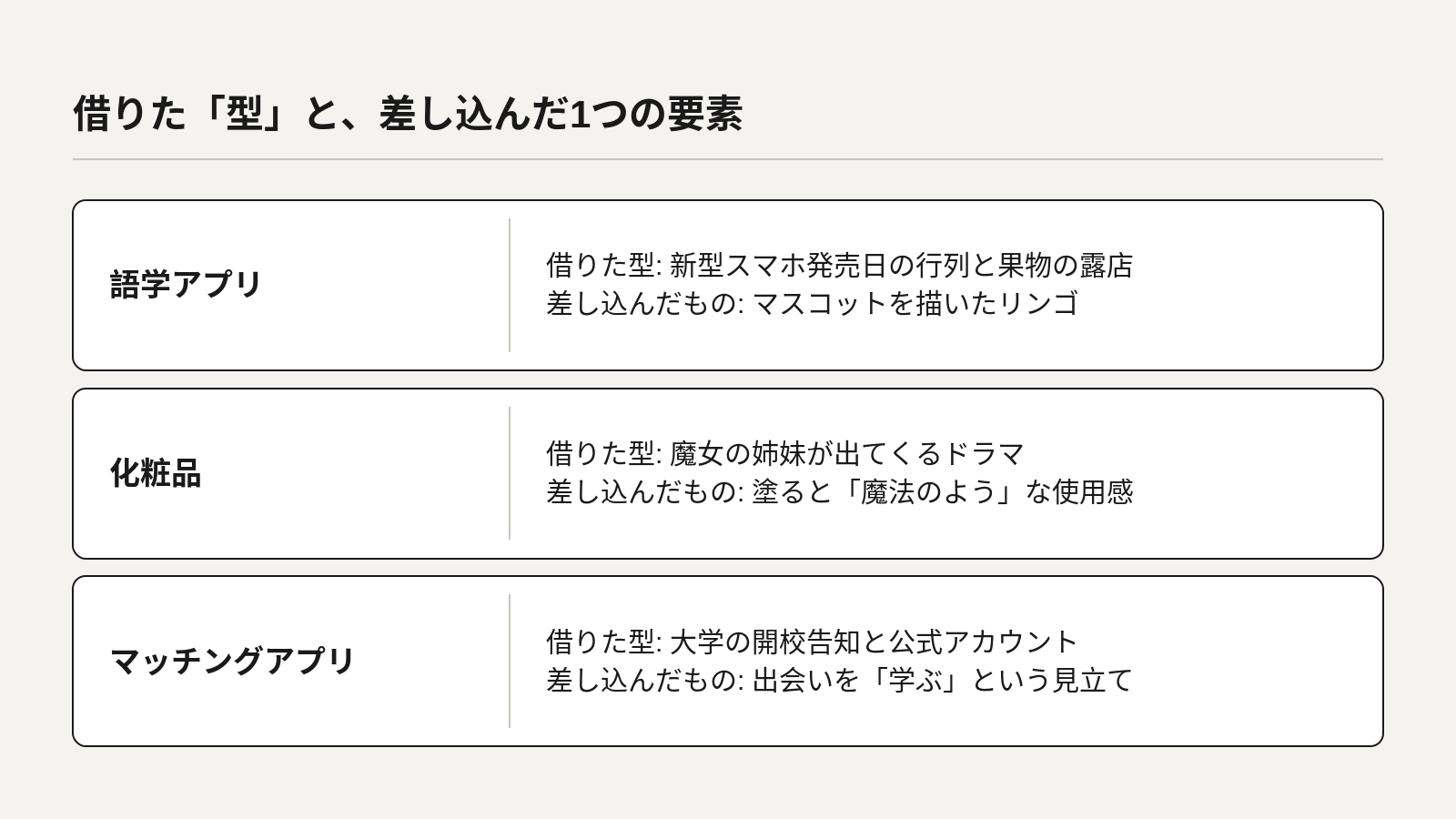
Case 1: An apple stand beside the launch-day line
On the weekend that included a new smartphone's launch day, Duolingo placed an apple cart a few meters from the line that had formed in front of a retail store. The mascot character handed out green apples as "Free Apple Duo." Each apple carried a sticker of the mascot drawn in the shape of an apple, along with a message encouraging lessons and a QR code. On Instagram, the brand posted photos from in front of the store and also displayed a poster showing the mascot on the screen of the new device.
The formats borrowed here are "the launch-day line" and "the fruit stand." A launch-day line is a scene that everyone photographs and talks about that day. Layer the old format of a fruit stand on top of it, and viewers notice for themselves that the manufacturer's name and the name of the fruit are the same. People who notice want to tell someone else. Because the brand didn't spell it out, the people who noticed become the storytellers.
Case 2: Borrowing a witch-sisters drama for a new video
To introduce its cream blush and stick bronzer, E.l.f. released a short, drama-style video before Halloween. It was based on overseas dramas and films featuring witch sisters. Young actors play sisters who believe they can work magic through the products, and the video layers the atmosphere of the 1990s through the Y2K era with a parody of how younger generations speak. The inspiration is explained as customers describing how the products feel to use as "magical." The video was published on the brand's own video and social media accounts, and reports say viewers in the comments called for it to become a series.
The format borrowed here is "a drama about witch sisters." Generations who know the format can respond with nostalgia, and those who don't can respond to the parody-style language. The one element added was simply the feeling of "it's like magic when you apply it," and the product explanation is contained within the drama's plot. The calls for a sequel can be read as evidence that the format came across to the audience.
Case 3: A dating app opens a fictional university
In July 2026, Tinder announced the opening of "Tin University" on its official X account, and has continued to run the account as if it were a university's official account. From September to October, it also ran outdoor ads around the station where the university is said to be located. Starting from the contrast that "studying has right answers, but dating doesn't," it casts the app as a university where people learn how to relate to others through meeting people.
The formats borrowed here are "the university" and "the way people talk about exams and studying." According to reports, the aim was to prompt playful reactions even from people who don't usually talk about the app. Because everyone knows the conventions of a university, such as admission, lectures, and credits, audiences can use those conventions to joke back. The conventions of the format become a handle for participation.
Why does borrowing a familiar format make responses more likely?
With a familiar format, the audience already has an expectation of what comes next. The three campaigns played the format out to the end, following that expectation, and inserted only the brand element. Because the audience doesn't have to work to understand the format, they can direct their remaining attention to the one inserted point.
The other point is that the format teaches the audience how to respond. They can respond to a line with photos, to a drama with requests for a sequel, and to a university with jokes about admission and credits. A campaign where people know how to respond is easier for them to join. We cover designs that subvert expectations in Why were three campaigns that subverted audience expectations on just one point talked about?
What to decide when applying this in Japan
- Choose a format your intended audience will understand without explanation (an event, a TV show, a school, a store format, etc.)
- Narrow the inserted element to one point tied to a strength of the product
- Don't break the conventions of the format; play it out to the end
- At the planning stage, anticipate how the audience can respond (photos, jokes, requests for a sequel)
- If you overlay another company's product or event, check that the expression doesn't put the other party down
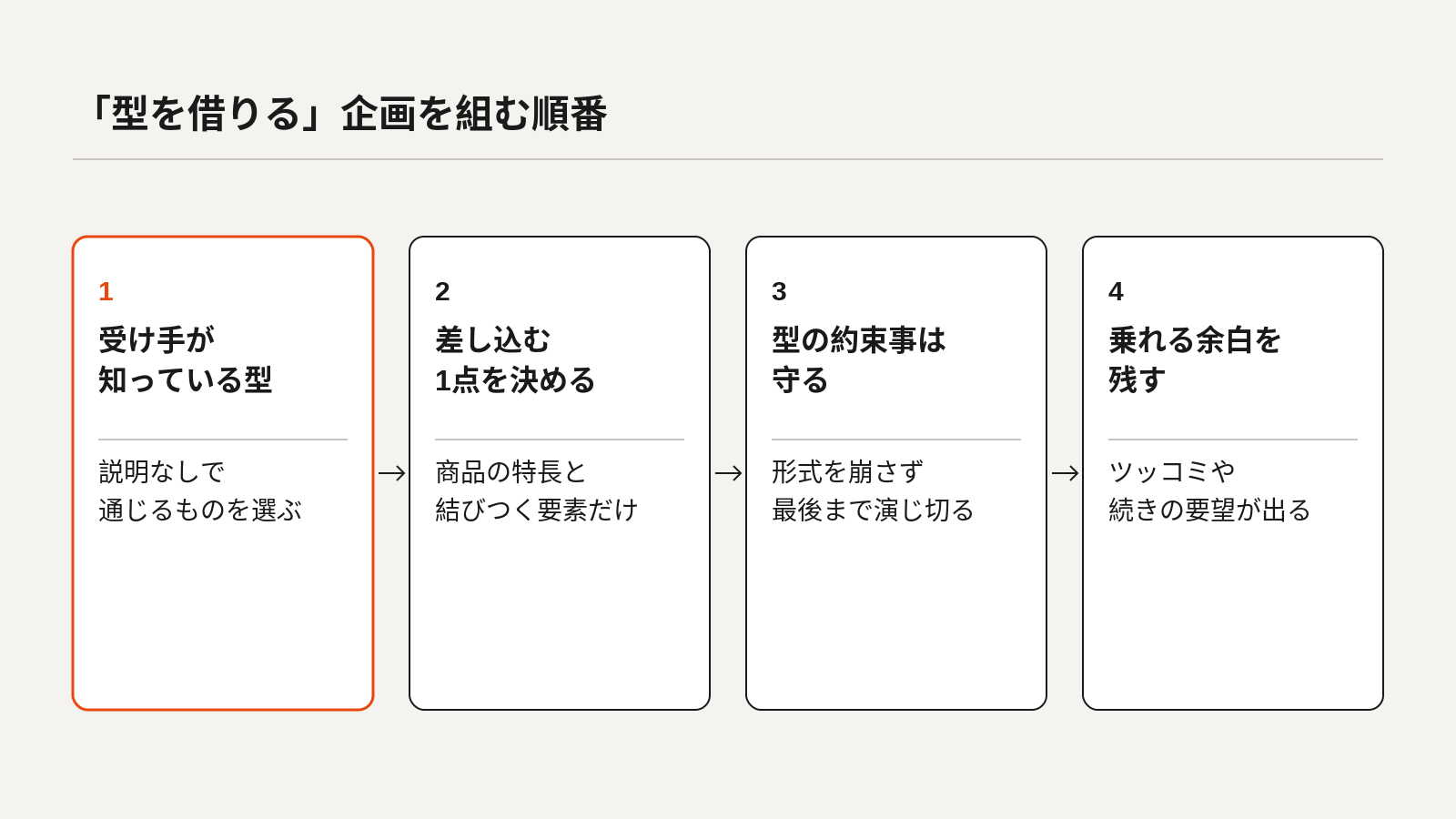
These five points are concrete examples of the "design for getting talked about" outlined in What is SNS activation? How we approach the design process is summarized on our service page.
Scope of this article
Based on facts in published reports, this article breaks down the structure of the three campaigns. It does not cover the figures for each campaign's results, costs, or details of statements by those involved. There is no intent to rank the campaigns; we only organize the structure of "why responses come more easily."
Conclusion
A campaign that borrows a format relies not on eccentricity but on knowledge the audience already has. Deciding which format to borrow and what single element to insert is the starting point for a campaign that gets responses.