How to Make a Pop-Up Spread on Social Media: Where to Focus Your Venue Design
This article was automatically translated from the Japanese original. Read the original in Japanese
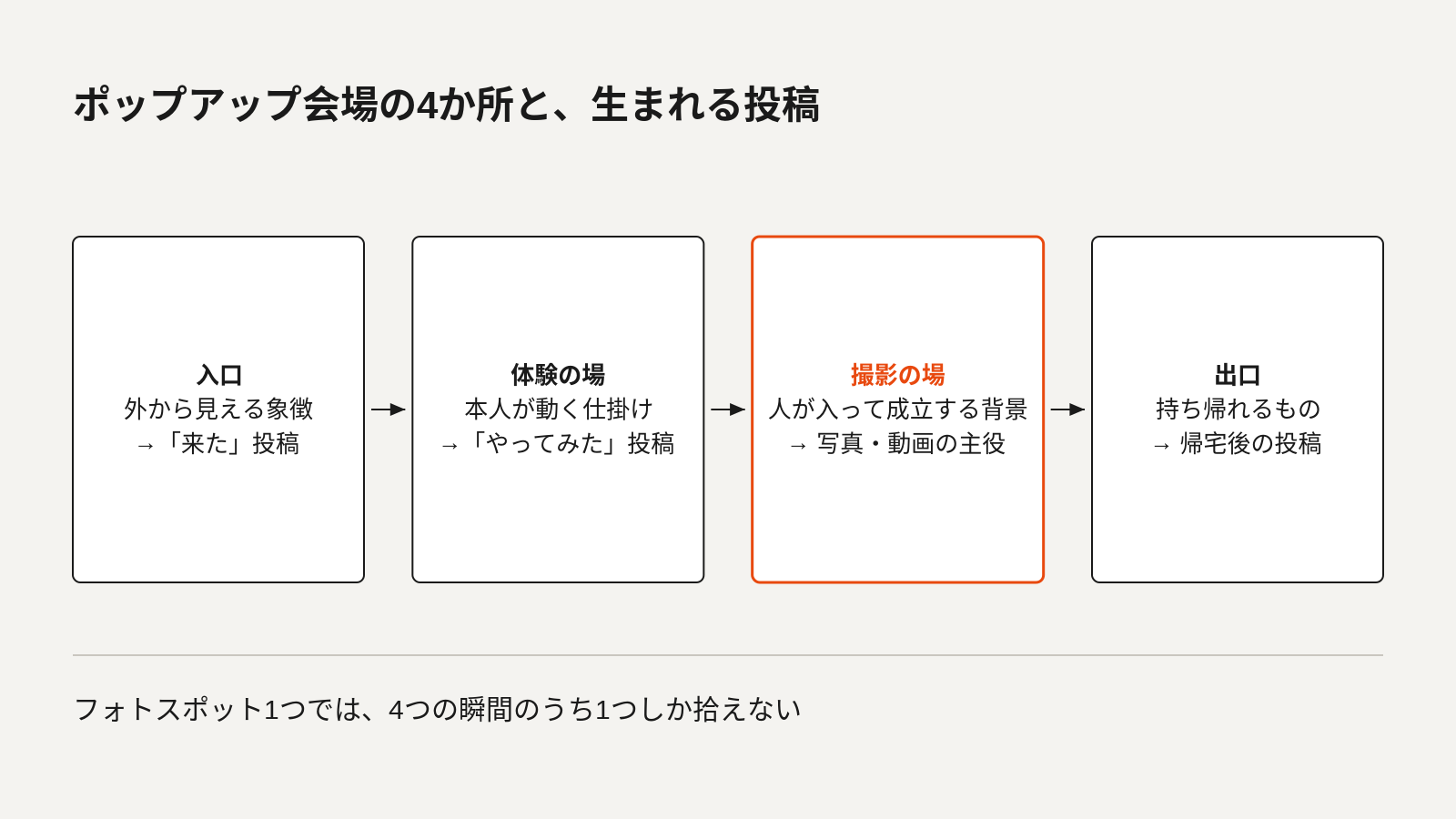
If you want a pop-up to spread on social media, place one trigger for posting at each of four points in the venue: the "entrance," the "experience area," the "photo area," and the "exit." A single photo spot is not enough. Visitors feel the urge to post at four moments: the instant they walk in, right after an experience, the moment they take a photo, and on the way home. If any one of these points is missing, the posts that would have come from that moment never happen.
| Point | What to place | How it leads to posts |
|---|---|---|
| Entrance | A visible landmark from outside (signage, facade, how the queue looks) | Becomes an "I'm here" arrival post |
| Experience area | Something visitors do themselves, such as touching, choosing, or trying | Becomes an "I tried it" experience post |
| Photo area | A backdrop that works in a single shot with people in it, and a spot where visitors can shoot without waiting | Becomes the star of photos and videos |
| Exit | Something to take home (limited items, printed materials, an on-the-spot keepsake) | Becomes a "I bought it / I got this" post after getting home |
Why doesn't "placing one photo spot" make a pop-up spread?
A photo spot triggers posts in the photo area, but it cannot capture the other three moments. We cover the role of the photo spot itself in What Is a Photo Spot, and Why Does It Matter in Event Design?, but whether visitors post does not depend solely on whether there is a backdrop to shoot against.
For example, imagine a two-week pop-up in a commercial facility directly connected to a train station. Even with an impressive photo backdrop, if the entrance is hard to see from the walkway, "I'm here" posts are unlikely to happen, and if the experience is just reading explanatory panels, "I tried it" posts won't happen either. The result is only a handful of photos with the same composition. When you design the four points in order, a single visitor can produce several posts of different kinds, and people who see them get a more three-dimensional sense of "what happens when you go."
We call this approach SNS activation: activation designed to include the stage where the experience gets talked about on social media. The overall thinking is summarized in What Is SNS Activation?.
What should you show at the entrance?
At the entrance, place one landmark that makes it clear "something is happening" when seen from the walkway or street. Photos that visitors take before going into a shop are often shot in front of the exterior or entrance, so this is the brand's business card.
What you place might be a large form or color that conveys the brand's world at a glance, or facade decoration. What matters is that it is recognizable from a distance and that there is enough space in front of it for people to stop. If the entrance is narrow and stopping would block foot traffic, adjust to the facility's rules, for example by moving the photo area slightly inside the entrance. Commercial facilities and train stations often have detailed rules on photography and loitering, so checking them before signing the lease will save you from a scramble later.
What should you set up in the experience area?
In the experience area, set up something where visitors choose, try, or combine things with their own hands. People want to talk about what they did rather than what they saw, so an experience in which the visitor takes action produces more to say in a post than an exhibit that requires reading explanations.
For example, at a pop-up introducing a new fragrance series, instead of just displaying the scents, you could have visitors choose their favorite combination and record it on a small card. Visitors can photograph their own result and write, "This was my combination." If an experience takes too long, throughput drops, so decide the time per person in advance and prepare a shorter version for busy periods. For the relationship between time spent and posts, see also How Does Dwell Time at an Event Affect the Persuasiveness of Posts?.
How should you design the photo area and the exit?
The photo area comes down to two things: "a backdrop that works in a single shot with people in it" and "a position where visitors can shoot without waiting." A backdrop that is beautiful on its own but leaves viewers unsure what the photo shows once people stand in it will not be the star of a post. Placing it along the main flow of traffic causes congestion, so the basic approach is to set up several spots slightly off the flow. How to separate the flow is covered in detail in When Should You Separate Photo Lanes at an Event?.
At the exit, prepare something visitors can take home. Venue-exclusive products, printed materials, and keepsakes handed over on the spot become triggers for posts after getting home or the next day. Because the topic comes up again after in-venue posting has quieted down, this works especially well for pop-ups with short runs.
Should the design differ for invited guests and the general public?
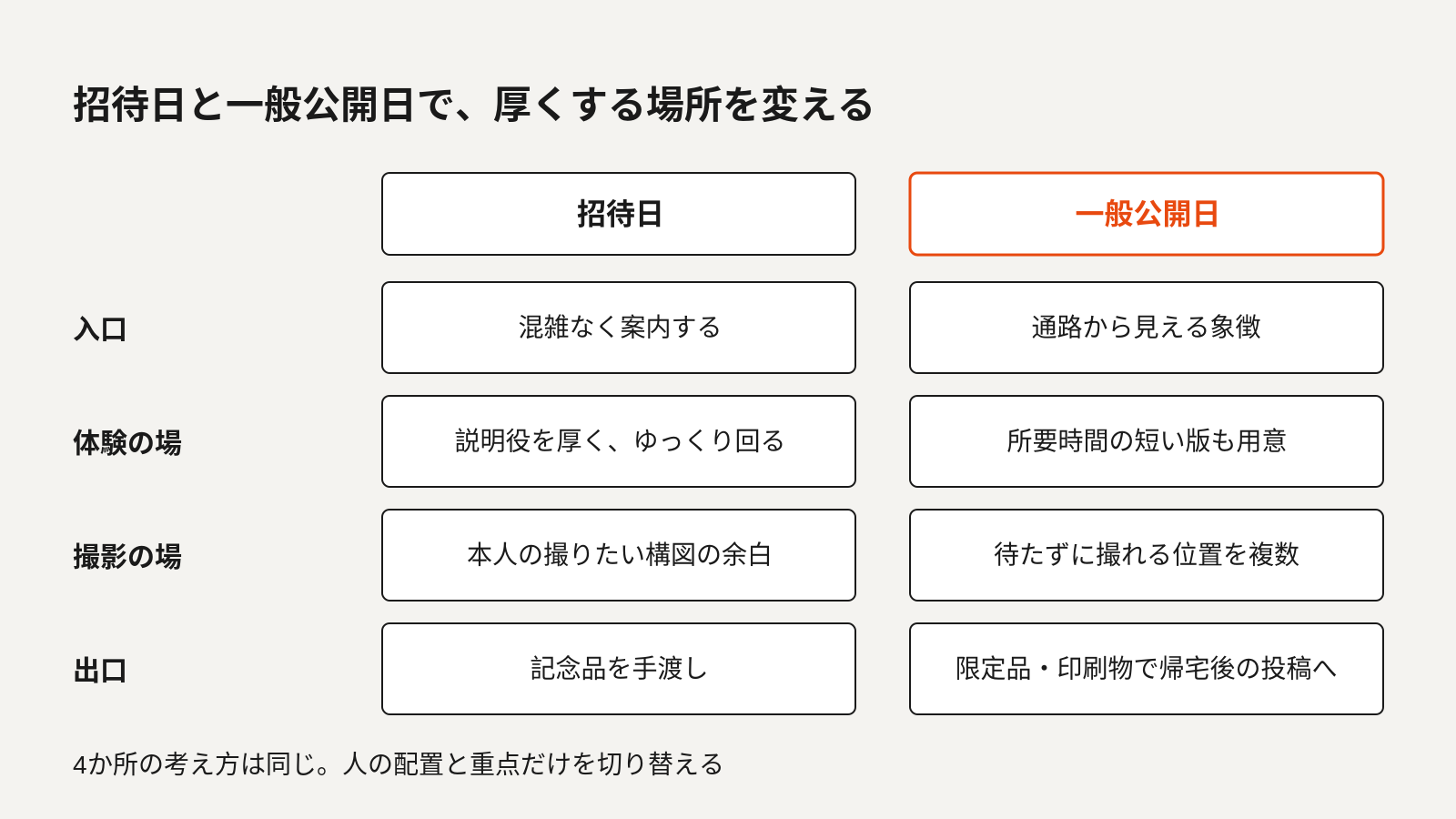
The thinking behind the four points is the same, but the emphasis changes. For invited influencers and media, it is important to let them tour the experience area at their own pace during uncrowded hours, and in the photo area you leave room for them to shoot the compositions they want. For general visitors, being able to shoot without waiting and having something to take home at the exit are especially effective.
For example, if you make the morning of the first day an invitation day and open to the public from the afternoon, you can shift staffing: more explainers in the experience area on the invitation day, and more guides in the photo area after the public opening. How to allocate visit days is summarized in When Inviting Influencers to a Pop-Up Store, How Should You Allocate Visit Days?.
Scope of this article
This article focuses only on where to place triggers for posting inside a pop-up venue. It does not cover choosing a location, the length of the run, how to proceed with announcements, details of each facility's photography rules, or how to handle PR disclosures. It is written on the premise that invited influencers' posts respect their own judgment, and it does not include ways to dictate the content of their posts.
Conclusion
Pop-up posts are not determined by the quality of the photo backdrop alone. When you place one trigger each at the entrance, experience area, photo area, and exit, the number of moments worth talking about in a visitor's day increases. Our approach of designing everything from experience to post as one continuous flow is summarized on the SNS activation page.