SNS Activation Case Studies: Why a "Cultural Space" That Doesn't Sell Products Gives People Something to Talk About
This article was automatically translated from the Japanese original. Read the original in Japanese
Brands that host "cultural spaces" without selling products share a common pattern. Instead of showing off new products, they provide entry points where people can take part by bringing their own time or belongings. This article examines two public examples from the perspective of SNS activation: activation designed to include the point where the experience gets talked about on social media.
| Country/Region | Industry | What they did | Mechanism that gave people something to talk about | Source |
|---|---|---|---|---|
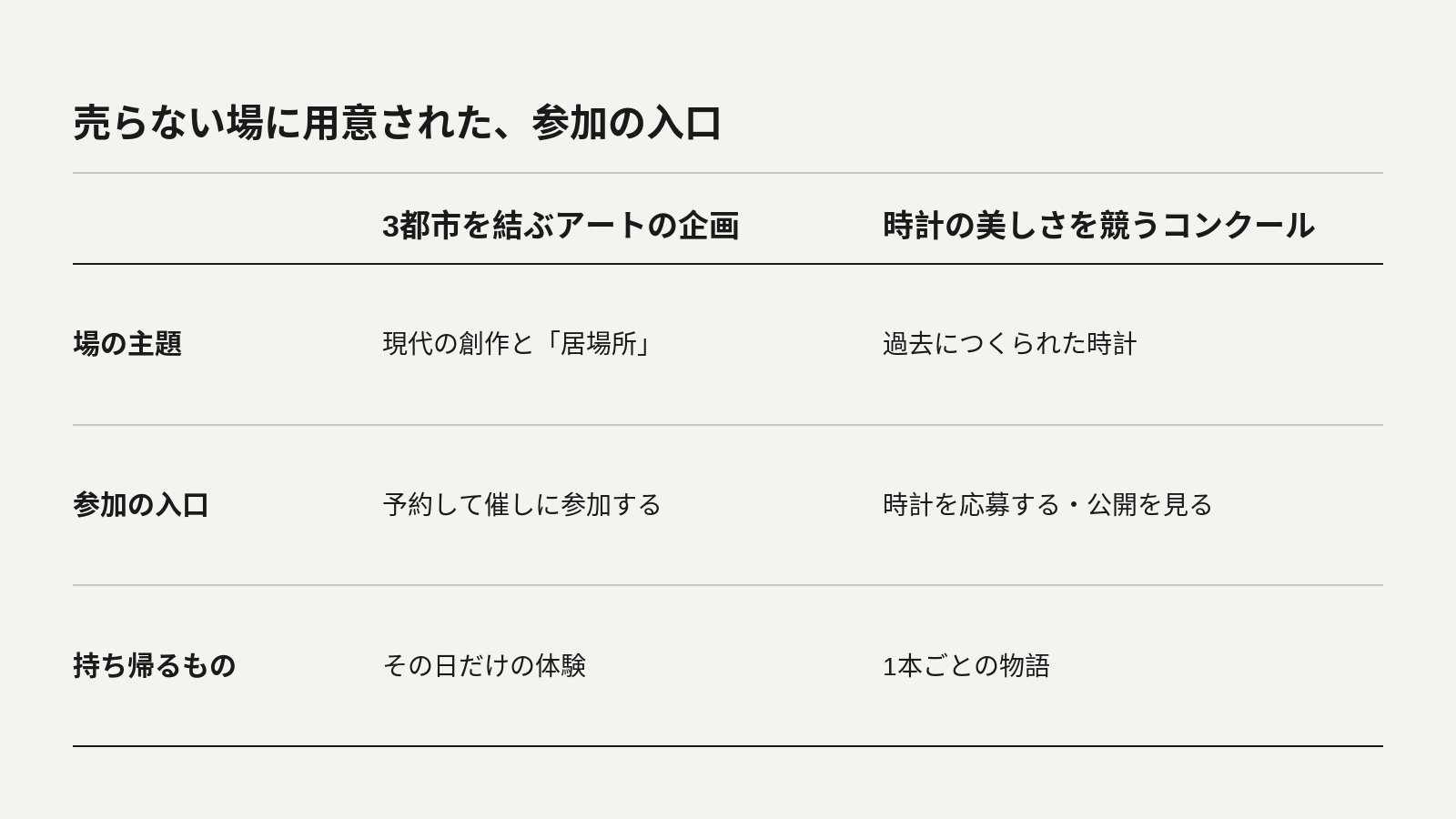
| Japan (linked with Germany and China) | Luxury | Louis Vuitton held a contemporary art project connecting three cities: Tokyo, Munich, and Beijing | Layered reservation-only events (traditional performing arts, music, talks, and workshops for children) on top of a free-admission exhibition | FASHIONSNAP |
| Europe (Switzerland) | High-end watches | Vacheron Constantin held its first concours celebrating the beauty of historic watches | Called for historic watches from a wide range of owners and opened the selected finalists to the public in Geneva | Luxury Daily |
What Serves as the Entry Point in Louis Vuitton's Three-City Project?
Louis Vuitton will hold a project supporting contemporary creation at its own art space in Omotesando, Tokyo, from October 24 to November 27, 2026. It will run simultaneously at spaces of the same name in Munich and Beijing, and the theme in Tokyo is "a place to belong." According to press reports, admission is free, and the space was designed by a collective of young Japanese architects.
What stands out is that the project doesn't end with viewing the exhibition. During the run, there will be Japanese traditional performing arts and storytelling, music performances, and talk events, along with workshops for children every Sunday. These events require advance reservations. Visitors take home not just "I saw the exhibition" but "I attended this event on this day," a date and content that are uniquely their own. Even at the same venue, what people share changes depending on the day they visited.
Whom Does Vacheron Constantin's Concours Put in the Starring Role?
The Swiss watchmaker Vacheron Constantin held its first concours celebrating the beauty of historic watches. The source article describes it as a first for the high-end watch field. In collaboration with an auction company, the event drew more than 550 watch entries, and 34 selected finalists will be opened to the public in Geneva from November 4 to 8, 2026.
The stars of this event are not the brand's new releases but watches made in the past and cherished by their owners. The automotive world has a similarly named event where owners compete on the beauty of their cars, and this can be read as transplanting that format to watches. Rather than telling its own history itself, the brand created a space where the people who own watches do the telling. Each selected watch comes with its owner's story, so the storytellers extend beyond the brand.
What Design Thinking Do the Two Cases Share?
What they share is that the brand has shifted from the side that "shows" to the side that "opens a space." Louis Vuitton welcomed visitors' time, and Vacheron Constantin welcomed owners' watches, as the content of the space. Neither puts new products front and center at the venue.
At venues that sell products, visitors' posts tend to lean toward product introductions and can be received as advertising. When a cultural event or a person's own belongings is the subject, posters can speak naturally about it as their own experience. The brand name is conveyed along with it, as the place where that experience happened. The difficulty of balancing wide recognition with preserving the brand's world in the luxury sector is covered in Why Is SNS PR So Difficult for Luxury Brands?. Definitions of the terms are summarized in What Is SNS Activation?.
When Is a Space That Doesn't Sell the Right Choice?
It suits cases where you want to convey the brand's values over the long term rather than drive short-term sales. When you want to encourage purchases just before a launch, a space where people can experience the product better fits the goal. A non-selling space suits anniversary milestones, building relationships in a new region, and times when you want to deepen ties with existing customers.
The other condition is that it can be continued. Reports say Louis Vuitton's project had a predecessor initiative in 2015 and that this edition follows from it. A one-off event is easily consumed as "an unusual event," while continuing makes it come across as "something this brand values."
What to Decide When Applying This in Japan
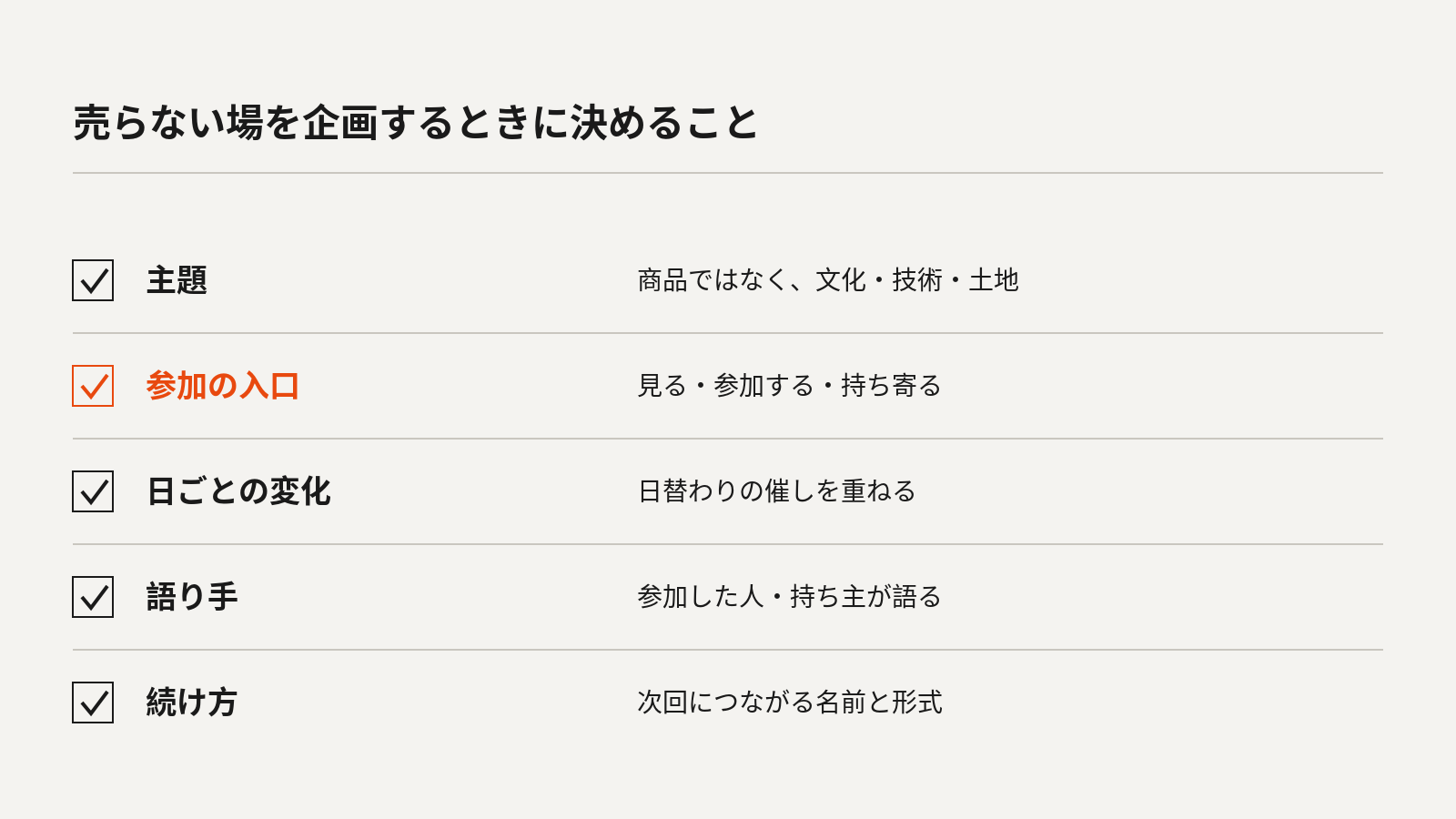
- Decide the subject. Rather than your own products, choose which culture, craft, or locality the brand values to make the content of the space.
- Create multiple entry points. Vary the depth of involvement for people who only look, people who reserve and participate, and people who bring their own belongings or works.
- Make the content change by day. Layering daily events onto the same exhibition means what each visitor talks about differs.
- Place the storytellers outside the brand. Leave material that participants and owners can talk about, rather than having brand representatives explain.
- Design on the premise of continuing. Decide a name and format that can carry into the next edition from the very first one.
For example, a long-established confectionery brand reaching its founding anniversary could, separately from a commemorative product sale, open a space that invites people to share memories and exhibits old wrapping paper and tins they own. A jewelry brand opening its first store in a new city could, before announcing the opening, hold a small exhibition and workshops in partnership with local artisans and makers, so that people begin talking from the brand's relationship with the place.
An approach that considers everything from experience design to spread on social media as one continuous flow is introduced on the SNS activation page.
Scope of This Article
This article interprets the design of these initiatives based on publicly available press reports. Neither report gives visitor numbers or post volumes, so these have not been verified. The concours's entry requirements and judging methods are not described in the source, so they are not covered. This is not a comparison of which initiative is better, and it does not address operating structures.
Conclusion
The two cases kept products out front and instead prepared entry points where people could get involved, extending the storytellers beyond the brand. Spaces that sell and spaces that don't sell play different roles. A space that doesn't sell is most effective when you have decided what you want to convey over the long term.