A Guide to Reception Design for Invitation-Only Events — How to Avoid Lines Right After Doors Open
This article was automatically translated from the Japanese original. Read the original in Japanese
Reception at an invitation-only event is the sequence of steps involved in confirming that an invited guest has arrived, recording that arrival, and guiding the guest into the venue. Each guest takes anywhere from a few seconds to about a minute, but because arrivals cluster around the moment doors open, a difference of just a few seconds per guest shows up visibly as a line in front of the venue.
Let's start with the conclusion. A line does not form because of how skillful the reception staff are. The line keeps growing only as long as the arrival rate exceeds the check-in rate. That's the whole story. So there are only three levers available: shorten the time per guest, increase the number of guests who can be processed simultaneously, or lower the arrival peak itself. This article organizes how to translate those three levers into actual design.
Note that this article is a generalization drawn from our own event operations experience, and does not refer to any specific brand, project, or individual.
Why Lines Form Right After Doors Open
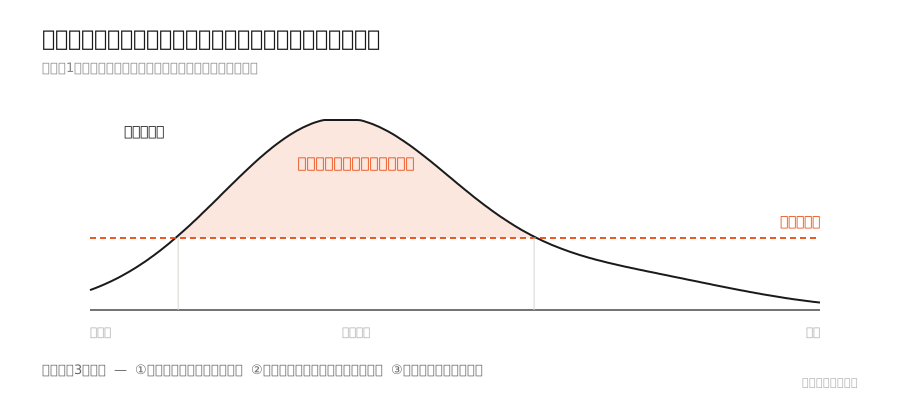
For invitation-only events, the doors-open time is printed on the invitation. As a result, arrivals aren't spread evenly — they form a peak just before and right after doors open. This peak is something we, as the organizers who sent the invitations, create ourselves.
As long as the height of that peak exceeds the check-in rate, the line keeps growing. The longer that condition persists, the longer the line gets. Conversely, once the check-in rate overtakes the peak even once, the line starts to dissolve from there. That's why things suddenly calm down some time after doors open.
What matters here is that it's the peak, not the average, that determines the length of the line. Even if you calculate that reception has plenty of capacity across the event as a whole, a line will still form if you can't get through the peak period. What you need to design for is the peak, not the average.
What Determines Check-In Time Per Guest
The time required per guest is the sum of the following four steps.
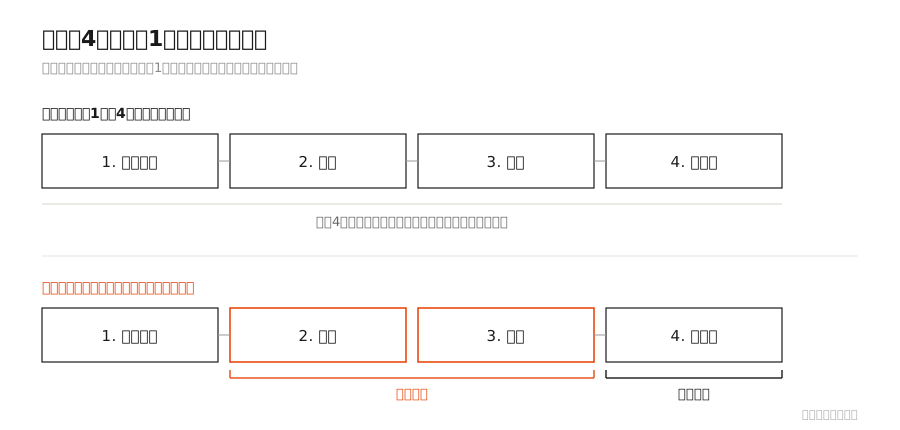
Of these, matching is the step where time differences vary the most from event to event. If the process involves visually scanning for a name, the longer the guest list, the longer it takes. Names that are hard to read, multiple guests sharing the same surname, or discrepancies between how a name is written on the invitation versus on the day — all of these add further delay.
| Step | Common bottleneck | Design fix |
|---|---|---|
| 1. Identity confirmation | Guests aren't told in advance what to present on the day | State clearly on the invitation what guests should bring on the day |
| 2. Matching | Staff are visually searching for names / the guest list is split across multiple copies | Replace searching with lookup. Have all lanes reference the same single guest list |
| 3. Recording | Staff only mark a checkmark and reconcile records later | Make the record complete on the spot |
| 4. Guidance | The same staff member who did the matching also handles guidance | Assign matching and guidance to different staff members |
Another point that's easily overlooked is that all four steps are often handled sequentially by a single staff member. If the person who matches the name also hands over materials and guides the guest to their seat, the next guest in line has to wait while that staff member is occupied. Simply separating matching from guidance changes how fast a single lane can process guests.
How Many Staff Should Reception Have?
The number of lanes should be determined not by the total number of invited guests, but by the height of the arrival peak. Even with the same number of invitees, an event where arrivals are spread out gradually requires a different number of lanes than one where most guests arrive right at doors-open time.
When deciding on staffing, we check the following four points:
- How many guests are expected to arrive during the peak window? Does the invitation stagger the arrival time by guest segment?
- Within a single lane, is there enough staff to separate matching from guidance?
- Can all lanes reference the same single guest list? This is what sets the ceiling on your staffing capacity. If the guest list is split up and distributed, adding more lanes just creates situations where a guest "isn't on the list I have," which actually stalls the line further.
- Can you keep one lane in reserve? Unexpected arrivals and equipment glitches do happen.
A Design Checklist for Avoiding Lines
What can be done in advance
- Don't communicate a single fixed doors-open time — give it a range. Stagger the start time by invitation segment.
- Decide in advance how changes, cancellations, and proxy attendance will be handled at reception, and set a deadline for reflecting those changes.
- Decide how to handle walk-in plus-ones (uninvited companions) before the event, not on the day.
- Designate a single, definitive location for the final version of the guest list. Make sure multiple versions don't exist on-site on the day.
- Plan the flow before and after reception, including the starting and ending points of the line.
What can be done on the day
- Separate matching from guidance.
- Complete the record on the spot.
- Avoid creating congestion right after reception (think about the placement of the cloakroom, welcome drinks, and photo spots).
- Decide in advance on a location and a staff member for handling cases that require verification, so guests can step out of line.
That last point is genuinely effective at preventing lines. When a guest requires some kind of verification and staff start investigating on the spot, everyone behind them stops moving. Just having a place where that guest can step aside for handling keeps the line flowing.
How Much Can the Reception Process Be Shortened?
Everything so far has been about operations, but of the four steps, matching and recording are the parts that can be replaced with a system.
Because we run our own event production operations, reception lines have always been our own problem too. The time guests spend waiting is time before the brand experience even begins. To cut that down, we developed our own QR-code reception system built specifically for invitation-only events: S/PASS. Its features include:
- Guests don't need to install any app
- Check-in is completed in 2 seconds
- Multiple devices can process check-ins simultaneously
- A second scan of the same QR code is automatically rejected, so attendance records never drift from reality
When matching becomes a lookup and recording becomes a single instant action, the remaining differences in time per guest come down to just identity confirmation and guidance. For specifics on what changes when moving from a paper guest list, see Digitizing Event Reception with QR Codes.
Not Making Guests Wait Is Part of Experience Design
Reception is the first minute of the brand experience. If guests are made to wait here, that minute becomes waiting time rather than experience. No matter how good the experience inside the venue is, the impression at the entrance lingers first.
How to design the conditions under which an experience gets talked about is something we covered in another article, but reception is the very first step in that process. We believe that avoiding lines isn't about cutting hospitality short — it's about securing the time you need to actually deliver that hospitality.
Frequently Asked Questions
Q. Where should we start if we want to make event reception run smoothly?
A. Start by lowering the arrival peak right after doors open. Advance design choices — such as giving a range rather than a single fixed doors-open time on the invitation, or staggering start times by invitation segment — are the most effective. Increasing on-the-day staffing comes second.
Q. How many staff should reception have?
A. This should be decided not by the total number of invitees, but by the expected volume during the peak arrival window right around doors-open time. At the same time, check whether matching and guidance can be split between different staff members within a single lane, and whether all lanes can reference the same single guest list. If the guest list is split up and distributed, adding more lanes just creates new points where the line stalls.
Q. Can a paper guest list still prevent lines?
A. Yes, for events where arrivals are spread out and the number of invitees isn't too large. It becomes difficult for events where arrivals cluster in a short time, where there are many last-minute changes, or where multiple lanes are needed. For details, see Digitizing Event Reception with QR Codes.
Q. What should we do if an uninvited companion shows up on the day?
A. Deciding on the spot stalls the line. Decide in advance with the brand whether to admit companions, and if so, who makes that call. Then have a location and a staff member ready to handle it outside the main line.
Q. Won't speeding up reception make the hospitality feel careless?
A. We think it's actually the opposite. Time saved on matching and recording can be redirected toward greetings and guidance. What you want to shorten is the administrative part; what you don't want to shorten is the part where staff actually engage with guests.
Note: This article is a generalization drawn from our own event operations experience. Descriptions of S/PASS's features are based on its specifications. It is written in a way that does not identify any specific project, brand, or individual.