From “Searching” to “Comparing” — The Effect of Sequence in Influencer Selection
This article was automatically translated from the Japanese original. Read the original in Japanese

Even if you hand the same person the same set of candidates, the quality of the answer you get back depends on how you present them. Asking someone to “find someone good” from a large pool of candidates is a fundamentally different question from asking them to “decide which of these fits this project better” when given a narrowed-down handful. The former is the work of "searching"; the latter is the work of "comparing."
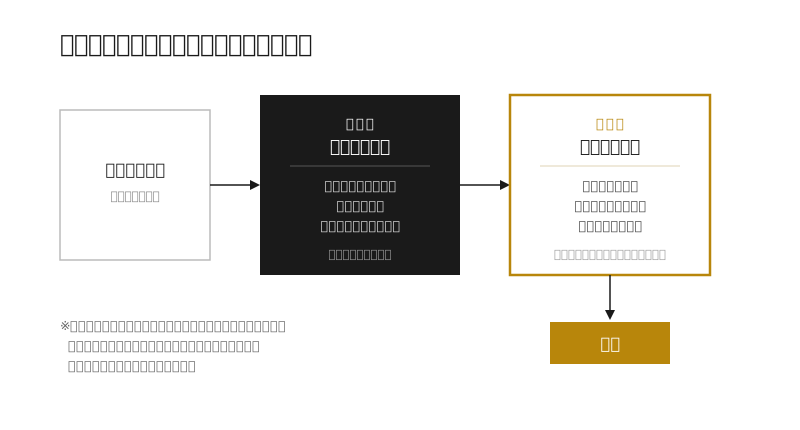
At our company, we split influencer selection decisions into two stages: a mechanical process that eliminates clearly unsuitable candidates, and a process where people compare the remaining candidates. What we want to discuss here isn't the two-stage structure itself, but what that sequencing changes — namely, the shape of the question the person ends up facing.
The Work of "Searching" vs. the Work of "Comparing"
"Searching" and "comparing" may both look like tasks where a person evaluates candidates, but they differ entirely in difficulty and precision.
The work of "searching for someone good" from a large pool inevitably involves structural oversights. A person's attention is finite, and it's simply not possible to look at many candidates with the same level of scrutiny. The moment you speed up your review to get through more candidates, the ones that happen to catch the eye gain an advantage, while candidates who don't stand out but would actually fit well end up never being noticed. This isn't a matter of the person's ability — it's a structural feature of the act of "searching" itself.
By contrast, "comparing" a handful of pre-narrowed candidates is a different kind of task altogether. When the number of candidates is small, you can hold the information on each one in mind while comparing them side by side. Even qualities that are hard to articulate in isolation — the atmosphere of a feed, how well someone fits with a brand — become clear the moment two candidates are placed next to each other. The act of comparing itself sharpens the resolution of judgment.
Even when the same person applies the same criteria, the quality of the conclusion they reach differs depending on whether they're being asked to "search" or to "compare."
Stage One — Finishing the Work of "Searching" in Advance
Stage one's job is to mechanically eliminate combinations that clearly don't fit, thereby removing the need for a person to "search" at all. Based on conditions that can be expressed as numbers or attributes — follower count level, content genre, overlap with the target audience — we eliminate here any candidates that fail to meet the basic requirements from the outset.
What this stage requires is reproducibility and speed. Given the same conditions, anyone reviewing them should arrive at the same conclusion. If the standard shifts based on a staff member's mood or personal preference on any given day, the whole point of narrowing down is lost. Once you consider that the role of stage one isn't to "select candidates" but to "create a state where no one has to search," it becomes clear why this stage should be mechanical. We cover the design of this first stage in detail in The Success of Influencer Casting Is Largely Decided at the List-Building Stage.
Stage Two — Where the Work of "Comparing" Happens
Stage two is where people compare the candidates who made it through stage one. What we're looking at here is what numbers can't fully capture: the atmosphere conveyed by a feed, the mood gathering in the comments section, how well something fits with the world the brand wants to convey.
We believe this is territory where meaning is lost the moment you try to quantify it. The more you break things down into individual metrics, the more invisible the overall sense of coherence — how those metrics fit together — becomes. The world conveyed by a feed and the atmosphere of a comment section: the moment you turn each into a standalone score, the impression created by the two together disappears. What a skilled eye is actually looking at is this very coherence. And it's precisely because the pool has been narrowed down that there's room to compare this coherence properly. We cover patterns of failure where this comparison process didn't work in What's Really Happening When a Sponsored Collaboration Doesn't Deliver the Results You Expected — A Study in the Failures of Casting Design.
A Note on the Word "Eliminate"
Up to this point, we've used words like "eliminate candidates" and "narrow down." We want to clarify one thing so there's no misunderstanding. What gets eliminated in stage one is a combination with the context of that particular project — not a judgment of the person's worth.
It happens routinely that the same candidate passes stage one and advances to comparison for a different project. This time, they simply didn't fit the world the brand wanted to convey; for a different brand or a different campaign, they might have been a comparison candidate from the start. What we're always judging is whether "this person and this project are a fit this time" — never "how good this person is" in some absolute sense. Not conflating these two things is, for us, a basic premise of the work of selection.
On Looking at Comments and Posts
In stage two, we actually look at candidates' feeds and comment sections. If this is understood as a process of scoring past post performance or monitoring behavior, that would misrepresent our intent.
We look at comment sections to grasp how the atmosphere gathering there resonates with the world the brand wants to convey this time. What we're observing is the mood that has formed around the account — not secretly scoring the behavior of the person posting. We make a point of not forgetting, ourselves, that we're looking in order to understand.
A Counterargument — Isn't This Just Relying on Gut Feeling?
Having read this far, some of you may be thinking, "Isn't stage two ultimately just relying on gut feeling?" To answer honestly: yes, the judgment in stage two is a human judgment made by eye, without numerical backing. We're not going to dress that up as something it isn't.
However, the gut feeling being exercised in stage two is not the gut feeling used to "search" for someone from a broad pool. It's the gut feeling used to "compare" within an already-narrowed set of candidates. This difference isn't trivial. Gut feeling used for searching is structurally prone to oversights and remains low in reproducibility. Gut feeling used for comparing, because the pool is small, makes it easier to apply the same criteria consistently, which improves the precision of the judgment. The fact that we're relying on gut feeling is true either way — but which kind of gut feeling you rely on is something you can choose. The reason we split the process into two stages is that we're making this choice deliberately.
What's more, the criteria we're looking at in stage two aren't "vaguely good" or "vaguely bad." Fit with brand tone, the feel of a feed, the quality of a comment section — these are all things we can put into words every time. They may not be quantifiable, but they are articulable. This is the position we base our stage-two judgments on. We also address data on how much individual variation exists even under the same conditions in How Much Does Engagement Rate Vary Even Within the Same Follower Tier? — Insights from 487 Campaign Records, which supports the need for a stage-two judgment that doesn't rely on numbers alone.
A Practical Takeaway — Are You Making Your Team "Search," or Are You Making Them "Compare"?
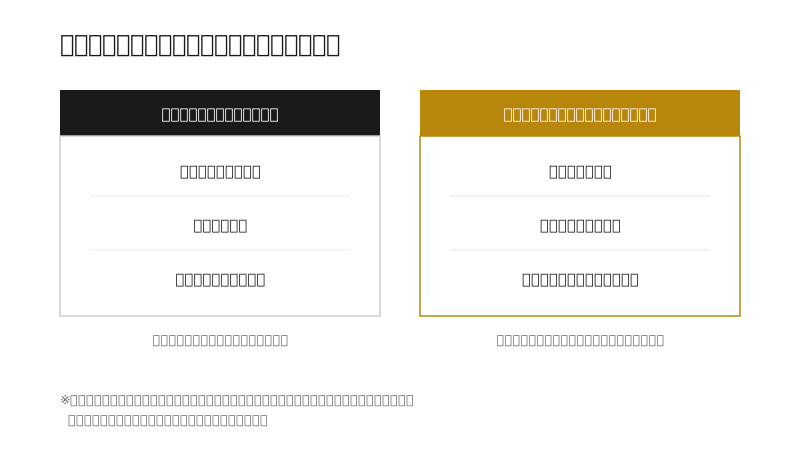
If there's one thing to take away from this article, it's this check: verify whether your own selection process is asking your team to "search" or to "compare."
The first thing to check is how many candidates you're handing over to stage two. Are you leaving it to your staff to review feeds from a large, unfiltered list? If you're handing over a number close to the size of the entire candidate pool, you're effectively still making people do the work of "searching."
The second thing to check is how you ask about the reasoning behind a decision. When you ask, "Why did you choose this person?" can your staff cite a point of comparison and say, "This one fits better than that one"? Or does the answer stop at a vague, standalone impression of "this one just seemed good"? The former is evidence of genuine comparison; the latter is a sign that narrowing hasn't gone far enough, and your staff is being forced into a kind of "searching" disguised as individual evaluation.
The third thing to check is the criteria used in stage one. Are those criteria written down in words, such that a different staff member could narrow down to the same pool of candidates? If the criteria exist only inside one particular person's head, the process has already become dependent on that individual before it even reaches stage two.
We can't offer a specific numerical target or a rule of thumb for how many candidates to narrow down to, but these three questions should be applicable to any selection process.
Closing Thoughts
Even when the same person applies the same criteria, the quality of the judgment they produce differs depending on whether they're being asked to "search" or to "compare." We split the process into two stages not merely for efficiency, but to make sure people are only handed the kind of work suited to human judgment. We believe that structuring the sequence itself is part of the design of selection.
Next time, we'll share another perspective drawn from our day-to-day work.
Future installments will be delivered via our email newsletter. Please sign up below.