How to Choose an Influencer Casting Company — 7 Points to Compare
This article was automatically translated from the Japanese original. Read the original in Japanese

When searching for a casting company, many marketers try to judge a company by "how many candidates they can present." But what a casting company is truly responsible for isn't lining up candidates—it's designing the entire framework: who to cast against the brand's objectives, how to direct their posts, and how to apply the results to future campaigns.
What you should compare isn't the lowest quote or the longest candidate list, but the substance of the proposal. Even when you request under the same conditions, the resolution of the proposals you get back varies significantly by company. That difference shows up in hard-to-see areas: the rationale behind candidate selection, the scope of direction provided, understanding of compliance, and the quality of post-campaign reviews.
This article organizes 7 points to evaluate when comparing multiple companies before placing an order, along with questions to ask each one. Use these as neutral comparison criteria applicable to any company you're considering.
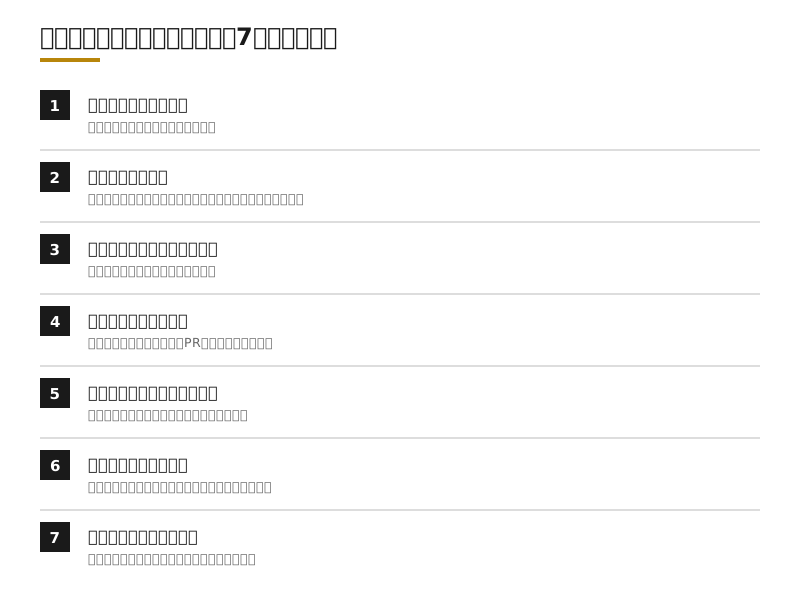
7 Points to Compare
① Platforms and genres of expertise
Instagram, YouTube, and TikTok each have their own posting conventions and audience reactions. Feed posts and short-form videos also demand different levels of editing skill, and companies clearly differ in their strengths across platforms. Similarly, whether a company can deliver proposals that understand a brand's worldview—in apparel, beauty, luxury, or any other industry—depends on their accumulated track record. Check whether they have experience close to your industry and platform.
Sample question to ask: "What platforms and industries have made up most of your work over the past year?"
② Rationale behind the candidate list
Follower count alone doesn't tell you how much a post will be seen or engaged with. Even within the same follower tier, engagement rates can vary widely (related article). A company that builds its list based purely on follower count—without accounting for this gap—and one that digs into actual performance data will produce proposals with vastly different levels of reliability, even with the same number of candidates. A strong proposal shows not just follower count but actual engagement data, audience age/gender composition, and past PR track records.
Sample questions to ask: "What data, besides follower count, is this list based on?" "Can you share audience composition data?"
③ Ability to explain the reasoning behind selections
What matters more than how many candidates a company can line up is whether they can articulate why each one was chosen. A company that can explain—not with a vague "seems like a good fit," but by connecting the brand's objectives to a candidate's posting tendencies and follower demographics—will also make consistent decisions during the subsequent direction phase. Even the order in which candidates are presented reflects a deliberate design choice that affects how easily you can compare them (related article).
Sample questions to ask: "Why did you choose this particular person?" "Is there a reason for the order in which candidates are presented?"
④ Scope of direction
Whether a company handles everything end-to-end—from brief creation, to supervising post content, to checking PR labeling—once a candidate is confirmed makes a major difference to both the quality of the output and the internal workload on your side. Some companies stop at candidate selection and leave the actual post content up to the influencer, while others work closely with you to refine the post copy so the brand's intent comes through. It's important to clarify upfront where the company's role ends and where the brand's own work begins.
Sample question to ask: "Who reviews the post copy, and at what stage?"
⑤ Event and offline execution capability
There are plenty of cases—launch events, experiential activations—that can't be completed through SNS posts alone. The overall quality of an event depends on whether the company can handle everything from venue selection to on-the-day operations and guiding attending influencers. Whether a company can seamlessly manage both online casting and offline event operations is one practical capability worth comparing.
Sample questions to ask: "Do you have a track record that includes event operations?" "Can you propose something that combines online and offline elements?"
⑥ Compliance readiness
Under the stealth marketing regulations within the Act against Unjustifiable Premiums and Misleading Representations, the responsibility for proper PR labeling now clearly falls on the party doing the casting (reference: Consumer Affairs Agency). What counts as regulated content and how to label it appropriately can vary by platform and post format, so it's important to check whether the company has a system in place to confirm this on a case-by-case basis. Whether they understand the rules and can explain concrete operational practices is a key indicator of whether a company is trustworthy.
Sample questions to ask: "How do you operationalize PR labeling rules?" "Who does the final check on labeling?"
⑦ Quality of reporting and review
Check whether reports go beyond raw numbers like impressions and engagement counts to include insights into what those numbers mean and how to apply them going forward. A company that can clearly separate out what worked from what didn't will also carry that learning into the design of your next casting effort. The quality of the review process directly affects the precision of future casting decisions.
Sample questions to ask: "What metrics are included in your reports?" "Do you have suggestions for how to apply this campaign's results to the next one?"
How to Proceed Before Placing an Order
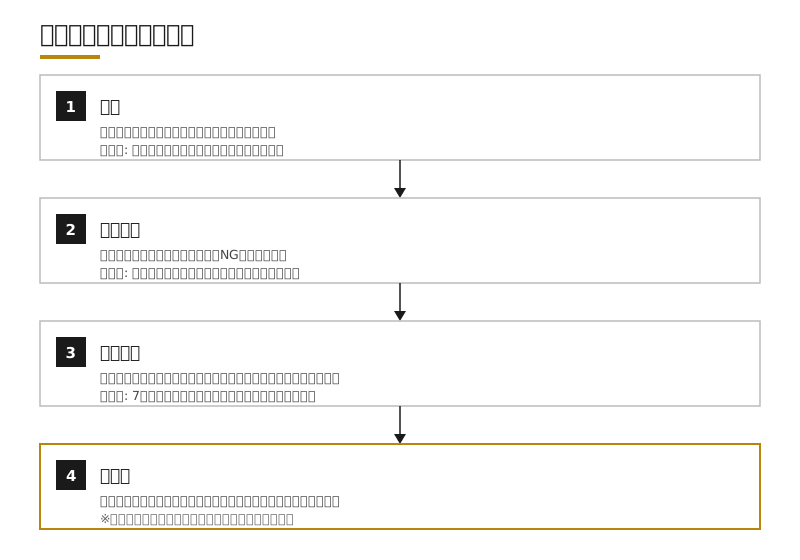
With the 7 points in mind, the actual comparison process typically unfolds in four stages. Deciding in advance what to request and what to look for at each stage keeps your judgment consistent even when comparing multiple companies in parallel.
At the consultation stage, you share your objectives, target audience, and the outcome you want to achieve. There's no need to get into pricing at this point. In fact, paying attention to what questions come back in response to your explanation reveals how well the company understands your needs.
At the requirements-sharing stage, you convey the brand's worldview, past track record, and any expressions or approaches to avoid. This is an opportunity to see how well the company absorbs your brief and reflects it in their proposal.
At the proposal comparison stage, you compare candidate lists, selection rationale, scope of direction, and reporting content side by side across companies, using the 7 points above as your framework. It's important to request proposals from multiple companies under the same conditions and evaluate them against the same criteria.
At the final decision stage, you confirm the speed and specificity of their responses to your questions, as well as your compatibility with the assigned contact person. A project doesn't end once you place the order—it continues through ongoing communication afterward.
Warning Signs
As you compare companies, if you notice any of the following signs, it's worth digging deeper. None of these are meant to condemn a company outright—rather, treat them as points worth probing further before you place an order.
The first is when, upon asking about the rationale behind a candidate list, no explanation comes back beyond follower count. This may indicate the company doesn't have engagement or audience composition data on hand.
The second is when PR labeling doesn't come up on the company's own initiative. Compliance is an area where responsibility falls on the party doing the casting, and it's a good sign when a company can explain this without being asked first.
The third is when a company's track record has no overlap with your industry at all, and they can't point to specific examples. Experience in a different industry can sometimes still be valuable, but in that case, ask further about what basis they're using for their proposal.
These are simply points worth checking—matching one of them doesn't automatically mean a company isn't a good fit. Asking about anything that concerns you, without hesitation, is the first step toward building a strong campaign framework.
About the Authors
STATS INC. (Stats Corporation) is an influencer casting company focused on Instagram, YouTube, and TikTok. Combining a discerning eye for brand worldview with objective data built on a track record of results, we have supported casting and PR event production for over 240 brands, including international luxury brands.