Gifting Without a Posting Obligation: What Percentage Actually Results in a Post?
This article was automatically translated from the Japanese original. Read the original in Japanese

Let's start with the conclusion. Even with gifting that carries no posting obligation, 91% of influencers still post. This figure comes from our own campaign records—44 projects and 342 influencers—compiled over the past four years. The gap versus paid posts, at 93%, was just 2 percentage points. In this article, we disclose the full breakdown, including the structure behind the single project that dragged down the average.
Why We're Publishing This Data
"If there's no guarantee of a post, shouldn't you go with a paid post instead?" This debate comes up on the ground every time we incorporate gifting into a proposal. Yet almost no published data exists to answer this question. This is a topic that has continued to be discussed based on impressions, with no real evidence to work from.
So we decided to compile and publish our own campaign records. The scope: our own campaign records (in-house research) covering the past four years, 44 projects, and 342 influencers. We only included records where whether a post was made or not was clearly documented. Note that event-invitation-type projects have a different structure, so we tabulated them separately and excluded them from this analysis. We recognize the data has its limits, and we're disclosing those limits as well, exactly as they are. We believe that turning this number into shared market knowledge—rather than keeping it to ourselves—will build greater trust in gifting as a method.
Results: 91% Post
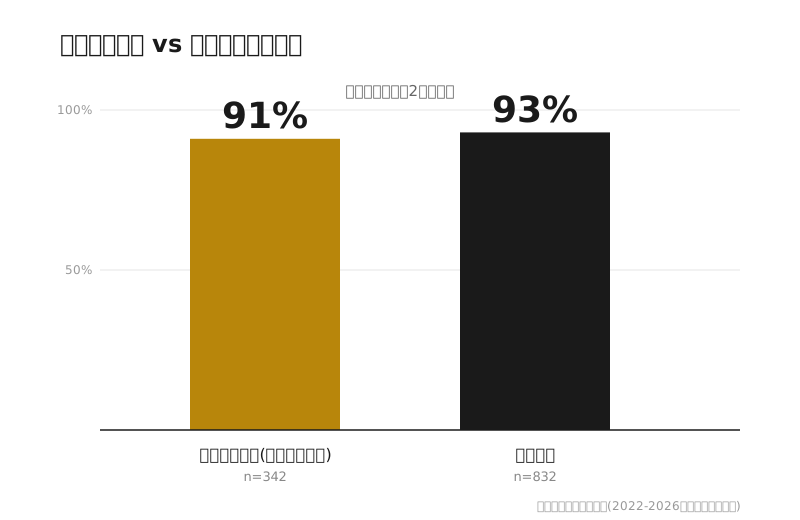
Our tabulation found that the posting rate for gifting with no posting obligation was 91% (n=342). For comparison, when we tabulated paid-post projects from the same records, the rate was 93% (n=832). The gap is 2 percentage points. Of the 342 influencers, 32 did not end up posting. In other words, out of every 10 influencers reached, 9 post—even without any obligation to do so. The common belief that "without an obligation, there's no post" does not hold up, at least based on our own records.
Why do people post even without an obligation? Our interpretation is simple. For influencers, posting isn't "an imposed obligation"—it's "something they want to feature if the material is good." Every day, they're looking for things worth putting on their feed. When a product that fits their aesthetic is delivered in the right way, it becomes material, not an obligation. Put differently, the success of gifting is determined not by "can you force a posting commitment" but by "can you deliver it in a way that makes them want to post it."
Of course, for campaigns that require controlling the number of posts, the posting date, and the messaging, paid posts remain the better fit. What we want to convey here isn't that one is superior to the other, but simply that the premise "gifting isn't a viable option because posts aren't guaranteed" doesn't hold up against the data. For the decision framework on which to choose, see Gifting or Sponsored Collaboration — A Decision Framework Based on Your Objective.
Does the Posting Rate Change by Follower Tier?
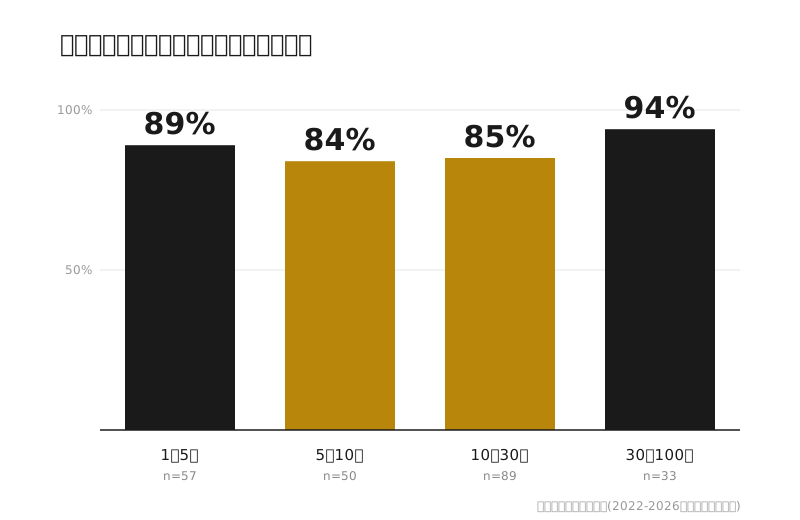
Breaking it down by follower tier reveals an unexpected pattern. 10k–50k followers: 89% (n=57); 50k–100k: 84% (n=50); 100k–300k: 85% (n=89); 300k–1M: 94% (n=33). The lowest posting rate was in the mid-tier range of 50k–300k followers.
The intuition that "the more followers someone has, the less likely they are to post" is contradicted by this record. Our hypothesis is as follows: the 50k–300k tier is the zone where PR requests concentrate most heavily. With many projects and products arriving daily, there's a physical limit to how many items can make it onto the feed, and gifting naturally falls by the wayside. Meanwhile, in the 300k–1M tier, many influencers are highly selective about what they even agree to receive in the first place—so once they decide to accept a gift, they tend to follow through with a post. This explanation also matches the on-the-ground sense from our casting work.
Note that the 1M+ tier has a small sample size (n=9), so no firm conclusions can be drawn there. We treat it as reference data only, and at this stage we don't recommend designing a plan that expects a post from this tier through gifting alone. If there's one practical takeaway, it's this: the more a request targets the mid-tier range, the more the "structure of the deal," discussed below, determines the posting rate.
The One Project That Dragged Down the Average by 3 Points
This is the part we most want to convey in this article. Looking at the breakdown of the 44 projects, 43 of them had posting rates that fell almost entirely within the 90–100% range. However, one single project had a posting rate of just 33% (n=30). This one project alone pulled down the overall average by about 3 percentage points. Excluding it, the posting rate rises to 96% (n=312).
In other words, the question "does gifting get posted?" is simply the wrong question to ask. Most projects do get posted. The real issue is "are you avoiding a structure that leads to no posts?" We believe what should be questioned at the proposal stage isn't whether a posting guarantee exists, but whether the plan is designed in a way that places it among the 43 successful projects rather than the 1 outlier.
To avoid identifying the parties involved, we won't disclose details about the industry or brand behind that one project. Based on our internal review, the structural reasons the posting rate fell short can be generalized into three factors. First, a mismatch in tone between the brand and the influencers—the casting list was built around follower count rather than the brand's aesthetic. Second, a mismatch between the gift and the recipient's expectations—the content and presentation of the gift didn't reach the level needed for recipients to feel it was "material worth featuring on my feed." Third, insufficient design around the timing of delivery and the motivation to post—the gift arrived at a time disconnected from any seasonal context, leaving recipients with no "reason to feature this right now."
These are qualitative observations, and we can't make definitive claims. That said, the record clearly shows that this one project consistently failed to clear hurdles that the other 43 projects cleared as a matter of course. The difference in posting rates isn't a matter of probability—it's a matter of structure. That's our conclusion.
Practical Checklist: Conditions for a Structure That Gets Posted
So what should you look at to avoid a structure that doesn't result in posts? Here, we're publishing the exact checklist we use when designing gifting projects.
- Check the fit with the gifting format itself. Carefully examine past posts to see whether introducing the gift would fit naturally into that person's content style.
- Confirm whether the brand and the influencer's aesthetic align. Look at the tone of the feed before you look at follower count. For more on how to assess this, see The Success of Casting Is Decided Almost Entirely at the List Stage.
- Align the delivery timing with posting motivation. Deliver at a time that overlaps with seasons, events, or the person's own content themes.
- Design what's included in the package. Whether or not there's a letter or explanation conveying the brand's context changes the item's value as "material."
- Follow up after delivery. Not as a reminder to post, but by providing information (tags, the brand's intent) that makes posting easier. For specific examples of how to word this kind of outreach, see What Does a Natural Message That Encourages a Post After Gifting Shipment Look Like?.
We make these calls using a two-step approach: "narrow down with data, then select with a trained eye." We use the numbers to narrow down by follower tier and posting history, and then, at the final stage, we review each feed one by one to judge aesthetic fit. We believe it's this latter, more discerning step that separates the one project with a 33% posting rate from the rest at 96%.
In Closing
Gifting isn't "a tactic where you can't be sure if it'll be posted"—it's "a tactic that gets posted more than 90% of the time, as long as you don't get the structure wrong." We hope this data helps put an end to impression-based arguments in proposal discussions.
Next time, we plan to publish the posting rate for event-invitation-type projects. The relationship between attendance and posting takes a different shape than gifting does.
We'll share further updates via our newsletter. Sign up below.
Source: STATS INC. research (2022–2026, based on in-house project records). Only records with clearly documented posting status were included. Event-invitation-type projects were excluded, as they were tabulated separately.