Switching Event Check-In to QR Codes — What Actually Changes from Paper Guest Lists
This article was automatically translated from the Japanese original. Read the original in Japanese

QR-code check-in for events refers to a system in which each invited guest is issued a unique QR code, which is then scanned on the day of the event to record their attendance. It replaces the process of searching for a name on a paper or spreadsheet list and crossing it off with a single scan.
Let's start with the conclusion. What QR-code check-in really changes isn't the speed of check-in itself, but rather the ability to view the same guest list at multiple locations, at the same time, always in its most up-to-date state. Speed follows as a result of this. In this article, we'll look, from a practical standpoint, at what changes compared to paper-based operations, what's needed to make the switch, and the situations where paper is still necessary even after adopting QR codes.
Note that this article is a generalization drawn from our own event operations experience, and does not refer to any specific brand, project, or individual.
What Makes Paper Guest Lists So Difficult to Manage?
When checking guests in using a paper or spreadsheet list, the following four issues tend to occur at once.
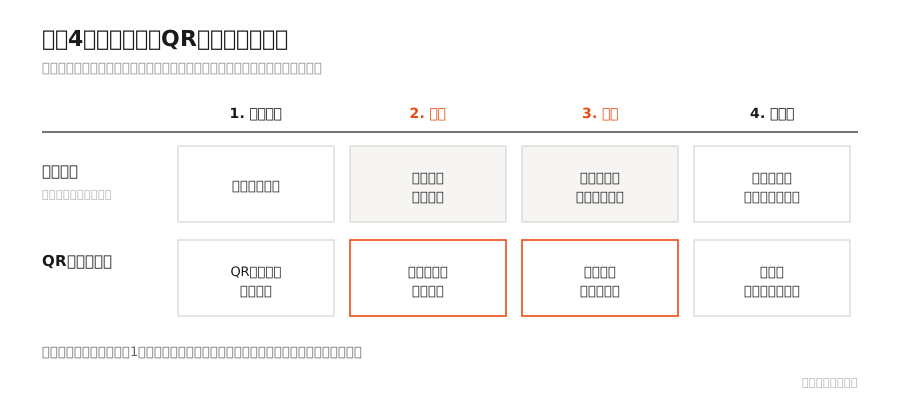
First, verification becomes a matter of "searching." Since names have to be located visually, the longer the list, the longer it takes. Names that are hard to read, multiple guests with the same surname, or discrepancies between the invitation and the name given on the day all add further delay.
Second, the list becomes outdated the moment it's printed. Last-minute cancellations, changes to a proxy attendee, or additional invitations aren't reflected on a list that's already been printed. As replacement sheets pile up, multiple versions end up circulating on-site.
Third, it becomes difficult to add more check-in lanes. Splitting check-in into two locations means either dividing the list or having two copies of the same one. Dividing it risks guests whose names aren't on the list in front of the staff member helping them; having two copies risks confusion over which copy has already been marked.
Fourth, attendance records end up as a downstream task. The marks made on the day have to be transcribed cleanly afterward. This transcription work often happens once memories of the day have already faded.
What Changes When You Switch to QR Codes?
| Paper/Spreadsheet Guest List | QR Code Check-In | |
|---|---|---|
| Verification | Search for the name visually | Confirmed instantly by scanning |
| Simultaneous check-in | Split the list, or consolidate to one location | The same list can be viewed simultaneously on multiple devices |
| Last-minute changes | Requires reprinting | Can be updated right up until the event |
| Attendance record | Marks from the day are compiled afterward | Recorded on the spot |
| Second check-in attempt on the same invitation | Can only be caught visually | Automatically blocked |
| What's needed on-site | Nothing in particular | A device and network connectivity |
We'll be upfront about that last row. QR-code check-in requires a device and a network connection. This is exactly why, as discussed later, there are still situations where paper is necessary.
How Do Guests Receive Their QR Code?
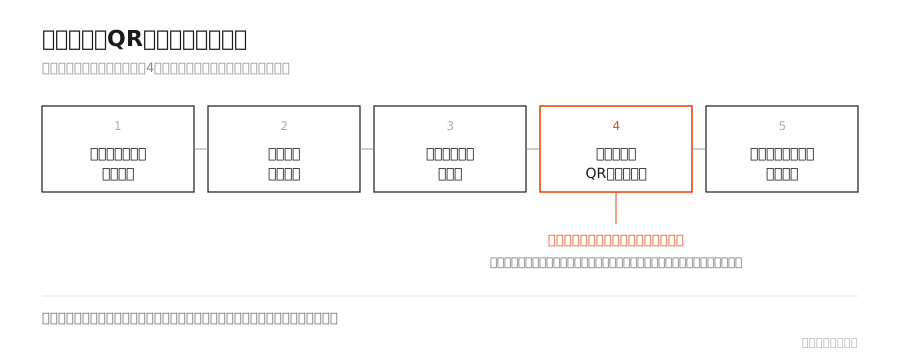
The process generally follows these steps:
- Prepare the invitee list. Names and contact information (such as email addresses) are required
- Send out the invitations. Clearly specify at this stage what guests need to bring on the day
- Collect RSVP responses. Without responses, you can't move to the next step
- Issue a QR code for each confirmed attendee. Make sure it's delivered directly to the person who responded
- Scan and record it at check-in on the day. Once the event is over, attendance status and arrival times remain as data, ready for use
Step 4—"delivered directly to the person"—is the key point. If the organizer receives all the codes in bulk and forwards them, that creates a separate management burden of tracking who received which code, and increases the risk of mistakes.
Situations Where Paper Is Still Necessary, Even with QR Check-In
This is the first thing to check before deciding to make the switch.
- Venues with weak network connectivity. For basement venues or locations with poor signal, always check on-site in advance
- Device power supply. Check-in starts before doors even open. Keep backup power sources on hand
- Cases where a guest can't present a QR code. Situations do occur where an email hasn't arrived, or a guest doesn't have their device with them on the day. Always keep a name-based check-in option available. Never design a check-in process where guests without a QR code simply can't enter
- Walk-ins and proxy attendees. Prepare a way to register these guests on the spot
The third point is both an operational matter and, we believe, a matter of attitude. Once a guest has taken the trouble to come, they should never be kept waiting simply because they don't fit the system that was set up for our own convenience.
Why We Built Our Own System
Everything described above reflects challenges we've faced ourselves. We run our own event production operations, and every time, we've had to deal with long check-in lines, last-minute changes, and post-event transcription work firsthand. Out of that need, we developed S/PASS, a QR check-in system built specifically for invitation-only events.
- Guests don't need to install an app or create an account
- Check-in is completed in 2 seconds
- Multiple devices can check guests in simultaneously
- A second scan of the same QR code is automatically blocked, so attendance records always match reality
That said, replacing the system alone won't flatten the peak in arrivals. Decisions such as how many staff to assign to check-in and how to design the flow of guests still need to be made separately. We've covered that in our Guide to Check-In Design for Invitation-Only Events.
Closing Thoughts
Switching to QR codes isn't about making check-in mechanical. It's about reducing the parts of the process—"searching" and "transcribing afterward"—that people shouldn't have to do in the first place.
What you do with the time you free up depends on how the event itself is designed. We believe that time is best spent on greeting guests and guiding them.
Frequently Asked Questions
Q. What do we need to switch event check-in to QR codes?
A. Three things: the names and contact information of invitees, a system to issue and distribute QR codes, and a device with network connectivity to scan them on the day. No special equipment is required—a smartphone or tablet camera is enough to scan codes.
Q. Do guests need to install an app?
A. It depends on the system. For invitation-only events, we recommend a format that doesn't require an app installation or account registration, since guests attending for the first time would otherwise have to complete extra steps right at the entrance.
Q. Can guests who forget their QR code still enter?
A. They should be able to. Never design a check-in process this way—always keep a name-based check-in option available so attendance can still be recorded on the spot.
Q. How is this different from managing things with a spreadsheet?
A. A spreadsheet can also be viewed by multiple people at once, but at the check-in point, the "searching" task still remains. There's also a risk of confusion over who marked which row. QR codes combine this verification and recording into a single step.
Q. What should we do if we're unsure about the venue's network connectivity?
A. Check the signal on-site in advance. On top of that, always prepare a printed guest list and a name-based check-in procedure as a backup.
Note: This article is a generalization drawn from our own event operations experience. Descriptions of S/PASS's features are based on its specifications. It is written in a way that does not identify any specific project, brand, or individual.