5 Things to Sort Out Before You Talk to a Casting Agency
This article was automatically translated from the Japanese original. Read the original in Japanese

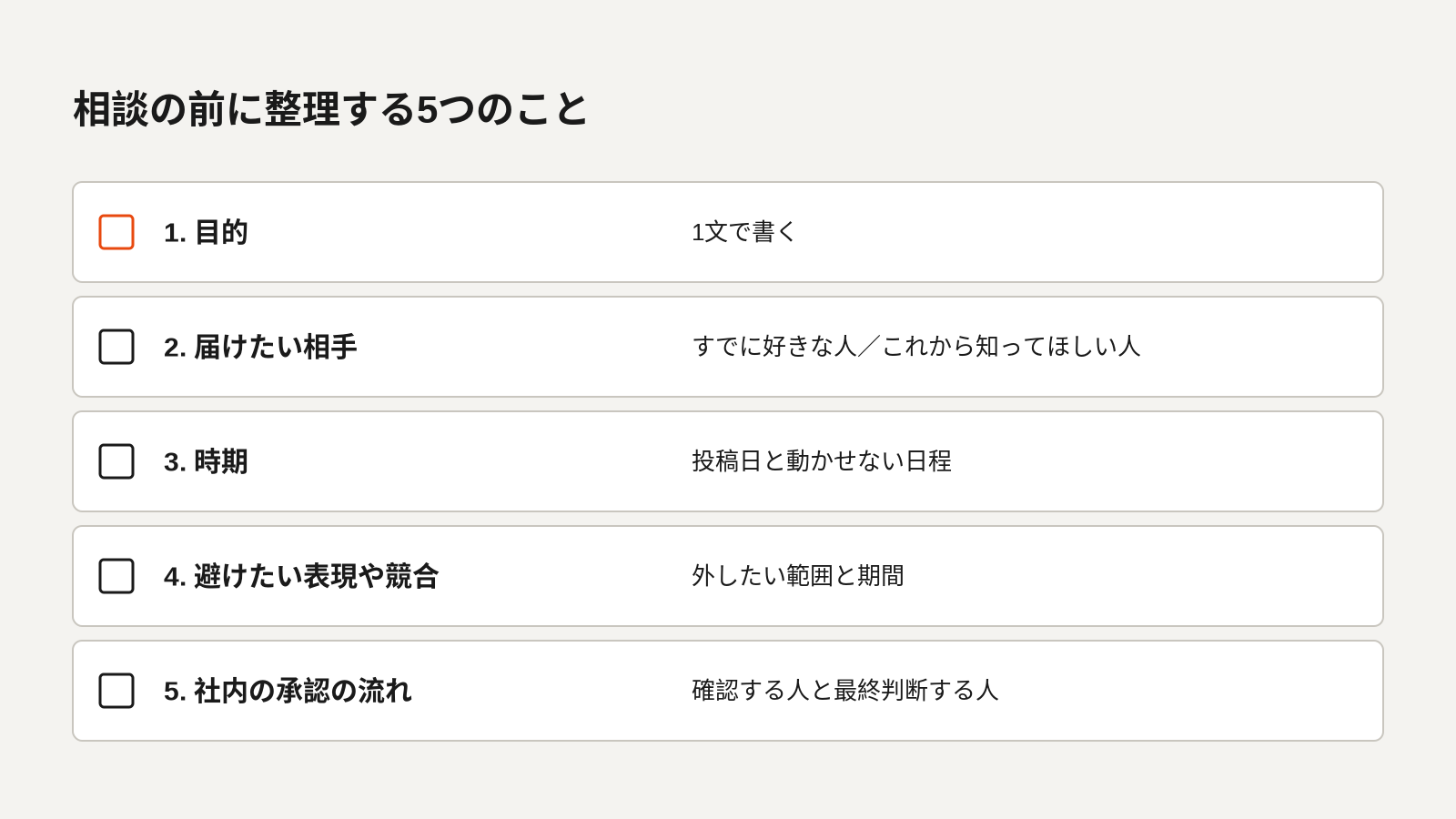
Before you consult a casting agency, it helps to sort out five things: your "objective," "the audience you want to reach," "timing," "expressions and competitors to avoid," and "your internal approval flow." None of them needs to be perfectly settled. Simply having a rough outline of all five improves the accuracy of the first candidates you see and reduces the back-and-forth before approval.
| What to sort out | What changes once it's settled | Who is involved internally |
|---|---|---|
| 1. Objective | The criterion for choosing candidates shifts from "buzz potential" to "fit with the objective" | Campaign owner |
| 2. Target audience | You can narrow candidates by how well their follower base matches your audience | Product/brand manager |
| 3. Timing | You can work backward from the posting date and secure candidates' schedules earlier | Launch/promotion manager |
| 4. Expressions and competitors to avoid | You can check against candidates' past posts and prevent rejections later | Legal/brand management |
| 5. Internal approval flow | You know whose decision you are waiting for when confirming candidates and posts | Approvers |
Influencer casting is the work of selecting creators who fit a campaign's objective and managing the process from request to posting (for an overview of how it works, see [What Is Influencer Casting? How It Works and How to Request It [Basics]](https://statsworks.tokyo/insight/what-is-influencer-casting)). Because the starting point for selection criteria lies with the brand, the amount of information shared at the outset determines the speed of every step that follows.
What happens if you consult us with a vague objective?
If your objective remains "we want to get people talking," the criterion for choosing candidates becomes an equally abstract "someone who seems likely to get people talking." As a result, even if candidates are gathered, internal review often brings feedback like "this isn't what we pictured," and the rounds of reselection multiply.
One sentence is enough for an objective. For example, if you can write "We want to give people who have never used it a reason to try our new fragrance," then creators who are good at describing scents in words, or who introduce products by tying them to daily-life situations, become the candidates. Whether you want to broaden awareness, deepen understanding, or drive store visits changes greatly who you should choose.
How specific should you be about your target audience?
Beyond age and gender, if you can describe the situations in which these people usually look for information, narrowing candidates goes faster. Even among women in their 30s, someone who gathers information through short videos on the way home from work and someone who spends time comparing photos on weekends will be reached by different creators and different platforms.
What matters here is to write separately about people who already like your products and people you want to introduce them to. For the former, creators who can talk about product details are a good fit; for the latter, creators who can introduce products naturally within everyday life are better. If you haven't decided which is the priority, both types get mixed into the candidate list and judgment becomes harder.
From what date should you work backward on timing?
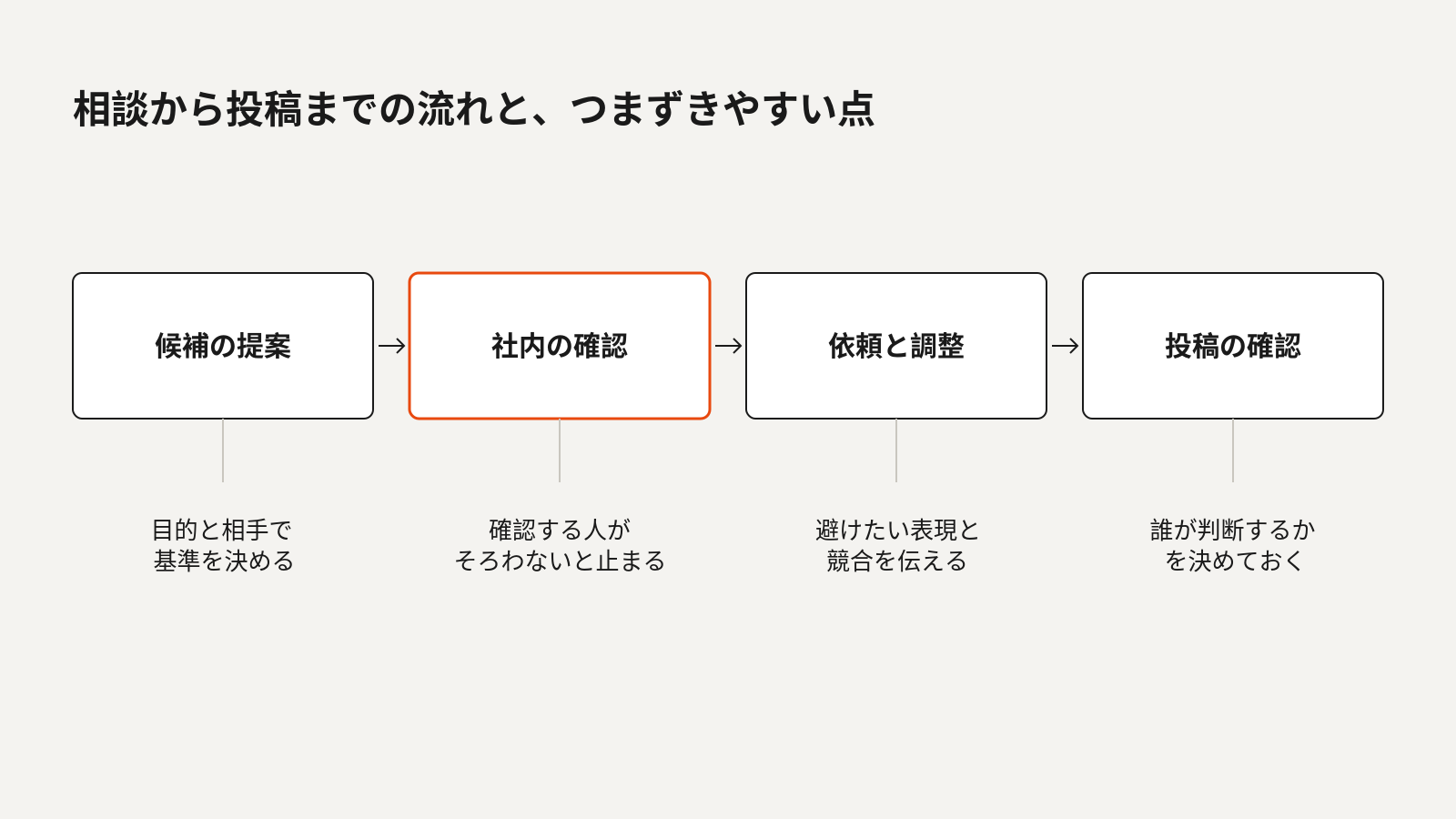
Work backward from the date you want the post to go live. Before the posting date come steps such as proposing candidates, internal review, adjusting the request and terms, shipping products or shooting, and confirming the post content. If a launch date or event date is already fixed, simply sharing it first lets us secure candidates' schedules earlier.
The common stumbling point is internal review taking longer than expected. For example, even if you start consulting three weeks before launch, if confirming candidates takes a week, popular creators' schedules may already be full. The causes of schedule delays are also covered in What Commonly Causes Casting Schedules to Slip?.
Why should you share expressions and competitors to avoid at the start?
Expressions you want to avoid, and the scope of competitors whose campaigns you don't want a creator to be working on at the same time, should be communicated before candidates are selected. If this comes to light after candidates have been proposed, the selection done so far has to be redone. Drawing lines early, such as whether to exclude creators who have featured a competitor's product in past posts, or to look only at a recent fixed period, also speeds up review.
As for expressions, there may be phrasings you don't want used or restrictions on wording that asserts effects definitively. Since these also go into the request brief, sorting them out first means you can use them directly when preparing the request. What to include in a brief, and how detailed to make it, is covered in Same Product, Different Results: How Brief Granularity Changes Deliverables—A Practical Guide to Briefing Design. For how to translate the scope of competitors into a contract, What Items Should Be Included at Minimum in an Influencer Contract? is also a useful reference.
What should you decide about your internal approval flow?
There are three points to decide: who reviews the candidate list, who reviews the post content, and who makes the final decision when opinions differ. If several reviewers lack shared criteria, one person may approve while another objects, and the candidate list is sent back repeatedly.
Designating a single point of contact who consolidates internal opinions before replying greatly reduces the back-and-forth. For example, even when both a brand manager and a PR manager review, dividing roles as "the brand manager for candidates, the PR manager for post wording" removes the effort of checking the same content twice.
What should you decide first before consulting us?
You don't need to firm up all five. If you separate what is decided from what isn't, in at least the following order, the first meeting can become a session for choosing candidates right away.
- Write the objective in one sentence
- Write the target audience, separating people who already like your products from people you want to introduce them to
- Write the desired posting date and any dates that cannot move
- Write the expressions to avoid and the scope of competitors to exclude
- Write who reviews candidates and posts, and who makes the final decision
If some items are undecided, simply writing "TBD" is enough. Once it's clear what hasn't been decided, we can work it out together during the consultation. What we help with in casting is summarized on this page.
Scope of This Article
This article covers the information a brand should sort out on its side before consulting a casting agency. It does not cover how to think about budgets, specific contract clauses, or how to choose a casting agency. Nor does it make legal judgments, such as whether PR disclosure is required.
Conclusion
Sorting out these five things before a consultation is less a courtesy to the other party than preparation to speed up your own decisions. If your objective, audience, and timing are clear, the first candidate list you receive becomes the foundation for your review.