What Should Be Included in the Termination Clause of an Influencer Contract?
This article was automatically translated from the Japanese original. Read the original in Japanese

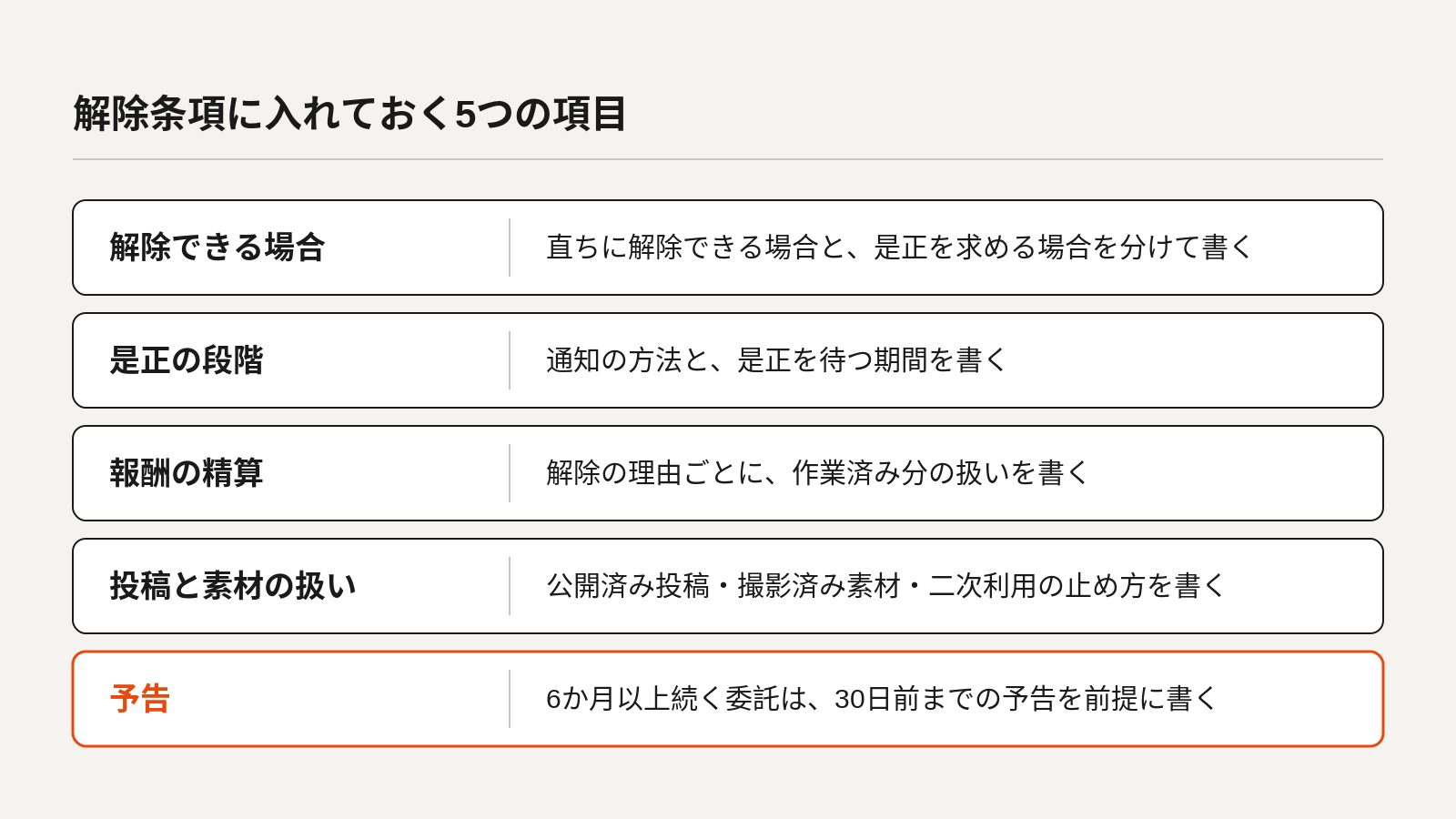
An influencer contract's termination clause should include five elements: (1) the cases in which termination is allowed, (2) a stage in which correction is requested before termination, (3) settlement of fees upon termination, (4) handling of published posts and filmed materials, and (5) advance notice. For engagements lasting six months or more (including those that reach six months or more through renewal), Japan's Freelance Act generally requires the brand to give notice at least 30 days in advance when terminating or not renewing. The purpose of the clause is not to bind one party or the other, but to decide in advance how to proceed when something happens.
The items a contract should include overall are summarized in What Should an Influencer Contract Include at a Minimum?. This article covers only the parts related to termination.
| Case | How termination is handled | What the clause should specify |
|---|---|---|
| An act that seriously damages trust occurs | A provision allowing immediate termination | The scope of covered acts, and the procedure for verifying the facts |
| A post does not follow the disclosure rules or guidelines | Request correction first; terminate if not corrected | The method of notice, and the period to wait for correction |
| The post date is well overdue and the influencer is unreachable | Terminate after a formal demand | The method of the demand, and the waiting period |
| The brand cancels a campaign due to a change in policy | Termination for the brand's convenience | Fees for work already done, and the timing of notice |
| Ending an engagement lasting six months or more | Notice at least 30 days in advance is the general rule (with exceptions) | Timing and method of notice, and how to respond if the influencer asks for the reason |
How Should the Cases for Termination Be Written?
Do not write the cases for termination using only broad phrases such as "when the brand's image is damaged." Instead, give examples of the covered acts: violations of law, accepting a project for a competing brand that the contract prohibits, and posts that harm the brand or third parties. With only broad wording, the parties end up debating which events qualify at the very moment of termination, which leaves both the brand and the influencer in an unstable position.
Also write down the procedure for verifying the facts. The order is to avoid deciding based only on news reports or social media posts, and to confirm the facts with the influencer or their agency before deciding to terminate. The overall flow when a scandal occurs is covered in What Happens to the Contract If a Cast Influencer Causes a Scandal?.
Why Place a Corrective Stage Before Termination?
Because many problems, such as a missing PR disclosure or the inclusion of prohibited expressions, can be fixed and the contract can continue. Terminating immediately over such problems would halt the campaign itself, which is a loss for the brand as well. In the clause, set up a stage in which notice is given in writing and the brand may terminate if the problem is not corrected within a set period.
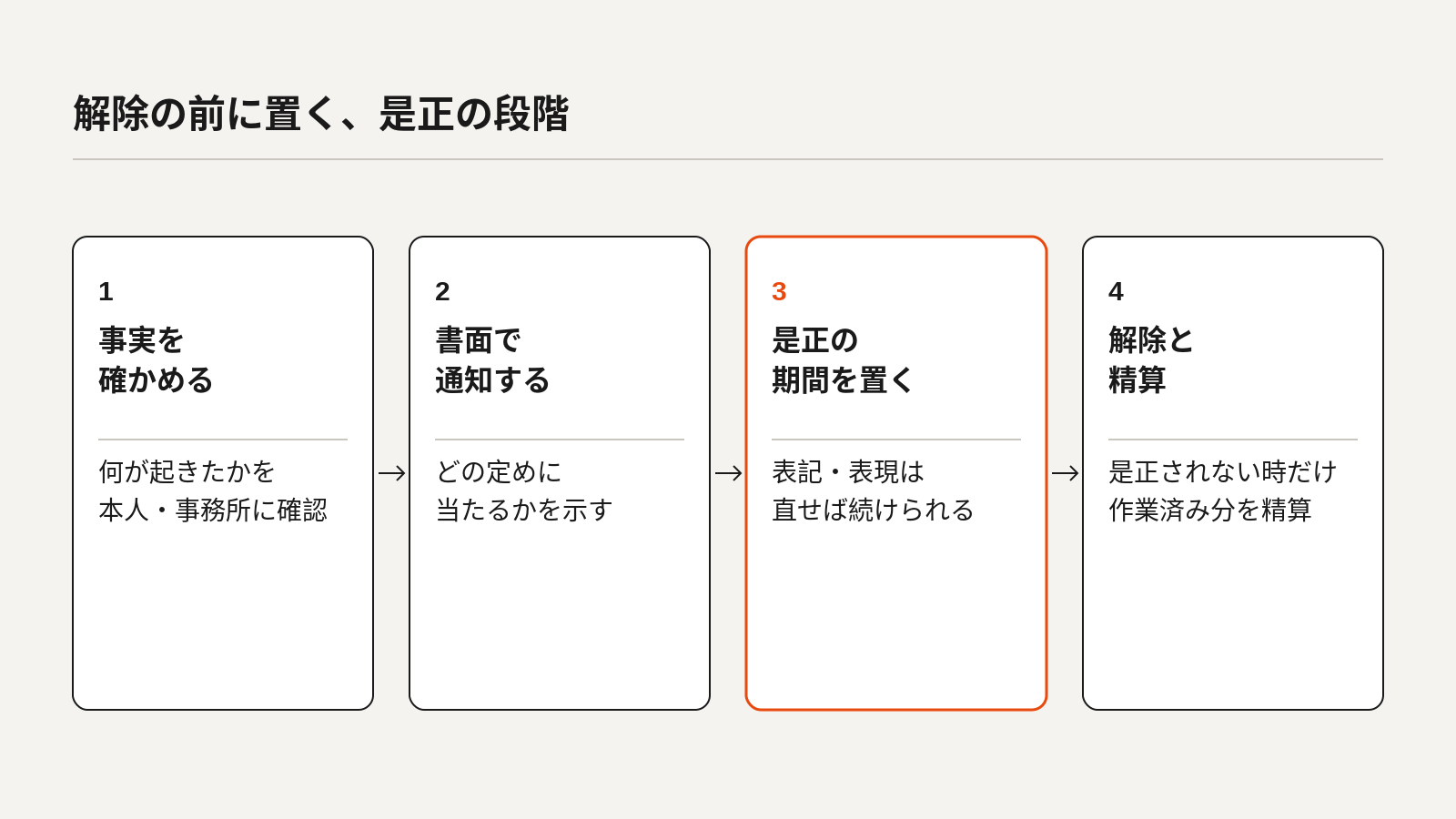
For example, suppose you ask five people to post for a product launch campaign, and one post lacks the PR disclosure. You first ask that person to add it, and once you confirm it has been fixed, the campaign can continue. The steps for handling a missing disclosure are summarized in What to Do When a Sponsored Collaboration Post Is Published Without a PR Disclosure. Gaps in disclosure or expression can often be reduced by how things are communicated at the request stage, so it is also reassuring to review When and How Should You Communicate Prohibited Products and Expressions Before Casting?.
How Are Fees and Posts Handled upon Termination?
Write the treatment of fees separately for each reason for termination. When the brand terminates for its own convenience, decide how to pay for work already completed, such as filming and drafts. Also write separately how fees are handled when termination results from the influencer's serious violation. If you write a blanket rule such as "no fees will be paid if the contract is terminated" without distinguishing reasons, the work becomes unpaid even when the brand is the one who stopped the project, and it becomes difficult to treat that as a valid agreement.
Divide posts and materials into three categories: published posts, filmed but unpublished materials, and secondary use by the brand. Decide whether you will ask for published posts to be deleted or leave them up, and when secondary use will stop. The thinking on how far you can request deletion is covered in When You Want an Influencer's Post Removed, How Far Can the Brand Go in Asking?.
What Should Brands Watch for When Ending on Their Own Convenience?
When a brand terminates midway, or does not renew, an engagement lasting six months or more, such as a long-term ambassador contract, the Freelance Act requires notice at least 30 days before the termination date or contract expiration date. Exceptions include unavoidable circumstances such as disasters, and cases where the cause is attributable to the individual. If the influencer asks for the reason for termination after notice is given, the brand must state it unless an exception applies.
Note that even if the contract says "we may terminate without notice in certain cases," notice does not become unnecessary unless the situation falls under an exception. For example, if a brand changes its policy and decides not to proceed with the next renewal of an ambassador whose annual contract has been renewed every six months, it should schedule the notice to be given at least 30 days before the contract expires. How to identify which counterparties are covered is explained in How Does the Freelance Act Relate to Requests Made to Influencers?.
What to Decide at the Request Stage
- Separate cases allowing immediate termination from cases requiring a request for correction, and give examples of the covered acts
- Specify the method of notice (in writing or by message) and the period to wait for correction
- For each reason for termination, specify how fees for completed work are handled
- For published posts, filmed materials, and secondary use, specify how each is handled after termination
- Check whether the engagement will last six months or more, and schedule the timing of notice for non-renewal
The overall picture of the contract is summarized in What Should an Influencer Contract Include at a Minimum?.
What Are Common Misunderstandings?
Some see the termination clause as a provision to protect the brand, but the more specific the clause is, the better the influencer can also see what keeps the contract going and when it will end. Another view is that "under the Civil Code a contract can be terminated at any time, so a clause is unnecessary," but even the Civil Code has provisions under which termination at a time unfavorable to the other party, or before the work is completed, can raise questions of damages. Because treatment varies with the nature of the contract, there is value in deciding the procedure in the clause.
Scope of This Article
This article organizes the items to decide in a termination clause based on the pamphlet on the Freelance Act (Act on Ensuring Proper Transactions Involving Freelancers and Businesses) prepared by the Ministry of Health, Labour and Welfare and others, and the Civil Code on e-Gov Law Search (both confirmed in October 2026). It does not cover how to word the provisions, or whether a particular contract or termination complies with the law. Please have an expert review any actual contract.