Post Count, Revision Rounds, and Usage Period: When Should You Agree on Them, and With Whom?
This article was automatically translated from the Japanese original. Read the original in Japanese

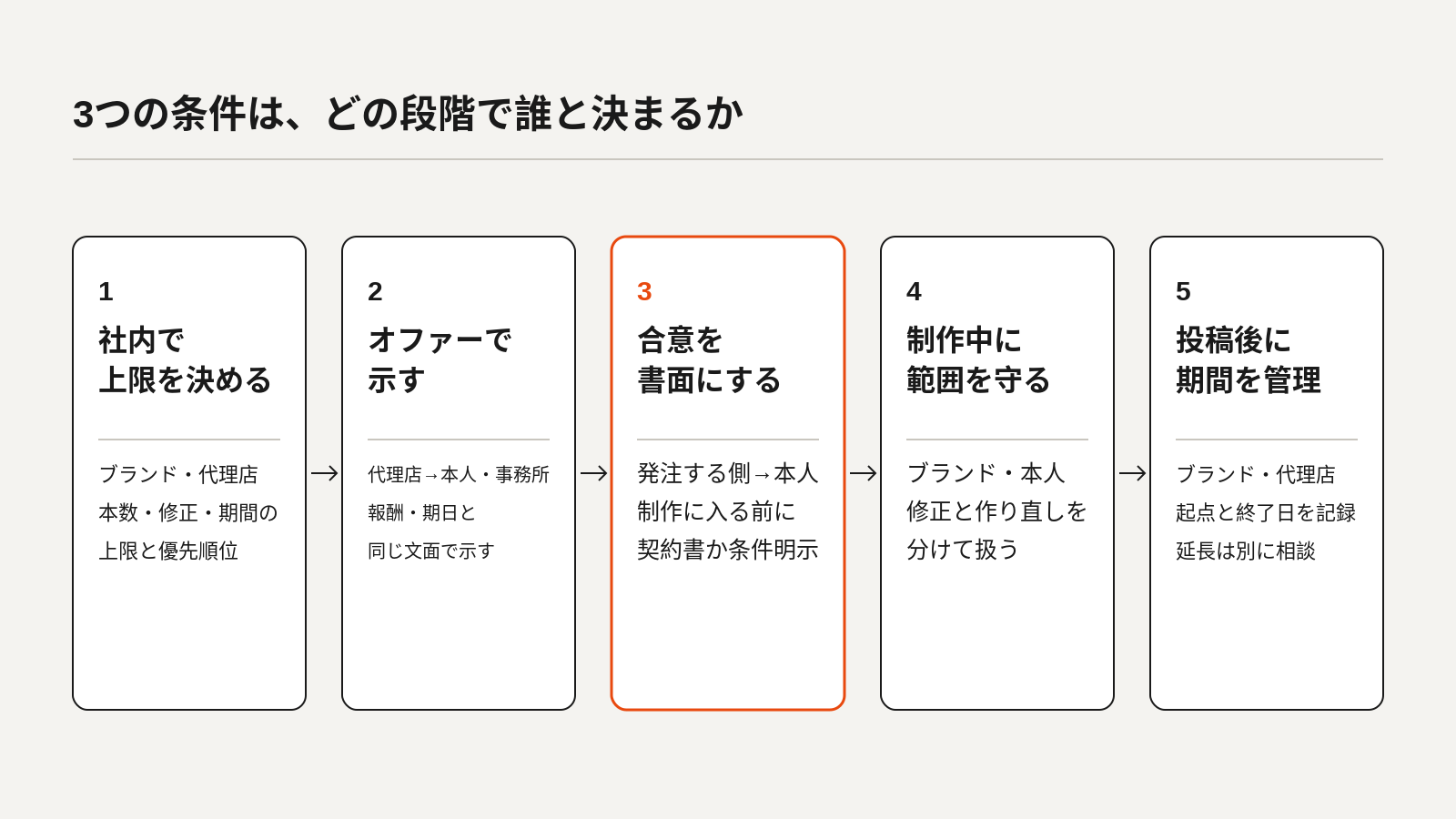
Present all three terms (post count, number of revision rounds, and usage period) in the formal offer, alongside the fee and deadline. Obtain agreement from the influencer or their agency, then confirm the terms in writing before filming or production begins. To do this, the brand and the agency need to settle the upper limits for all three before sending the offer. If you want to add terms after agreement, treat it as a new request and obtain agreement again, rather than as an extension of the original request.
| Step | What to decide | Who is involved |
|---|---|---|
| 1. Planning and internal review | Upper limits for the three terms, and the order in which you can concede them | Brand manager, agency, and legal or headquarters if needed |
| 2. Offer | Present the three terms in the same message as the fee and deadline | From the agency or casting lead to the influencer or agency |
| 3. Agreement and documentation | Confirm the agreed terms in a contract or written statement of terms | The commissioning party and the influencer or agency |
| 4. Brief and production | Share where the line falls between "revision" and "redo" | Brand, agency, and influencer |
| 5. After posting | Record the start and end dates of the usage period, and discuss any extension separately | Brand and agency |
Why should the three terms be shown at the offer stage?
The three terms are exactly what an influencer uses to decide whether to accept a request. Even at the same fee, the burden differs enormously depending on whether it is one post or three, one revision or unlimited revisions, and whether the content will be used only on the brand's own social media or in advertising as well. If the terms are not shown at the time of the offer, the influencer cannot make an informed decision, and if terms increase after agreement, it feels like "this isn't what we first discussed."
The most common case is adding requests after agreement, such as "we'd like you to announce it in Stories too" or "we'd also like to use it in ads." Even if the addition is reasonable, raising it later means the relationship suffers not because of the content of the terms but because of the order in which they were raised. For how to think about adding terms later, see Is it acceptable to ask for secondary-use permission after the fact?
The reason to set limits internally first is so that you can write them into the offer. If you send a request while the brand has not yet decided whether it "might use the content in ads," the usage period field ends up blank or vague, and that vagueness becomes a source of miscommunication later.
What should be counted in the post count?
Count posts by platform and format. Instead of "2 posts on Instagram," write something like "1 Reel and 2 Stories," so the influencer can estimate the workload. Also note, as work separate from the post count, whether a link will be added to Stories, whether the brand's post will be reposted on the influencer's account, and whether it will be a collaborative post.
For example, suppose you ask 10 people to post around a new product launch. If the conditions are one Reel on launch day and one Story during the week the product reaches stores, also state the window for the Story posting date (for example, within 7 days of launch). Without a date window, the influencer cannot choose a convenient day, and the brand may find that posts do not appear in the week it expected.
If you are unsure about the number of posts, work backward from how many are needed to achieve the campaign's goal. If the goal is to announce the launch, put more weight on the launch-day post; if the goal is to drive store visits, add one post after the product reaches shelves. The goal determines the number and timing of posts needed.
Where should you draw the line on what counts as a "revision"?
When setting the number of revisions, first decide what counts as a revision, before deciding how many there will be. Factual errors, missing PR disclosures, expressions that involve the Pharmaceuticals and Medical Devices Act and similar regulations, and replacing expressions the brand prohibits are revisions. Reshooting with a different structure or location is not a revision but a redo. If you write "up to 2 revisions" without this distinction, a single revision request can end up demanding a reshoot, and the agreed number loses its meaning.
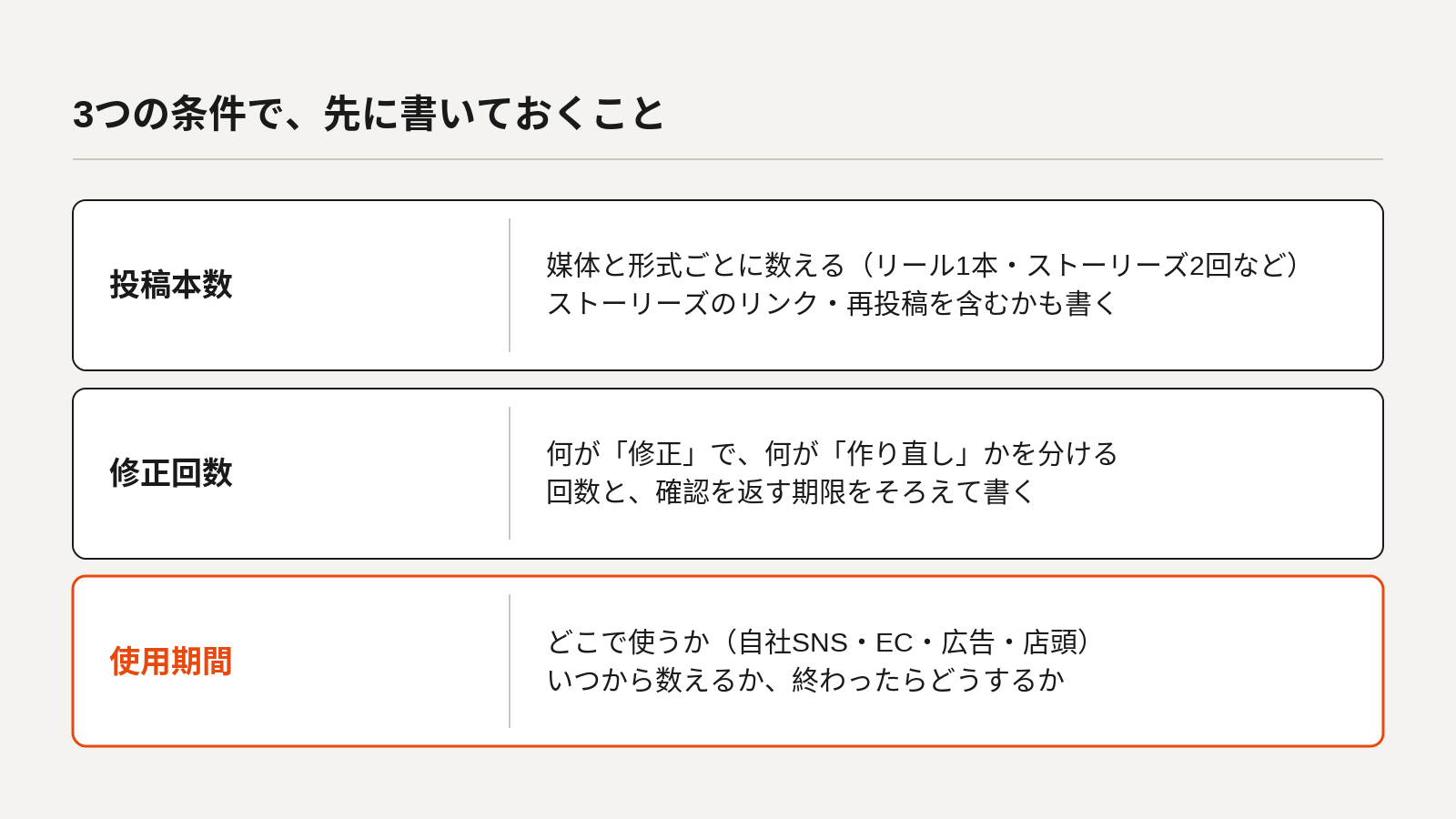
Also write down the deadline by which the brand will return its feedback. If it takes a long time to respond after the influencer submits a draft, the posting date approaches and the influencer has no time left to make changes. For how far revision instructions may go, see How far can you go when giving revision instructions to influencers?
What should the usage period be based on, and what should it specify?
Define the usage period with three elements: where the content will be used, when the period starts, and what happens when it ends. Break down the places of use, such as reposting on the brand's official social media, e-commerce product pages, ad delivery, and in-store POP displays. Align the starting point to either the posting date or the delivery date, and also decide whether content already published must be removed or may remain once the period ends.
For example, if an influencer's post is used for in-store POP and advertising in a launch campaign, the periods may differ by location: in-store until the display is replaced, and advertising until the end of the ad delivery period. Writing the period by location rather than as a single period also makes it easier to discuss when an extension is needed. For the basics of secondary use, see What is secondary use of posted content? Basics and cautions for repurposing it in ads.
What should the brand, agency, and influencer each confirm?
The brand sets the upper limits for the three terms and the order in which it can concede them, and completes any headquarters approval or legal review before the offer goes out. The agency or casting lead translates those limits into the offer message and sends the request prepared to answer questions from the influencer or agency. The influencer estimates workload and duration based on the terms shown and, if there is a term they cannot accept, says so at that point.
When commissioning an individual with no employees, there is a rule requiring that the terms of the transaction be stated immediately once agreement is reached. For details, see How does the new Freelance Act relate to requests to influencers? For an overview of contracts, see What items should an influencer contract include at a minimum?
What to decide first
- Decide the post count by platform and format, and note whether links, reposts, and collaborative posts are included
- Decide where the line falls between "revision" and "redo," and write down the number of revisions and the deadline for returning feedback
- For each place of use, write the start point, end point, and treatment after the period ends
- Decide internally the upper limits for the three terms and the order in which you can concede them in negotiation
- Confirm the agreed terms before production begins, in a contract or a message stating the terms
Scope of this article
This article organizes the order in which the three terms are decided and who they are decided with. It does not cover how to think about fees for each term, how to draft contract clauses, or whether a specific contract complies with laws and regulations. If you have concerns about the content of a contract, please consult a professional.
Conclusion
With the three terms, the order in which they are presented shapes the relationship even more than their content. Preparing internally so that everything can be written into the offer is the surest way to reduce miscommunication during production.